
Affordable Mens Necklace: Your 2026 Sourcing Guide
Affordable men's necklaces are no longer a narrow fashion experiment. One market report places necklaces and chains at USD 8,742.60 million, or about 24.6% of the broader men's jewelry market, while a U.S. Amazon analysis recorded 28,600 men's necklace units sold in July 2026 at an average price of $18.29. The same analysis recorded 360,000 units over the prior 12 months, making the affordable men's necklace a serious sourcing category rather than a side display item. These figures are reported in market data on men's jewelry and chains.
For a boutique, the opportunity is not just to find the cheapest chain. It's to buy a product with dependable metal, controlled finishing, sensible packaging, documented compliance, and enough margin after freight, defects, and returns. A low FOB quote can become an expensive SKU once those costs enter the P&L.
Why Affordable Men's Necklaces Are a Real Category Now
Affordable men's necklaces have moved into a repeatable retail category because the customer can test a style without taking on precious-metal pricing. The reported market data places chains and necklaces at 28% of a market segment, with strongest demand among Gen Z buyers aged 18 to 27. That creates room for width, pendant, gold-tone, and layering options at several entry points.
The retailer's calculation starts after the factory quote. An average price of $18.29 supports meaningful online unit movement, but retail potential depends on more than demand. Material consistency, plating thickness, minimum order quantity, freight, packaging, compliance documents, defects, and returns all belong in the SKU-level P&L. A chain that looks cheap at the supplier stage can lose its margin at the QA bench or after the first customer returns.
| Mens Necklace Demand Snapshot 2023-2024 | Value | Source Signal |
|---|---|---|
| Necklaces and chains in the broader men's jewelry market | USD 8,742.60 million, about 24.6% | Men's jewelry market report |
| Chains and necklaces in a reported market segment | 28% | Same report |
| Strongest cited Gen Z demand | Gen Z buyers aged 18 to 27 | Same report |
| U.S. Amazon units sold in July 2026 | 28,600 | Same report |
| Average Amazon price in July 2026 | $18.29 | Same report |
That demand has historical depth. Evidence of Neanderthals making ornaments from eagle talons places men's adornment at about 115,000 years. Bead use appears about 40,000 years ago, and gold jewelry use reaches back roughly 5,000 years, according to this history of men's jewellery. The commercial shift is clear: adornment that once signaled ritual or status now also functions as an everyday accessory with a manageable retail price.
Buying principle: Treat the affordable men's necklace as a reorderable category. Set quality, cost, and compliance thresholds before choosing styles.
Materials That Hold Up Under $25 Retail
At a $25 retail ceiling, material choice determines whether a necklace becomes a reorder or a return. 316L stainless steel is the strongest default for everyday affordable jewelry because its 2% to 3% molybdenum content improves resistance to chloride-driven pitting from sweat, seawater, and humid conditions. Good 316L jewelry is commonly expected to withstand 500+ hours of salt-spray exposure without visible corrosion. Lower-grade 304 steel may degrade sooner, as explained in this 316L stainless steel material guide and this 316L stainless steel jewelry guide.
| Material | Salt Spray (hrs) | Hypoallergenic | Cost @ 1k (US) | Best Retail Band |
|---|---|---|---|---|
| 316L stainless steel | Commonly expected at 500+ | Strong practical option, subject to nickel-release testing | Not provided in verified data | Affordable everyday tier |
| Titanium | Not provided in verified data | Completely hypoallergenic according to affordable men's jewelry guidance | Not provided in verified data | Premium affordable tier |
| 925 sterling silver | Not provided in verified data | Depends on alloy, plating, and testing | Not provided in verified data | Higher-value silver tier |
| Brass with gold plating | Not provided in verified data | Depends heavily on coating and release testing | Not provided in verified data | Fashion-led entry tier |
Material grade alone does not establish compliance. A supplier's use of “surgical steel” is not proof that a finished necklace meets the relevant requirements. In Europe, nickel release is the practical measure, rather than nickel content alone. For prolonged skin contact, EU REACH and EN 1811 set the limit at 0.5 µg/cm²/week. Pierced-body jewelry has a stricter limit of 0.2 µg/cm²/week, according to this stainless steel jewelry compliance explanation. Request a test certificate covering the actual product or production batch.
Titanium costs more, so use it where light weight and sensitive-skin positioning support a higher ticket. Sterling silver provides a more premium look and feel, but tarnish care and plating disclosures must be clear. Brass can produce a convincing gold appearance at entry level. Inspect base-metal exposure, finish consistency, and defect rates before approving it.
Gold-fill and gold-plated describe different construction. Gold-fill uses a mechanically bonded layer. Gold plating is a surface coating, and its service life depends on preparation, coating method, thickness, and wear conditions. Ask suppliers to state plating thickness in microns, then inspect edges and clasp contact points under magnification. “Premium gold finish” is marketing language, not a usable specification for your P&L or QA checklist. Track material, testing, plating, MOQ, packaging, and expected defects at SKU level before setting the retail price.
Style Breakdown and Assortment Logic
A merchandiser should be able to read a men's necklace SKU without opening the product photo. Start with the chain type, then check link width, clasp, pendant format, finish, length, and net weight. That sequence exposes whether the product has a clear customer and whether it can sit beside the rest of the collection.
Cable and box chains suit minimalist buyers who want an everyday base. Rope and figaro chains add visible texture and work as standalone pieces. Snake chains create a smoother, more fluid look, but they need careful packaging because kinks are harder to correct than a bent conventional link.
The fashion assortment planning guide is useful when turning individual designs into a coherent range. Apply the same discipline to jewelry by setting a role for every SKU.
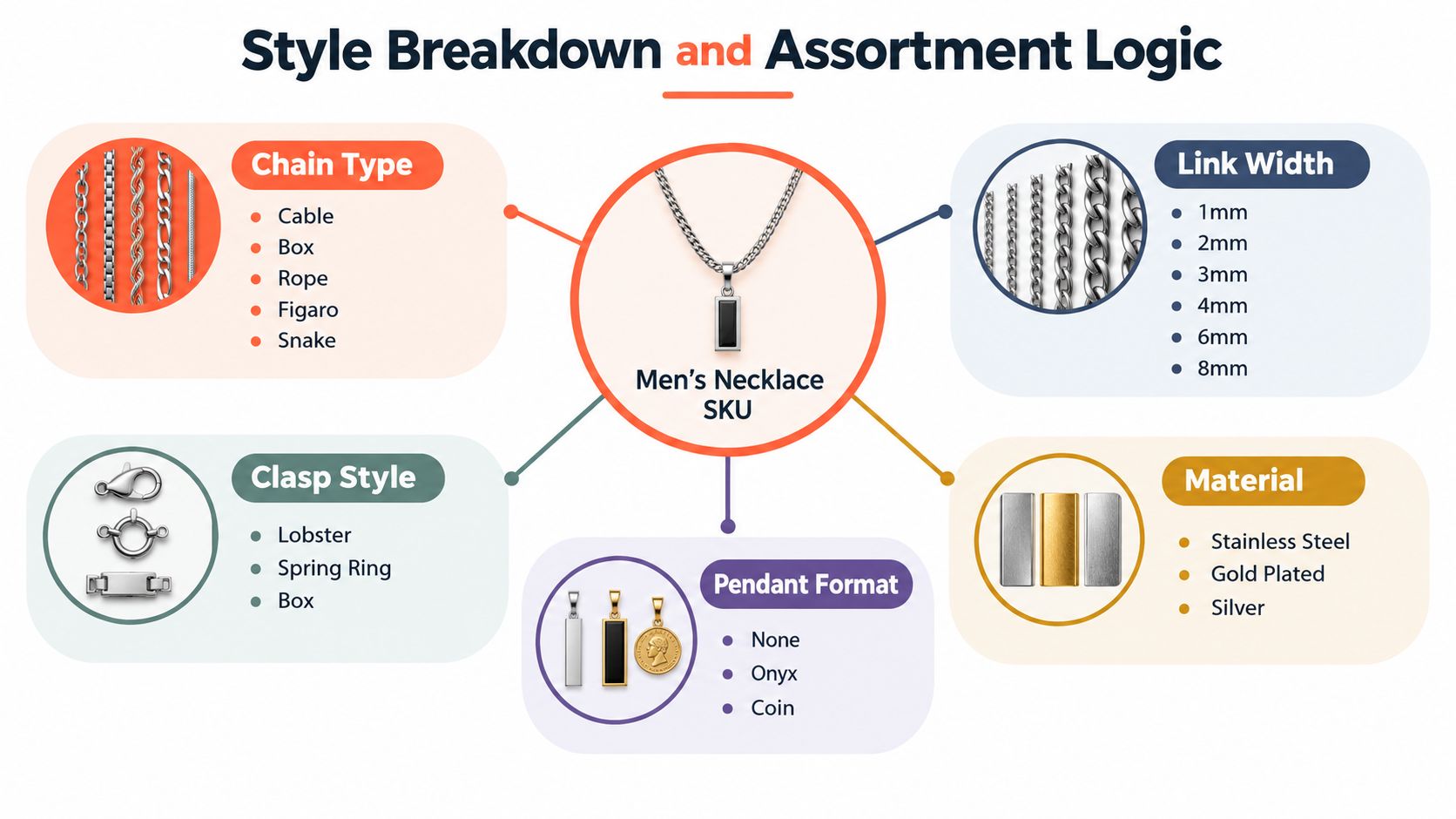
A practical starter range can use four core chains across 50cm and 55cm, four pendant styles in matte steel and gold tone, two layering lengths, and two statement pieces. Keep colorways controlled. Steel and gold cover the principal styling needs without forcing a small retailer to carry slow-moving shades.
Pendant weight matters operationally. Keeping pendants under 12 grams reduces the strain placed on bails, jump rings, carding, and shipping packages. Before approving a design, pull the clasp repeatedly, lay the pendant flat against fabric, and check whether the chain twists under its weight.
Vetting a Wholesale Supplier Before You Wire Money
Supplier vetting should happen in a fixed order. Start with documentation, not a polished catalog. Request the factory audit, business license, and export record from the supplier contact, whether that contact came through Alibaba, JewelryBuyDirect, or a Canton Fair introduction.
Then order samples. Inspect solder joints, clasp spring tension, lobster claw symmetry, jump-ring closure, pendant alignment, and plating uniformity under a 10x loupe. A sample that looks attractive in a product photograph can still fail when the clasp sticks, the bail rattles, or the plating thins around the edges.
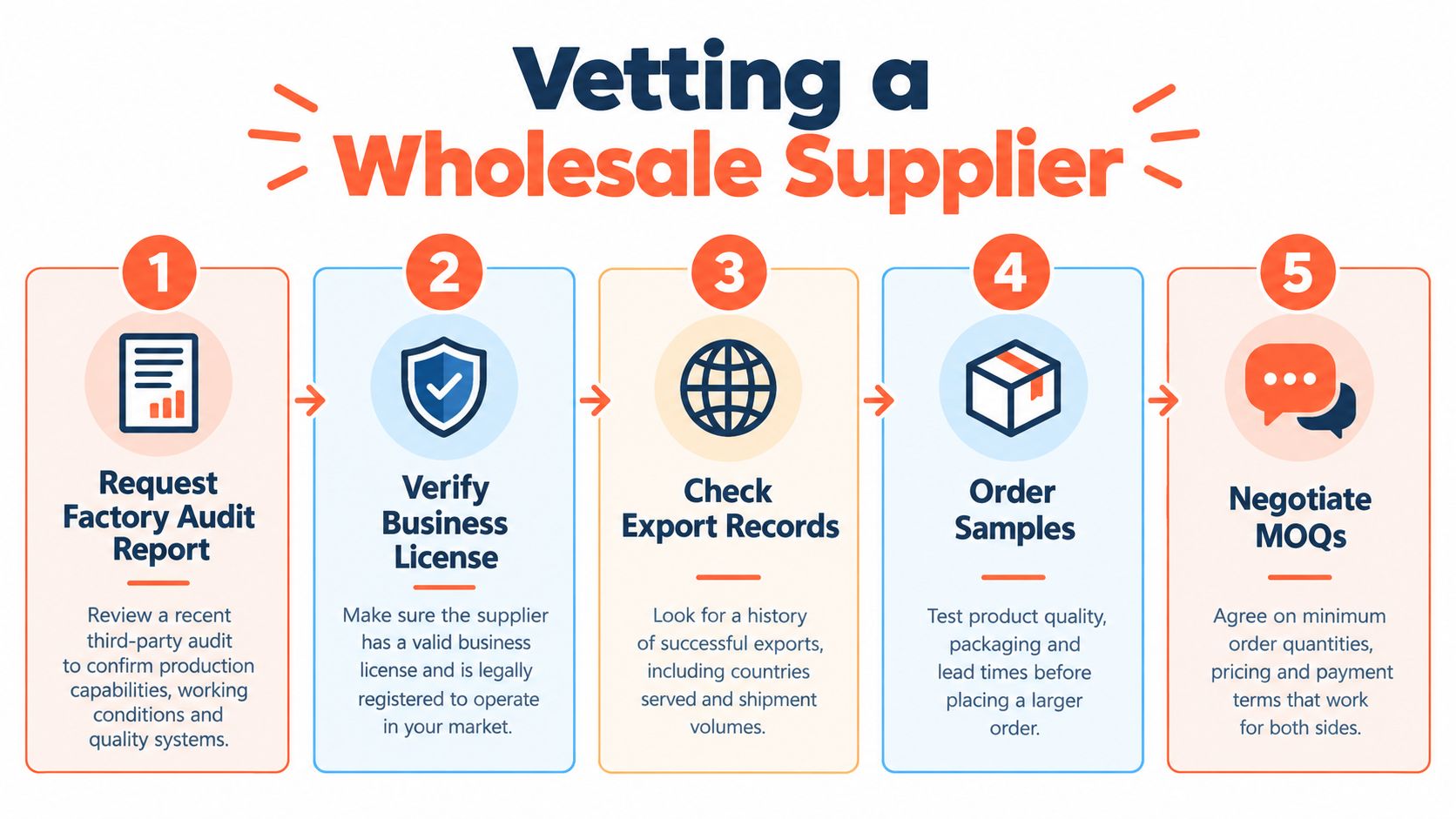
Use a basic evaluation sequence:
- Review the physical sample: Check construction before discussing a large order.
- Run handling tests: Use a drop test appropriate to the finished product and packaging.
- Request salt-spray records: Confirm the report identifies the material, finish, and tested sample.
- Verify compliance paperwork: Ask for nickel-release documentation against REACH and any applicable California Prop 65 requirements.
- Read the SGS report carefully: Confirm the tested product, batch scope, date, and test method. A generic report may not cover your custom pendant or current production run.
A supplier's payment terms also provide a useful signal. A 30/70 structure leaves a balance due after production, while a demand for full T/T before meaningful sampling increases your exposure. The inspection clause should identify the third-party QA partner before the deposit is sent. This wholesale jewelry supplier checklist can help structure the comparison.
Walk away from a quote that sits far below comparable offers when the supplier refuses to provide material specifications, uses generic catalog images, or won't produce a pre-production sample for custom pendant tooling. Cheap inventory with no traceable specification isn't cheap. It's unpriced risk.
Landed Cost, MOQ, and Quality Thresholds
A sourcing spreadsheet should calculate the unit that reaches your warehouse, not the unit shown on the supplier's quotation. Use this formula:
Unit FOB + tooling amortization + sample cost allocation + shipping + duty + 3PL pick-and-pack + defect reserve = total landed unit cost.
Keep shipping terms separate. DDP sea and DDP air solve different problems, especially for a first run below 50kg, where speed may matter more than the lowest freight rate. Add packaging, duties under the relevant jewelry tariff classification, payment fees, and the cost of inspecting or reworking defective units.
The verified data doesn't establish universal FOB prices, landed costs, or MOQ tiers for every material, so a buyer should replace supplier promises with written quotations. Wholesale sourcing guidance recommends asking about base metal, steel grade, plating type, stone quality, finish, MOQ, shipping, packaging, duties, and defect or return costs, as outlined in this wholesale fashion jewelry sourcing guide.
| Material | FOB at 200pc | Total Landed | Defect Reserve | Plating Threshold | Quality Standard |
|---|---|---|---|---|---|
| 316L stainless steel | Quote required | Calculate from actual freight and duties | Set from inspection history | Request thickness and method if plated | Verify nickel release and corrosion performance |
| Titanium | Quote required | Calculate from actual freight and duties | Set from inspection history | Usually finish-specific | Confirm titanium grade and skin-contact testing |
| 925 sterling silver | Quote required | Calculate from actual freight and duties | Set from inspection history | Request thickness and disclosure | Verify silver content and tarnish expectations |
| Brass with gold plating | Quote required | Calculate from actual freight and duties | Set from inspection history | Request microns and coating method | Test adhesion, wear points, and nickel release |
For 316L, use the 500+ hour salt-spray expectation as a reference for uncoated quality, not as a universal guarantee. Plated products need a separate standard because the coating can fail before the base metal. For prolonged skin contact in Europe, document the 0.5 µg/cm²/week nickel-release limit, and use the stricter 0.2 µg/cm²/week threshold where the product falls into the pierced-body category.
MOQ should support learning. A small first order can justify a higher unit price if it protects cash flow and reveals which lengths, finishes, and clasps sell. The right comparison is not "Which factory has the lowest quote?" It's "Which supplier gives the best reliable unit after quality loss and logistics?"
Listing and SEO Tactics That Move Units
Product presentation starts with the image file. Use the required 383:204 horizontal ratio, approximately 1.88:1, so product and editorial images fit the website display without avoidable cropping. A wide composition should show the clasp, chain texture, pendant scale, and how the necklace sits on a person rather than hiding those details in a lifestyle crop.
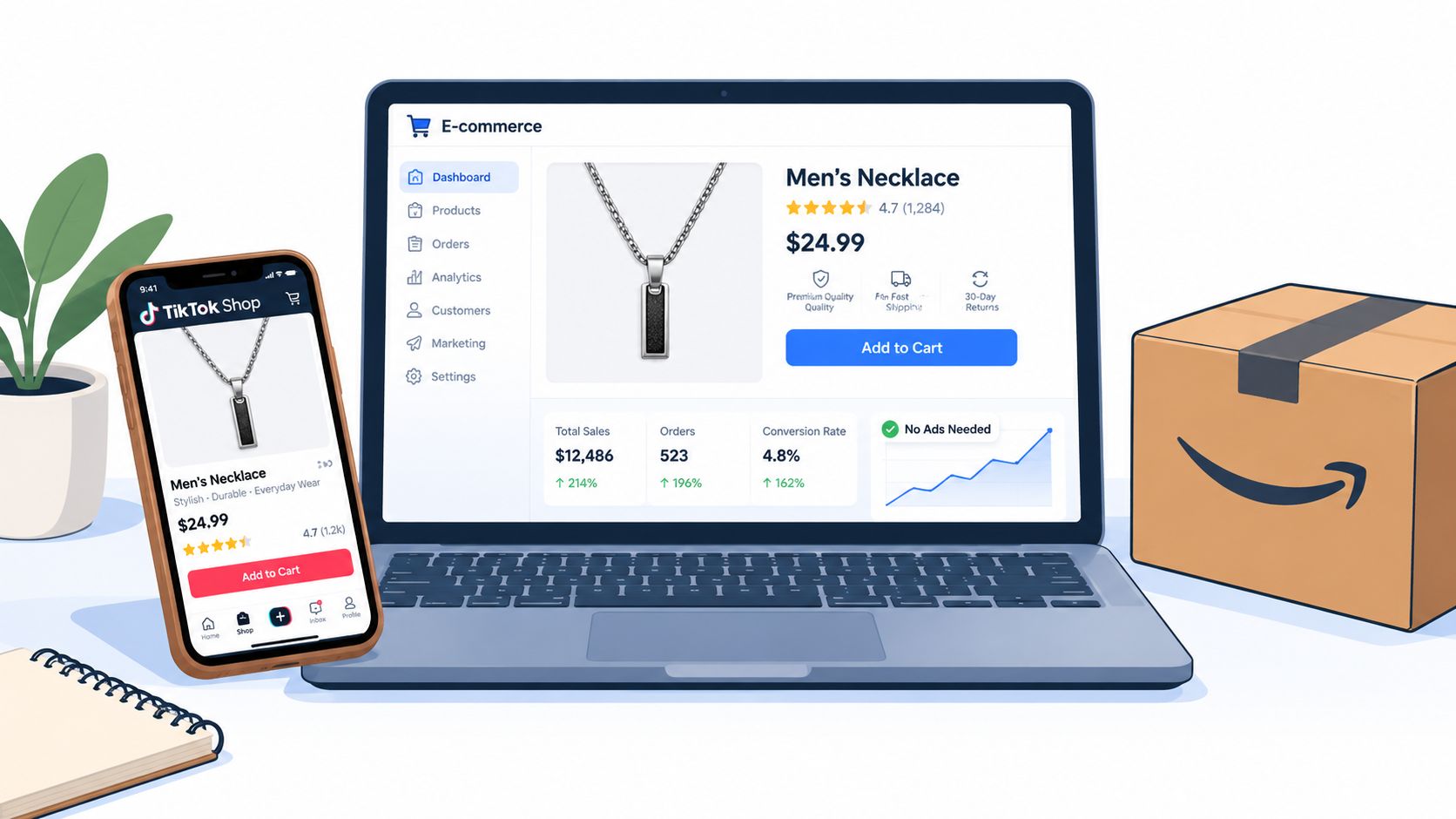
Build the title from the buyer's actual questions: primary keyword phrase + length + width + material + clasp + style tag. For example, a clear title might identify a stainless steel chain, its length, width, lobster clasp, and rope or box style. Don't lead with vague phrases such as “luxury fashion accessory” when the customer is searching for a specific construction.
Use bullets that answer purchase objections:
- Length fit: State the measurement and show where it sits on the neck.
- Material: Name the base metal and disclose plating where relevant.
- Skin contact: Refer to documented testing rather than making unsupported hypoallergenic promises.
- Care: Explain exposure limits, cleaning, and storage.
- Returns: State the policy in plain language.
A useful guide on how to craft winning product descriptions can help with clarity, but the final copy still needs accurate specifications from the supplier. Add backend terms naturally, including chain style, length, finish, pendant type, and gift intent. Use the SEO guide for jewelry stores to align collection pages, product pages, and internal search language.
Place the video after the specification content, not beside the opening image. A short demonstration can show clasp operation, drape, and layering without asking the customer to infer scale.
Merchandising by Fit, Length, and Layering
Fit is a stronger merchandising tool than another generic style list. A shopper can decide whether a chain suits a crew neck or open collar, but they need the retailer to make length and proportion understandable. Product pages should show the necklace on a person, provide the measured length, and explain whether the pendant rests high, central, or low on the chest.
Chain length should be presented as a visual choice rather than a technical field. Shorter options sit closer to the neck, while longer options create more room for pendants and layering. The exact result changes with neck size, garment neckline, chain width, and pendant weight, so a retailer should photograph each length rather than relying on a flat measurement.
| Length | Chain Width | Pendant Size | Pairs With | Layering Match |
|---|---|---|---|---|
| Shorter fit | Fine to medium | Small pendant | Open neckline or light layers | Longer box or cable chain |
| Mid-length fit | Medium | Medium pendant | T-shirt and casual shirt | Shorter minimalist chain |
| Longer fit | Medium to broad | Larger pendant | Crew neck or outer layer | Shorter fine chain |
Layering works when the pieces differ enough to separate visually. Pair a narrow cable chain with a more textured rope or figaro design, and keep pendants from occupying the same vertical space. A heavy pendant on two thick chains usually looks crowded and can create tangling, while two lighter chains with distinct lengths sit more cleanly.
Use collection filters for length, width, material, finish, and pendant presence. Add a “build your set” module on the product page, then show the recommended pair on a mannequin or model. This turns an affordable men's necklace from a single low-ticket purchase into a considered styling decision without forcing the customer to search across the catalog.
Your First 30 Days Sourcing Affordable Mens Necklaces
A small retailer can start with a disciplined month, but the plan must protect cash and evidence quality before scaling. Begin by defining the SKU matrix, then reduce it to the styles that can be sampled, inspected, photographed, and replenished without confusion.
Week one defines the range
Choose the chain families, lengths, finishes, pendant formats, and packaging standard. Shortlist three factories and send every supplier the same specification sheet. Ask each one to state the base metal, grade, dimensions, finish, clasp, weight, packaging, MOQ, sample terms, and compliance documentation.
Week two tests the product
Request samples from JewelryBuyDirect and two comparators. Log clasp performance, link consistency, pendant alignment, surface finish, packaging damage, and the supplier's response time. Ask for SGS nickel-release and REACH paperwork, then verify that the documents match the product you're buying rather than a generic catalog item.
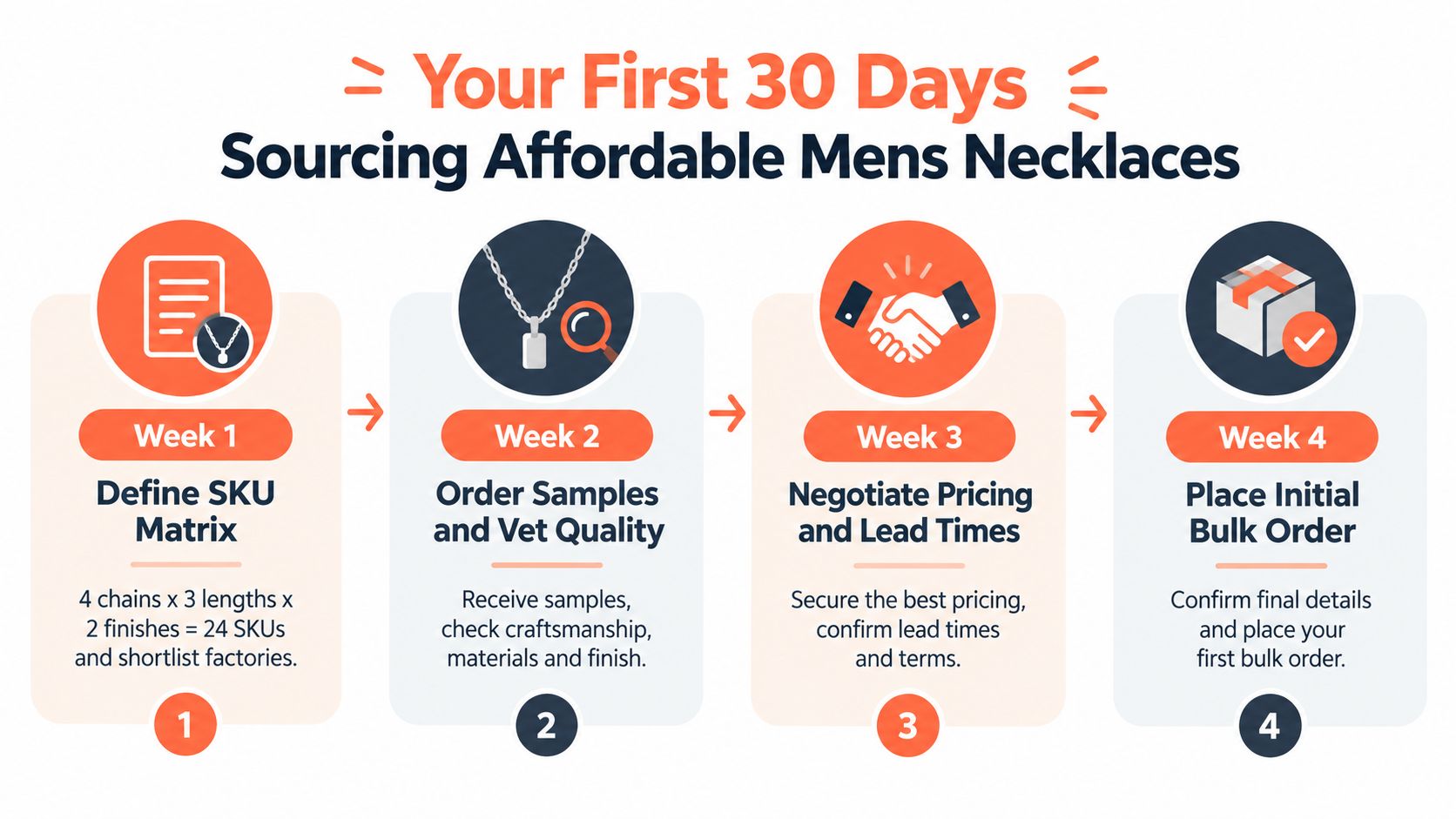
Week three checks the P&L
Enter unit FOB, tooling, sample allocation, freight, duty, fulfillment, payment costs, and the defect reserve into the landed-cost sheet. Compare suppliers on the final unit, not the first quote. Negotiate an opening quantity that lets you test demand without creating dead stock, and write the inspection standard into the purchase order.
Week four prepares the launch
Photograph every approved length and finish using the 383:204 website ratio. Publish titles that identify material, dimensions, clasp, and style, then add care, fit, compliance, and return details. Track gross margin, returns by defect category, clasp complaints, finish complaints, and the average order value generated by paired chains.
A reorder trigger should reflect actual sell-through, available cash, lead time, and defect history. Don't reorder a popular SKU blindly if its return rate points to a construction problem. Scale the products that sell cleanly, photograph well, and arrive within specification.
JewelryBuyDirect offers no-MOQ wholesale jewelry sourcing, a broad necklace catalog, factory-direct pricing, SGS-certified manufacturing partners, first-order savings, and logistics support for boutiques and online sellers. Visit JewelryBuyDirect to compare affordable men's necklaces, test a focused assortment, and build your first purchase around documented landed cost rather than guesswork.