
How to Source Bulk Custom Bracelets for Retail
A boutique owner lands an order for 800 logoed wristbands with only two weeks before a conference. At the same time, a Shopify brand is planning a Q4 launch and needs 2,000 bracelets that can survive daily wear, not just look good in a product photo. Both buyers need bulk custom bracelets, but they shouldn't buy the same product.
The right order starts with the use case, then works backward through material, MOQ, finish, packaging, inspection, and freight. The global bracelet jewelry market was valued at US$46.84 billion in 2025 and is projected to reach US$67.55 billion by 2033, with Asia Pacific leading revenue in 2025 and India expected to record the highest CAGR from 2026 to 2033, according to Grand View Research's bracelet market data. That scale creates opportunity, but it also means careless sourcing can leave you with expensive stock, weak margins, or a return problem.
Mapping Your Bulk Order to the Right Use Case
Start with the commercial job the bracelet must perform. A conference giveaway prioritizes speed, brand visibility, and low landed cost. A bracelet sold through a boutique needs stronger perceived value, comfortable sizing, and a finish that supports repeat purchases. A loyalty gift may justify better packaging, while a festival entry band needs dependable closure and easy identification.
Write the order profile before contacting suppliers. Record the sales channel, target margin, expected wear intensity, gift-versus-retail split, and likelihood of a repeat order. Those five details stop suppliers from steering you toward whatever style they already have available.
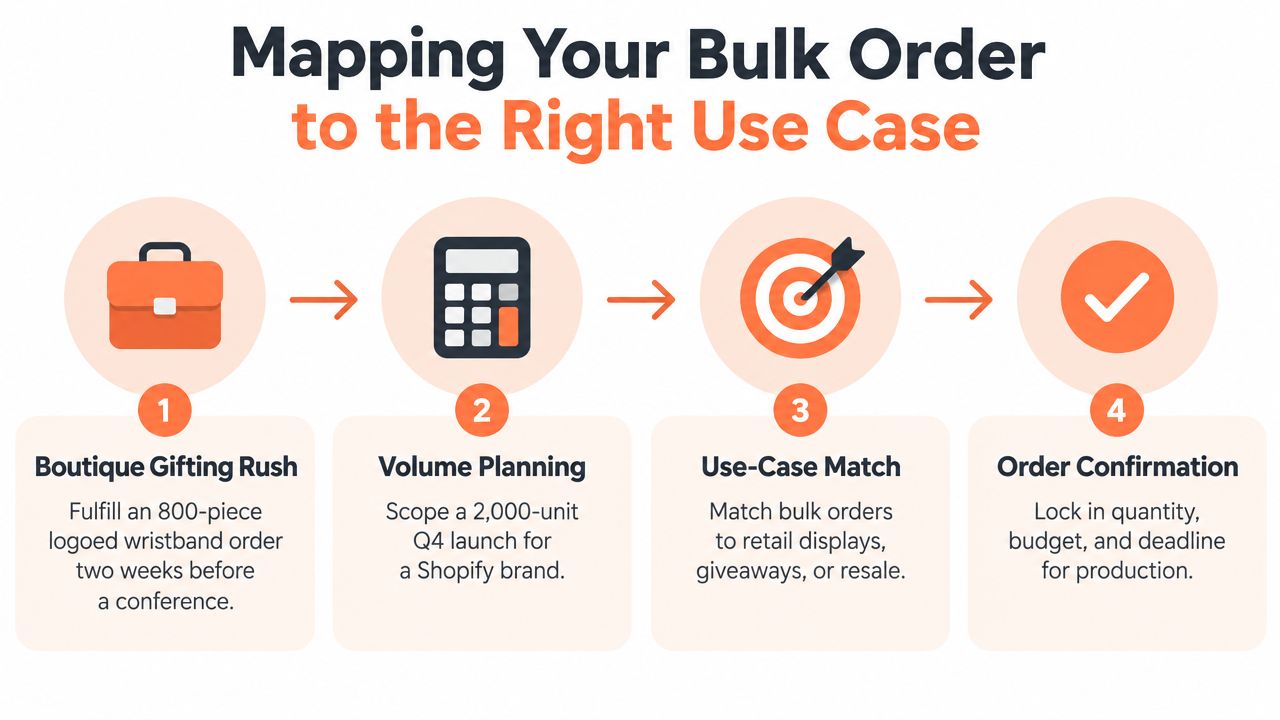
Match the order to the job
For an urgent corporate order, silicone or TPU may be the sensible choice because branding is prominent, sizing is simple, and production is usually less complex than a multi-component metal design. For a Q4 retail collection, stainless steel or sterling silver can support a higher ticket, but only if you can absorb longer sampling and stricter finish checks.
A fundraising run usually needs low unit cost and uncomplicated customization. A customer loyalty gift needs the opposite balance, better packaging and a finish that feels deliberate when the recipient opens it. A festival or event-entry bracelet must withstand handling, sweat, and repeated fastening, so the clasp or closure deserves more attention than decorative detail.
The order quantity also changes the calculation. A buying guide notes that silicone bands can start at 50 units, while metal cuffs often require 100 or more. The same guide says orders of 1,000 or more may receive 15–25% discounts, while orders of 50–100 can carry 20–30% premiums, depending on the product and supplier, as outlined in this bulk bracelet sourcing guide.
Buyer's rule: Never approve a material before you know whether the bracelet is being worn once, gifted occasionally, or sold as an everyday product.
If you operate across wholesale and online channels, your order process also needs clear product data, inventory control, and purchasing workflows. A resource on PlatformDTC enterprise commerce can help frame those operational requirements. Once the use case is fixed, compare materials against the wear cycle and margin you actually need.
Choosing Materials That Match Margin and Wear
Material choice determines more than appearance. It controls unit economics, MOQ flexibility, comfort, corrosion resistance, decoration options, and expected return risk. Don't pay for sterling silver when a promotional silicone band does the job, and don't put a thin fashion coating on a bracelet customers expect to wear every day.
| Material | Cost/Unit | Durability | Typical MOQ | Best Fit |
|---|---|---|---|---|
| Silicone or TPU | Low | Flexible and suitable for promotional use | Often flexible at lower quantities | Events, giveaways, entry bands |
| Elastic cord with beads or glass | Low to moderate | Comfortable, but cord and bead connections need inspection | Often flexible for collection tests | Fast-fashion and boho ranges |
| Stainless steel | Moderate | Strong, suitable for everyday wear | Commonly higher than soft-band formats | Mid-market retail jewelry |
| Sterling silver | High | Premium material, but needs finish and care control | Usually less flexible for small runs | Gift lines and higher-value collections |
| Zinc or copper alloy | Low | Suitable for fashion use, finish-dependent | Often flexible for trend-led designs | Statement pieces and rapid assortments |
Silicone and TPU make sense when the bracelet's job is visibility and volume. If you need branded bands for an event, order branded silicone wristbands from a supplier that can show decoration options, sample quality, and production references before you commit.
Elastic beaded styles can refresh a boho or fast-fashion assortment quickly, but inspect stretch recovery, bead drilling, knot security, and sharp edges. Stainless steel is the stronger default for everyday retail because it supports engraved details and repeated wear without the fragility of softer finishes. Sterling silver belongs in a premium gift line where packaging, story, and perceived value justify the higher material cost.
Specify finish instead of accepting vague claims
Ask for the plating method, finish thickness, base metal, and intended wear conditions. Technical guidance for stainless-steel bracelets cites a target hardness range of 180–220 HV and recommends artificial-sweat exposure at pH 4.7 for 72 hours as a validation step, according to Honho Jewelry's stainless-steel bracelet guide.
Plating life varies sharply by construction. Independent jewelry guidance indicates rhodium plating commonly lasts 12–24 months in real wrist wear. It also reports that very thin gold plating may wear through in 2–4 weeks, around 1.0 µm can last roughly 6–12 months, and 2.5 µm vermeil-grade plating can last 1–3 years under moderate use, as summarized in the same technical reference.
Don't let a supplier describe an item as hypoallergenic without defining the claim. Ask which base metals touch the skin, whether nickel content is controlled, and which test or certificate supports the statement. Treat “water resistant” the same way. Ask whether it means occasional splashes, shower exposure, pool use, or laboratory testing, then select the finish for the actual use case.
Customization Methods and Private-Label Setup
Treat customization as a production checklist, not a creative afterthought. Every added color, component, or packaging element introduces another approval point and another possible source of mismatch.
Lock the decoration method
- Silicone branding: Choose debossed, embossed, or color-filled artwork. Debossing is clean and durable, while color filling increases visual contrast but adds a fill-control checkpoint.
- Metal branding: Use engraving or stamping for stainless steel, sterling silver, and alloy pieces. Confirm line depth, logo scale, and placement on the physical sample.
- Elastic branding: Use a printed woven label when the design needs more copy than a bead or clasp can carry.
Send vector artwork and identify the exact logo version. Ask the supplier to show the mark at production size, not only as a large digital rendering.
Control color and packaging
Use PMS references for silicone and plastic colors. For metal, approve the plating finish through a physical sample because “gold” or “silver” can describe noticeably different tones. Bead, cord, and thread colors also need written references, especially when you intend to reorder the same collection.
Your packaging should match the selling context. A promotional order may need a simple branded card, while a retail product may require a care card, thank-you note, branded backer card, hangtag, and barcode. Private-label suppliers should confirm whether they can apply UPC and EAN bar codes, fiber-content information where relevant, and markings such as nickel-safe or lead-free claims when you have valid documentation for them.
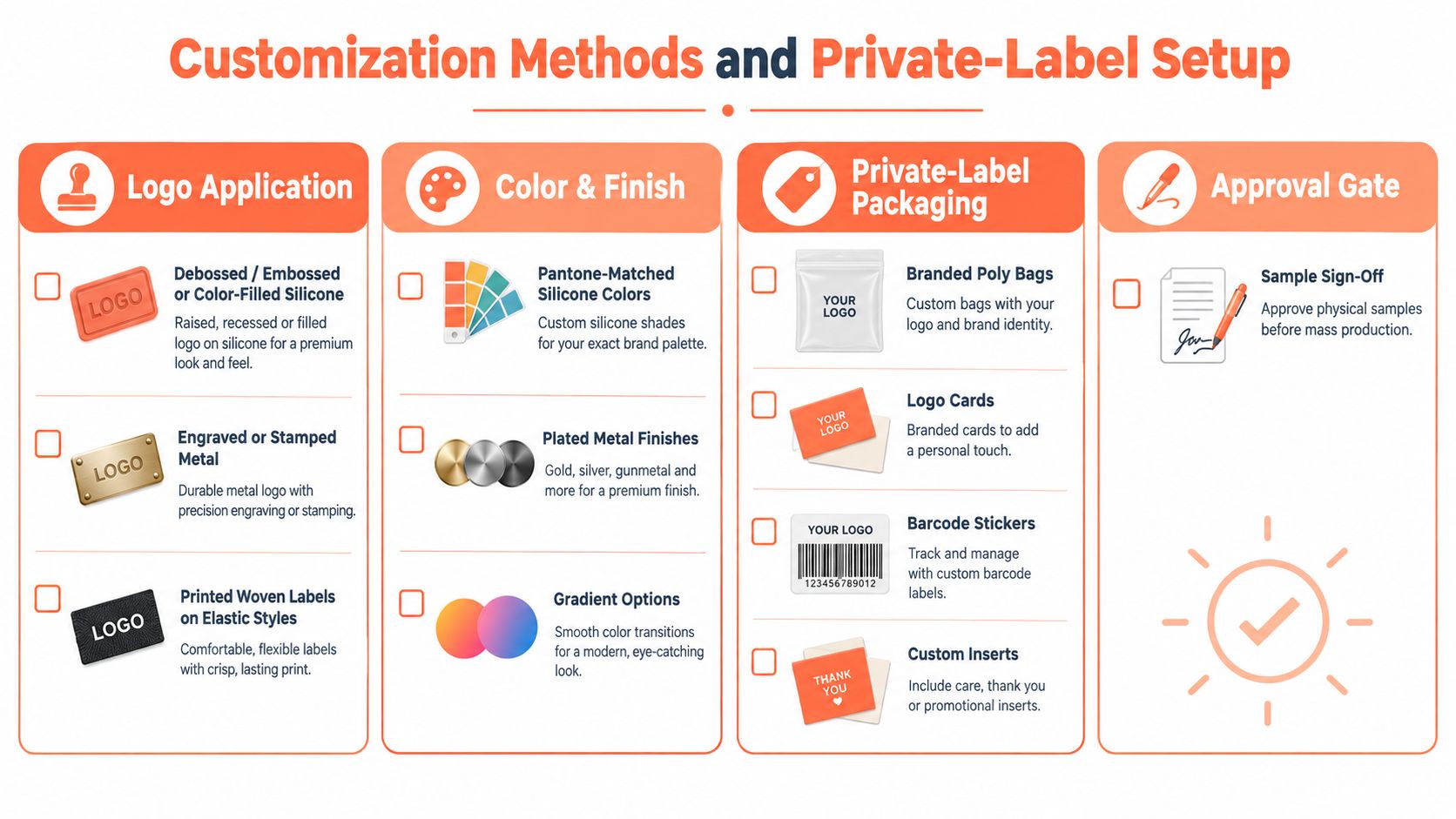
Separate tooling from digital work
Ask which changes require molds, plates, dies, or custom clasps. A new silicone mold, stamped charm, or custom clasp can create a tooling charge and extend sampling. Digital printing and some packaging artwork may avoid hard tooling, but they still require proof approval.
For a practical reference on private-label requirements, review this guide to private-label jewelry manufacturers. Before mass production, approve the bracelet, decoration, colors, packaging, barcode placement, and care language in one signed specification.
Pricing, MOQ, and Hidden Costs to Negotiate
A supplier's quoted unit price is not your landed cost. Request price tiers at the quantity you may buy, then calculate the order using material, decoration, packaging, freight, duties, inspection, and payment costs.
A 500-piece MOQ rarely receives the same unit economics as a 5,000-piece MOQ because suppliers spread material yield, setup, labor, and machine preparation across more units at higher volume. That doesn't mean you should automatically over-order. Excess inventory destroys the saving if the style is seasonal or the finish produces returns.
| Cost Variable | Typical Range | Negotiation Lever |
|---|---|---|
| Sample fee | Supplier-dependent | Ask whether it is credited after bulk approval |
| Mold or tooling | Supplier-dependent | Request reuse terms and a clear ownership statement |
| Plating upgrade | Supplier-dependent | Compare thickness, base metal, and wear validation |
| Packaging | Supplier-dependent | Quote plain, branded, and retail-ready versions separately |
| Barcodes and hangtags | Supplier-dependent | Supply final artwork and consolidate production |
| Inbound freight | Supplier-dependent | Compare sea, air, and consolidated shipment options |
Sample fees are often waived or credited when a sample converts into a production order, but get that promise in writing. Custom clasps and charms may trigger tooling charges. Ion plating, PVD coating, and hypoallergenic finishes can also raise the landed cost because the supplier may quote them as upgrades rather than part of the base product.
Add every component to a per-unit model. Include the bracelet, logo application, plating or finish, packaging insert, barcode sticker, hangtag, carton allocation, inbound freight, and any inspection charge. If a supplier charges for Pantone dye matching above four colors, list that surcharge separately rather than burying it in a revised unit price.
Ask for one proforma invoice, line by line, before paying a deposit. If the supplier can't show where the cost comes from, you can't protect your margin.
Use a structured conversation about how to negotiate with suppliers, then ask for the price at your test quantity, planned reorder quantity, and realistic scale quantity. Negotiate the whole order, not just the bracelet.
Sampling and Multi-Stage Quality Control
A final inspection alone is too late. Bulk custom bracelets need staged checks that catch wrong materials, dimensional drift, loose stones, weak closures, and packaging mistakes before those defects travel through the entire batch.
A practical workflow includes raw material inspection, dimension verification, stone security testing, surface-finish inspection, plating-thickness testing, final appearance inspection, and packaging inspection. Incepto Jewelry's bracelet manufacturing guidance also highlights the value of piece-by-piece or multi-stage inspection for custom OEM and ODM orders, particularly where plating, clasp fit, and surface cosmetics matter.
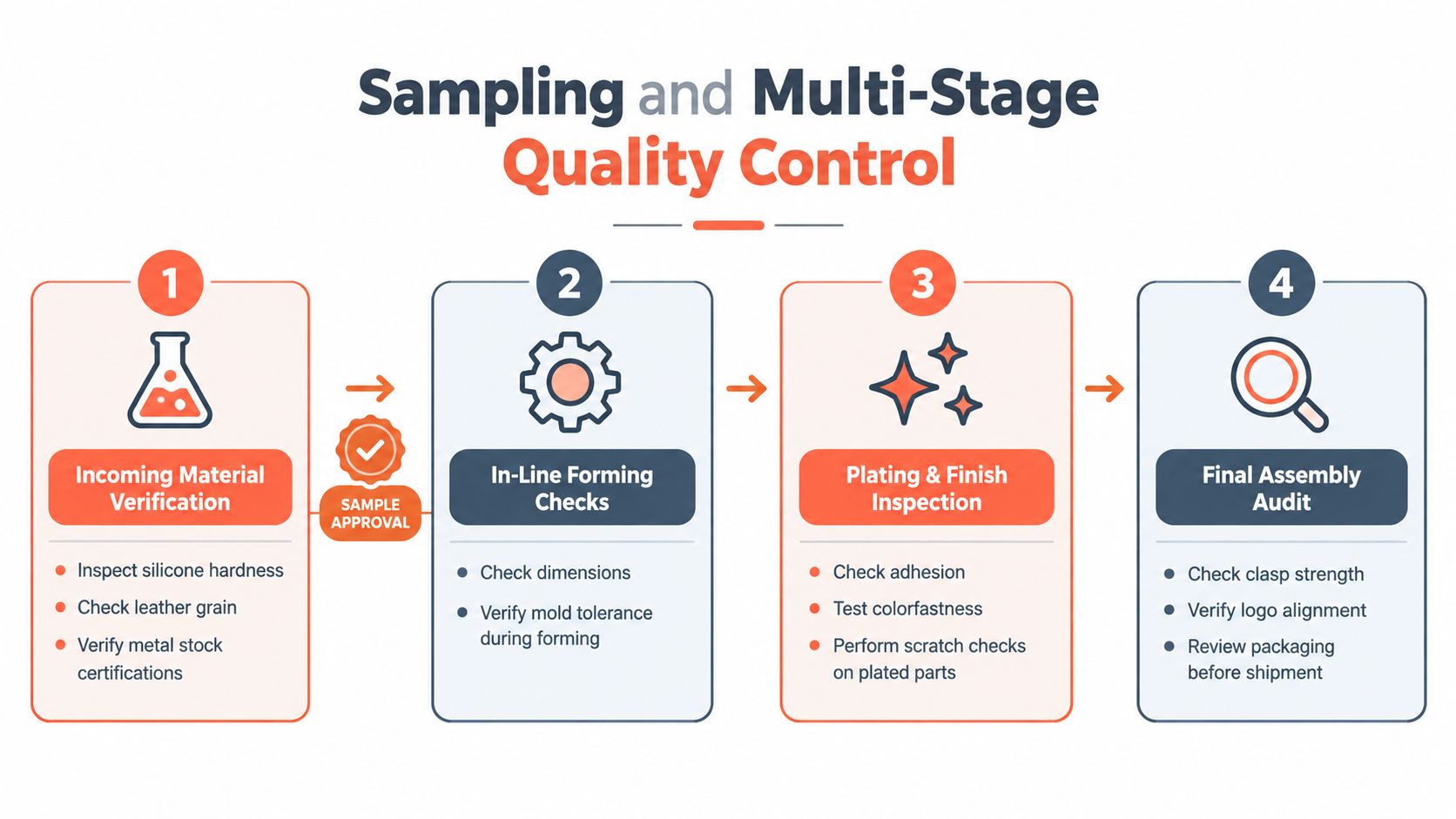
Use four approval gates
Gate one, incoming materials. Confirm silicone hardness, leather grain, elastic stretch, bead quality, and metal stock against the approved specification. Request relevant material certificates rather than accepting a verbal assurance.
Gate two, forming and assembly. Check inner diameter, wearable length, opening width, weight, edge smoothness, jump-ring closure, clasp force, and component alignment. For elastic bracelets, test stretch and recovery. For cuffs, verify that the opening doesn't create a sharp pressure point.
Gate three, plating and surface finish. Inspect thickness, tone, adhesion, colorfastness, scratches, polishing, and high-contact areas such as clasps and edges. A finish that looks perfect on the center surface may fail first where the wrist rubs against a desk or sleeve.
Gate four, final audit. Compare logo position, dimensions, appearance, clasp operation, and packaging against the approved sample. Check SKU labels and carton counts before release.
Control the reference sample
Sign off the pre-production sample through photos and retain a sealed golden sample. The supplier should retain a matching reference. Write down acceptable variation for dimensions, color, logo placement, and finish, then define defect categories for the production inspection.
Don't rely on vague “AQL passed” language. Specify the sampling standard, the acceptable defect level for critical, major, and minor defects, and the evidence required before shipment. Require inspection reports, dated photos, batch codes, and packaging images. If the order is large or highly customized, arrange an independent pre-shipment inspection rather than trusting a supplier's final message.
Lead Times, Shipping, and Negotiation Tactics
Lead time begins after sample approval, not after your first inquiry. A realistic production schedule for custom orders is 10–18 days for silicone, 20–35 days for stainless steel, and 25–45 days for sterling silver, according to the supplied production guidance. Add time for artwork approval, revisions, inspection, packaging, and customs clearance.
Sea freight from Asia to North America or Europe commonly takes 18–30 days, while air freight can take 4–7 days at roughly four to six times the cost, based on the supplied shipping guidance. The infographic below lists air freight as 3–7 days and courier as 2–4 days, so confirm the actual service level and destination with the forwarder before promising a launch date.
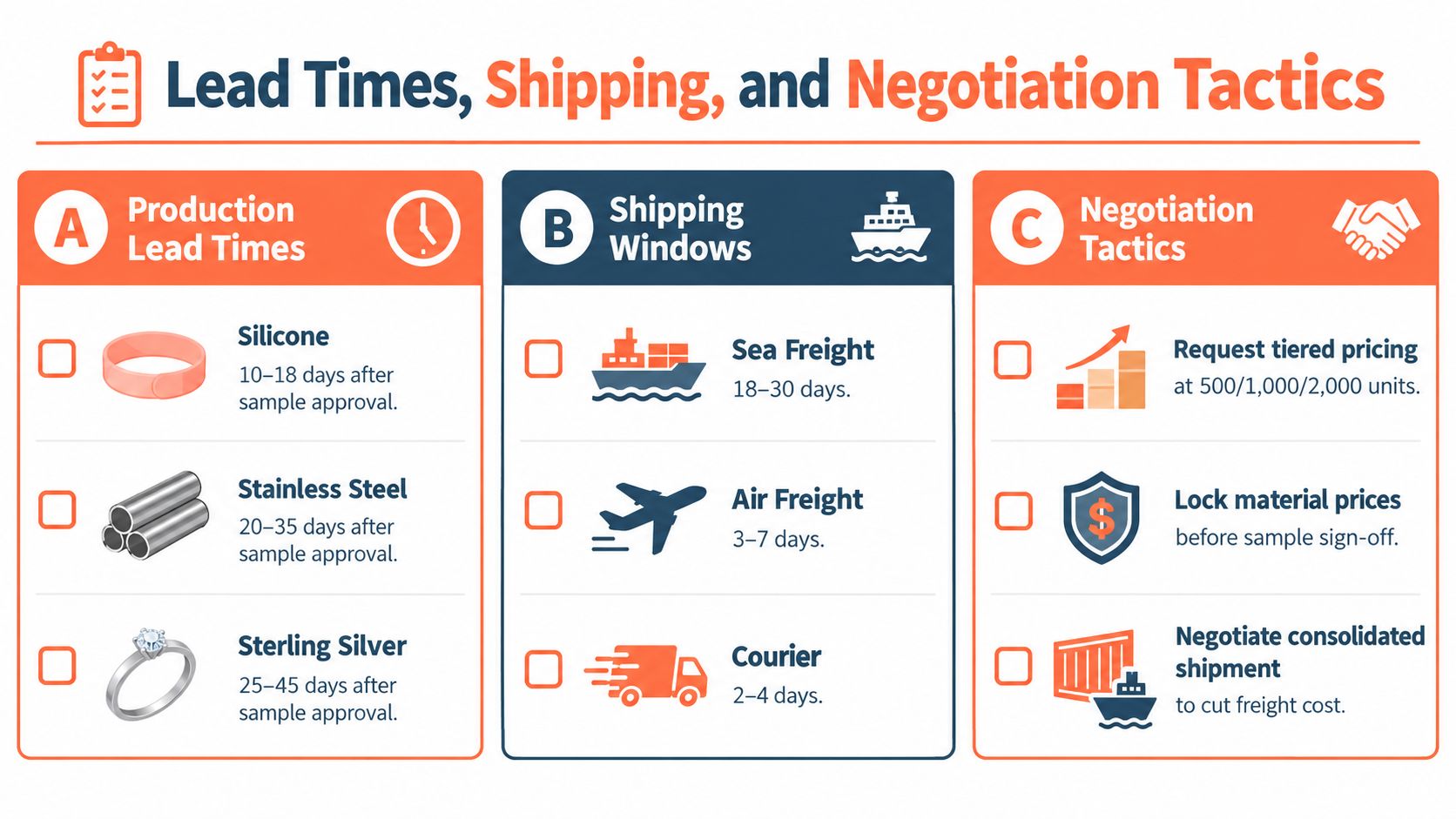
Peak periods around Lunar New Year, the Canton Fair, and Q4 holidays can add two to three weeks. Build the calendar backward from the date inventory must be available, not the date you hope the supplier will ship.
Negotiate terms that protect cash flow
Ask for 30/70 payment terms instead of paying the full amount upfront. Request free replacement when defects exceed 2%, and lock repeat-order pricing for six months if the material and construction remain unchanged. Confirm Incoterms in writing, including who handles export clearance, freight, insurance, import duties, and delivery.
For factory sourcing context, review this guide to direct factory jewelry. Use the supplier call to confirm:
- Production: Sample approval date, production start, completion date, and inspection window.
- Freight: Sea, air, or courier service, transit estimate, carton dimensions, and insurance.
- Documents: HS codes, commercial invoice, packing list, certificates, and batch records.
- Payment: Deposit, balance trigger, defect remedy, and any bank or platform charges.
Don't accept a “fast shipment” promise without a written production schedule. A cheaper freight method is only cheaper if it still arrives before your selling window.
Your Bulk Bracelet Buying Checklist
Save this checklist before the first supplier email. It turns a vague request for “custom bracelets” into a specification a factory or trading company can price accurately.
Pre-order preparation
- Use case: State whether the order is for resale, gifting, fundraising, event entry, loyalty rewards, or a promotional giveaway.
- Margin: Set your target landed margin before choosing material or packaging.
- Quantity: Request pricing at the test quantity, expected reorder quantity, and planned scale quantity.
- Wear cycle: Define whether the bracelet needs occasional use, daily wear, water exposure, or short event use.
Supplier and product checks
- Supplier identity: Confirm whether you're buying from a factory or trading company, and ask who controls production.
- Capability: Request relevant certifications, material documentation, references, and photos of comparable work.
- Material: Name the substrate, base metal, elastic type, bead composition, and skin-contact components.
- Finish: Specify plating method, thickness, tone, hardness, corrosion validation, and water-resistance meaning.
- Fit: Approve length, inner diameter, opening width, weight, edge smoothness, clasp force, and jump-ring security.
Branding and private label
- Logo method: Approve debossing, embossing, color filling, engraving, stamping, or woven labels at production size.
- Color: Supply PMS references and approve physical color chips or samples.
- Packaging: Confirm branded cards, care instructions, thank-you notes, poly bags, hangtags, and barcode placement.
- Compliance: Use nickel-safe, lead-free, or similar claims only when supporting documentation exists.
Commercial and logistics terms
- Price: Get a line-by-line proforma invoice covering product, decoration, packaging, tooling, inspection, and freight.
- Samples: Confirm the sample fee and whether it is credited against the bulk order.
- Payment: Push for 30/70 terms and define when the balance becomes payable.
- Defects: Put the replacement threshold, inspection method, and remedy in writing.
- Repeat orders: Ask for a six-month price lock when specifications remain unchanged.
- Shipping: Confirm production lead time, Incoterm, freight mode, insurance, HS code, commercial invoice, and packing list.
Print or save this list, then send it with your first inquiry. The supplier who answers each point clearly is easier to price, inspect, reorder, and hold accountable.
JewelryBuyDirect offers retailers access to wholesale bracelets, private-label options, and jewelry components across materials including sterling silver, stainless steel, titanium steel, copper, alloy, plated styles, gemstones, and pearls. Visit JewelryBuyDirect to compare products for your use case, check sourcing options before your next supplier call, and build an order around margin, durability, and repeatability.