
Charm Bracelet Wholesalers: The Smart Sourcing Playbook
You've approved the samples, negotiated a workable price, and committed cash to an order of charm bracelets. Then the cartons arrive. The clasps feel loose, the plating varies from piece to piece, and a few stones shift under light pressure. For a retailer, the purchase price is only the beginning of the cost.
Profitable sourcing depends on more than finding cheap jewelry. You need reliable charm bracelet wholesalers, documented materials, lot-level quality control, sensible minimums, and demand planning that accounts for seasonal spikes. This playbook focuses on the operational details that protect your margin, from factory vetting to receiving inspection and image presentation. For website merchandising, use the 383:204 image ratio, which is effectively a 1.876:1 horizontal proportion, so product content is less likely to be cropped when displayed online (JewelryBuyDirect's image-ratio guidance).
The High Cost of Getting Charm Bracelet Sourcing Wrong
Profitable charm bracelet sourcing is decided by defect cost per sellable unit, not invoice price. A low quote can become expensive once staff must sort inventory, replace failed pieces, manage returns, and explain inconsistent quality to customers.
A common failure starts with approving one attractive sample and assuming the production run will match it. In bulk deliveries, clasps may not close cleanly, gold-tone finishes may vary between SKUs, and decorative stones may sit loosely in their settings. The retailer then loses time photographing replacements, answering complaints, and discounting products that were planned for a full-price launch.
Returns add outbound shipping, processing work, and lost selling opportunities. Negative reviews can make first-time shoppers hesitate, while customers buying a durable gift may not return.
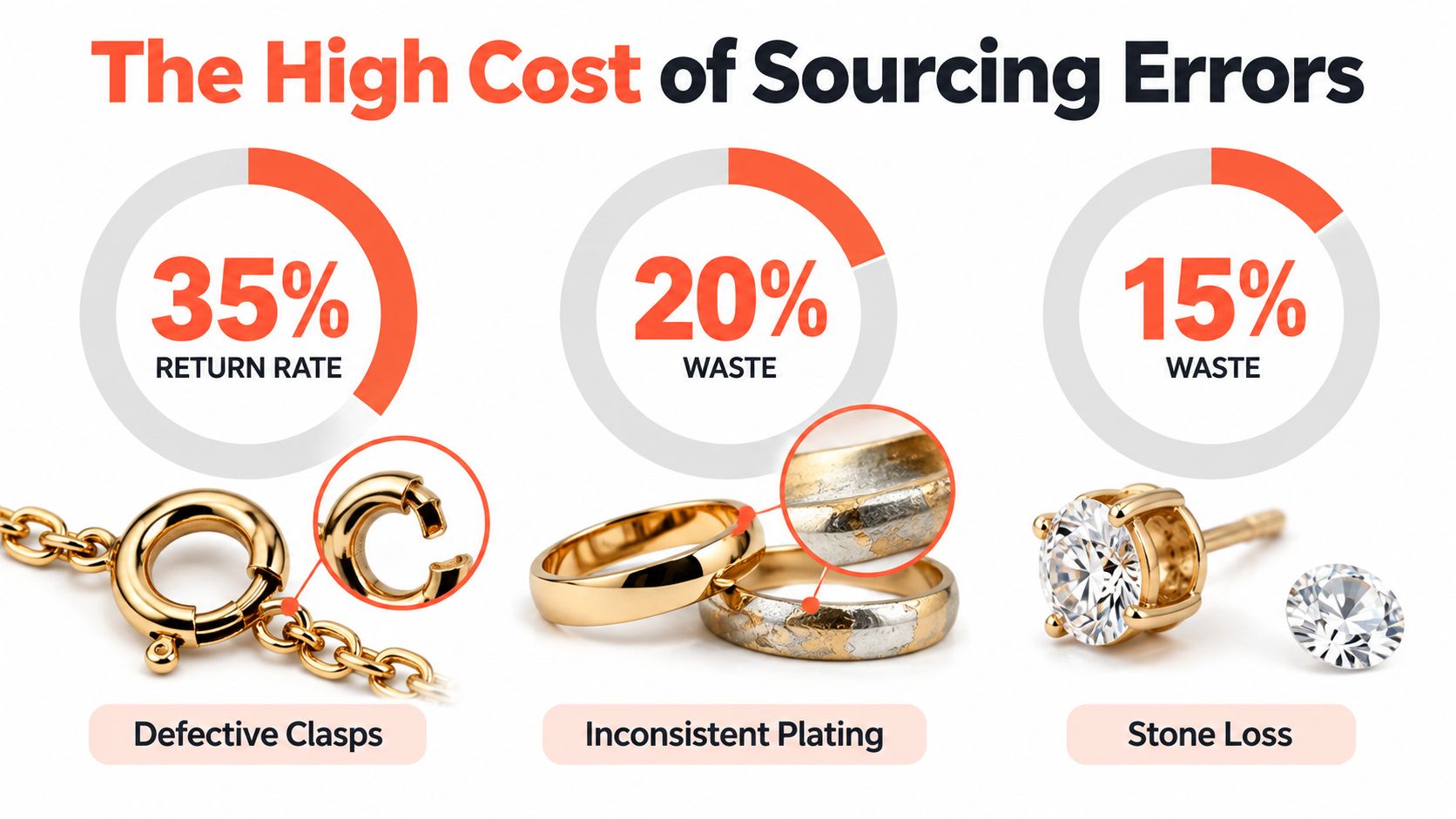
The purchasing mistake is often weak evidence rather than the lowest possible price. One sample does not demonstrate consistent factory execution.
Why a low unit price can mislead
A published wholesale comparison shows that a $0.28 charm with a 12% defect rate can cost more per usable unit than a $0.41 charm with a 1.8% failure rate after sorting, replacement, and reshipping labor are included (the wholesale charm comparison). The same logic applies to bracelets. A low invoice price offers little protection if receiving staff must inspect every piece, remove failures, and chase replacements.
| The True Cost of Quality Failures | Unit Price | Defect Rate | Usable Cost Per Unit | Annual Margin Impact (500 units) |
|---|---|---|---|---|
| Low-cost, high-failure charm | $0.28 | 12% | Higher after sorting and replacements | Margin erosion from unusable stock and service labor |
| Higher-cost, lower-failure charm | $0.41 | 1.8% | Lower after quality-related costs | More predictable sellable inventory |
The comparison's figures come from the cited wholesale example. Its annual impact column is an operational interpretation, not a fabricated financial estimate. Actual results depend on labor, freight, selling price, replacement terms, and the value of a lost customer.
Practical rule: Treat the sample as evidence of a supplier's capability, not proof that every production lot will match it.
Three sourcing failures appear repeatedly:
- Single-sample approval: One polished sample may come from a separate run or receive more attention than bulk production.
- Unclear material specifications: “Gold tone” or “silver color” does not establish plating thickness, base metal, hallmarking, or corrosion performance.
- Price-only selection: A supplier that will not document inspection steps may transfer quality-control work to your staff.
Protecting margin starts before payment. Put material requirements, finish expectations, clasp tests, stone-setting checks, lot-specific inspection records, and replacement terms in writing. Set the acceptance standard before production begins, so a supplier cannot redefine acceptable quality after the cartons arrive.
Where to Find Reliable Charm Bracelet Wholesalers
The right sourcing channel depends on your assortment, order size, speed requirements, and ability to inspect suppliers yourself. No channel removes risk. Each one moves the risk to a different part of the buying process.
Online marketplaces can provide direct access to factories and trading companies, but the product pages often tell you less than the supplier conversation. Ask for material documentation, production photographs, a sample process, and a clear answer about whether the listed product is made in-house. A specialized B2B jewelry platform may reduce search time and offer a more structured buying experience, while local markets and trade shows let you handle the product before committing.
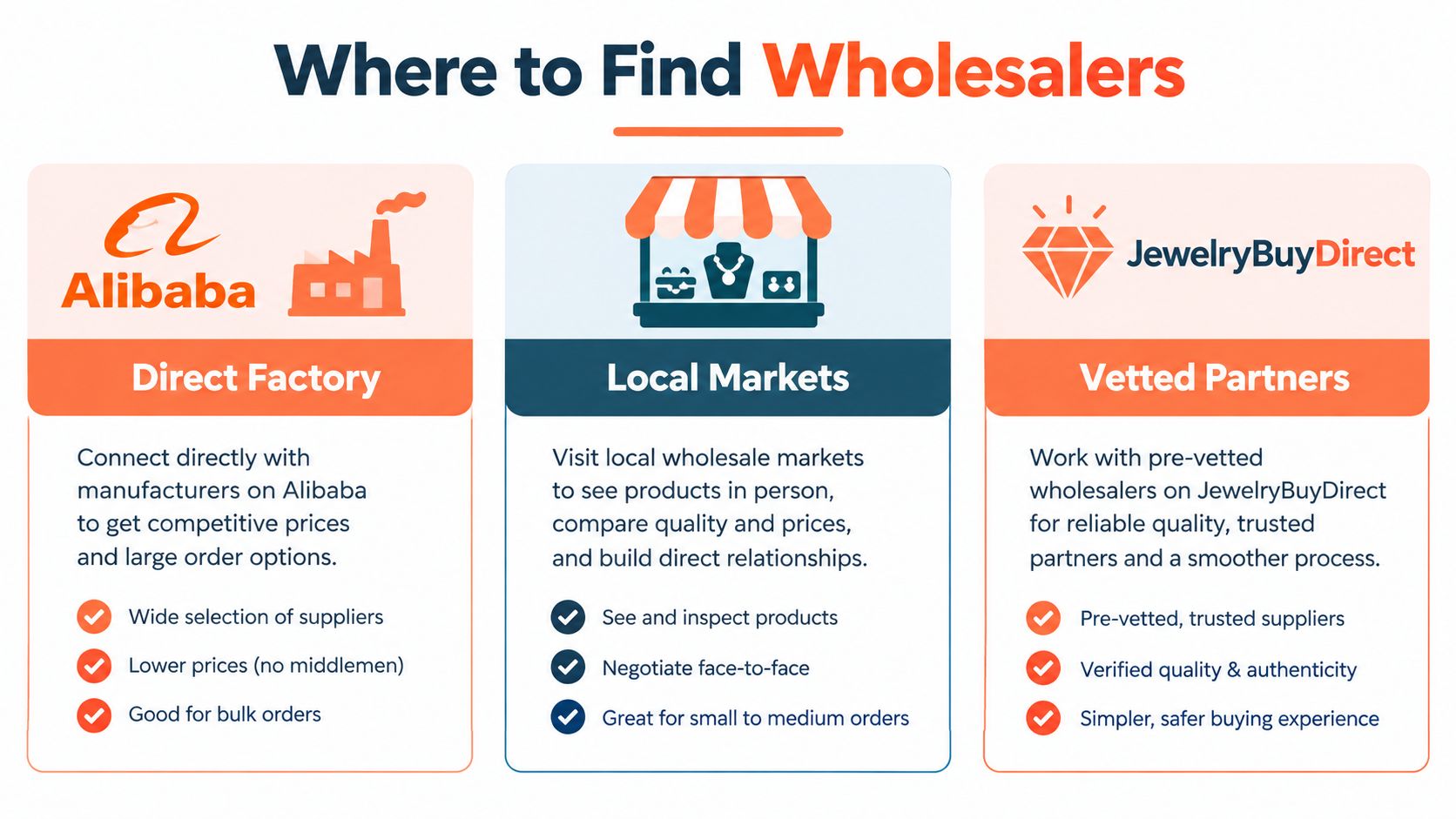
Match the channel to the job
| Sourcing Channel Comparison | Best For | Typical MOQ | Key Advantage | Main Risk |
|---|---|---|---|---|
| Online marketplace | Buyers comparing factories and product ranges | Varies by supplier | Broad access and direct negotiation | Difficult supplier verification |
| Local market or trade show | Retailers who need hands-on sampling | Varies by vendor | Immediate product evaluation and relationship building | Travel, event, and follow-up costs |
| Specialized B2B platform | Small retailers and growing brands | May offer no-MOQ options | Curated catalog and simpler reordering | Less direct factory visibility |
| Direct manufacturer | Established buyers with repeat demand | Usually negotiated | Greater control over specifications | Higher vetting and coordination burden |
Trade shows work best when you arrive with a scorecard, not just an appetite for new styles. Check clasp tension, chain articulation, stone security, and finish consistency at the booth. Record supplier names, product codes, sample terms, lead times, and follow-up commitments before you leave. A busy show can create useful relationships, but a conversation isn't a quality system.
For online sellers and small boutiques, low-MOQ access can be more valuable than the absolute lowest unit price. A smaller test order lets you measure sell-through and customer response before tying up cash in an unproven assortment. For a broader guide to evaluating wholesale charm bracelet collections, review this charm bracelet sourcing resource.
Build more than one route to supply
Avoid putting an entire collection behind one untested relationship. Keep a primary supplier for repeatable core styles, a secondary source for urgent replenishment, and a discovery channel for trend-led products. The objective isn't to manage unnecessary vendors. It's to avoid having one production delay or quality dispute stop your entire bracelet category.
How to Vet Charm Bracelet Suppliers and Factories
A supplier's catalog can look professional while its quality system remains unknown. Vetting should therefore move from documents to process evidence to physical samples. Each stage answers a different risk question.
Start with identity and material records
Request the supplier's business license, registered company details, factory address, and the name of the entity that will invoice you. If a trading company is involved, ask it to identify the manufacturing partner rather than presenting itself as the factory.
For materials, require specific descriptions instead of sales language. Wholesale jewelry guidance recommends verifying hallmarks or laboratory records, including stamped 925 sterling silver, 14K gold-filled markings, and documented gemstone grading where relevant (material verification guidance). Missing stamps, inconsistent finish quality, and weak clasp or plating durability are warning signs during bulk-order review.
Ask for third-party testing records and quality certifications, such as ISO 9001 or SGS-linked inspection documentation, while remembering that a certificate doesn't automatically validate every SKU in your order. The document should identify the relevant company, facility, material, or inspection scope. A supplier who sends a generic certificate without explaining its connection to your products hasn't answered the question.
Test the supplier's operating discipline
A reliable factory can explain its checkpoints without hesitation:
- Raw material review: What does the team verify before components enter production?
- Mid-production inspection: Who checks assembly, plating, stone setting, and dimensions while the order is still recoverable?
- Pre-shipment sampling: How are finished pieces selected, recorded, and released?
- Defect resolution: What evidence triggers replacement, credit, rework, or rejection?
Request a short factory video, current production photographs, and an example inspection report. Vague answers, copied photographs, unexplained changes in contact person, and pressure to pay before samples are approved deserve caution.
A supplier's response to a difficult quality question often tells you more than its product catalog.
Order physical samples and assess craftsmanship, clasp strength, plating thickness, and overall finish before placing a large order. Also verify the supplier's payment identity, shipping responsibility, packaging standard, and communication process. This supply-chain risk guide from Readymerce is useful context for thinking beyond the factory and examining the wider chain that can interrupt delivery.
A direct factory relationship can be valuable, but “factory direct” shouldn't end the investigation. Use this direct-factory jewelry guide as a comparison point, then judge every supplier by evidence tied to your own order.
Quality Control Standards for Bulk Charm Bracelet Orders
Quality control belongs in the purchase process before production starts. Set the approved material, finish, dimensions, sampling method, and defect remedy in writing. A workable workflow combines lot-specific plating or thickness checks with three inspection gates: raw material review, mid-production checks, and pre-shipment sampling (bulk charm bracelet QC guidance).
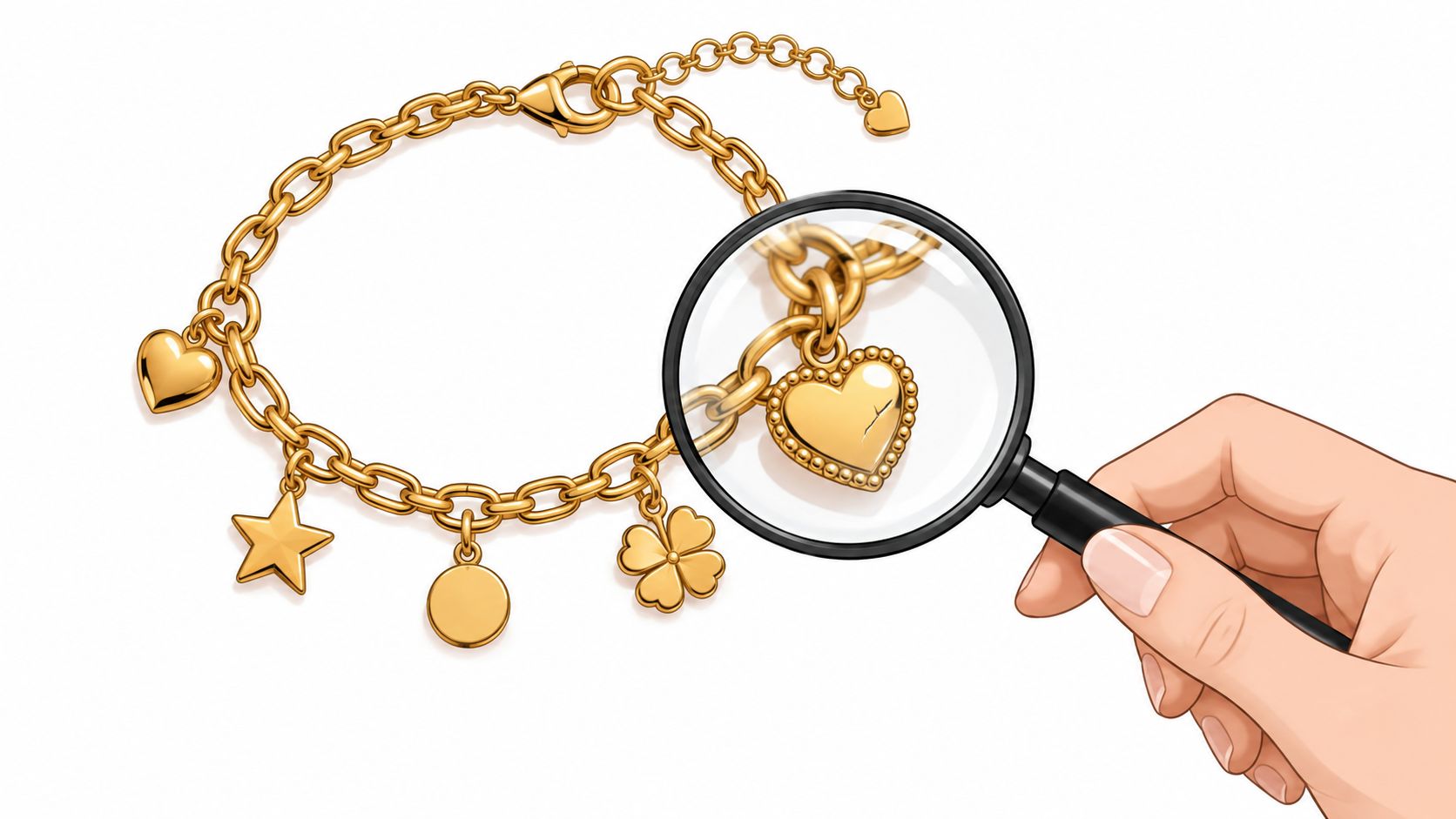
Request XRF plating-thickness scans by lot, rather than accepting a general statement that the bracelet is plated. Ask the factory to label results with the lot number, SKU, production date, and tested pieces. Record the report with photographs and the inspector's name so a later claim can be tied to a specific batch.
Set a defect threshold below 1.5% before the purchase order is released. The agreement should state that a lot exceeding the threshold triggers replacement or credit, identify who pays inspection and freight costs, and define the evidence required. Record results by SKU because plating inconsistency, clasp failure, and missing components can occur within one collection.
Use tests that reflect customer handling
A bracelet can look acceptable on a tray and still fail in use. Test the parts customers touch and stress:
- Cycle each clasp repeatedly and confirm that it closes securely.
- Pull strung components and connectors to expose weak joins.
- Check stones for movement, gaps, and incomplete settings.
- Flex chains through their normal articulation points.
- Measure dimensions against the approved specification sheet.
- Inspect high-friction areas for early finish wear.
For stainless-steel components, request mill test reports for every batch. Common reference points include hardness around HV 180–220, no visible defects at 30 cm under 500-lux lighting, tape adhesion of Class 4B or better, and no red rust after 48 hours for 304 steel or 96 hours for 316 steel in salt-spray testing (stainless-steel and finishing benchmarks). Treat these as acceptance references, then align them with the product's intended use and finish.
| Charm Bracelet Quality Benchmarks | Key Specification | Testing Method | Acceptance Standard |
|---|---|---|---|
| 925 sterling silver | 925 hallmark | Marking review and material documentation | Correct stamp and supporting records |
| Gold-tone finish | 2–3 microns commonly used for gold-tone plating | Thickness scan and high-friction wear check | Matches the agreed specification |
| Stainless steel hardness | HV 180–220 | Mill report or material test | Within the approved range |
| Plating adhesion | Class 4B or better | Tape-adhesion test | Meets the agreed class |
| 304 stainless steel | Salt-spray resistance | Salt-spray test | No red rust after 48 hours |
| 316 stainless steel | Salt-spray resistance | Salt-spray test | No red rust after 96 hours |
| Bracelet assembly | Secure clasp, joins, stones, and dimensions | Cycling, pull, stone, articulation, and measurement checks | No critical failure and within specification |
For larger lots, define the sample size and rejection rule before inspection. One wholesale benchmark describes inspecting 200 pieces from a 5,000-unit lot and rejecting the batch if more than 10 defects appear under AQL 5.0. Certified third-party pre-shipment inspection is commonly budgeted at 3–5% of order value. Use a protocol that matches product price, failure risk, and return exposure, rather than applying one rule to every style.
The practical margin decision is the sellable-unit rate. A slightly higher purchase price can be cheaper when it reduces sorting, replacements, and reshipping. Use the inspection record to support that decision, not a unit quote alone.
The video below demonstrates the visual inspection mindset buyers should apply before accepting a shipment.
Negotiating Pricing, MOQs, and Logistics Terms
A supplier negotiation should end with a workable landed-cost model, not merely a lower unit quote. Calculate the product cost alongside freight, duties, payment fees, inspection, packaging, expected replacements, and the cost of cash being tied up in stock.
A lower minimum order quantity can justify a higher unit price when you're testing an unfamiliar style. That flexibility reduces the risk of buying into a bracelet that looks attractive in a catalog but performs poorly with your customers. Once a style proves repeatable, negotiate better pricing through reorder commitments, consolidated shipments, or a narrower range of packaging variations.
Put commercial terms in writing
Confirm these points in the pro forma invoice or purchase agreement:
- Sample treatment: State whether samples are refundable, credited, or charged separately.
- Specification control: Attach approved photographs, measurements, material descriptions, and finish requirements.
- Defect remedy: Define replacement, credit, rework, and evidence requirements.
- Inspection rights: State whether you can appoint a third-party inspector before shipment.
- Packaging: Specify individual protection, SKU labels, carton marks, and packing lists.
- Shipping responsibility: Clarify the agreed delivery term, carrier, tracking, insurance, and responsibility for damage.
- Payment stages: Tie final payment to inspection or documented release conditions where possible.
Don't accept a vague delivery promise such as “fast shipping.” Ask when production starts, when goods are ready for inspection, when the carrier receives them, and how tracking becomes available. A supplier who cannot explain those handoffs may leave you unable to plan a launch or replenishment.
Payment terms also affect buying capacity. A no-MOQ program can help a small retailer test styles, while a larger minimum may lower unit cost but increase exposure to slow-moving stock. Use the approach described in this supplier negotiation guide, then adapt it to your cash cycle rather than copying a single bargaining script.
The strongest negotiation position comes from being a predictable buyer. Share a clear forecast, pay on time, consolidate sensible reorders, and report defects with photographs and SKU references. Suppliers are more likely to protect a relationship that produces clean communication and repeatable decisions.
Why JewelryBuyDirect Stands Out as a Wholesale Partner
A wholesale platform should be judged against the operational problems it solves. For a small boutique, that may be access to no-MOQ testing. For an online seller, it may be catalog breadth, trackable delivery, and fast replacement handling. For a growing brand, material variety and repeatable fulfillment may matter more than the lowest listed price.
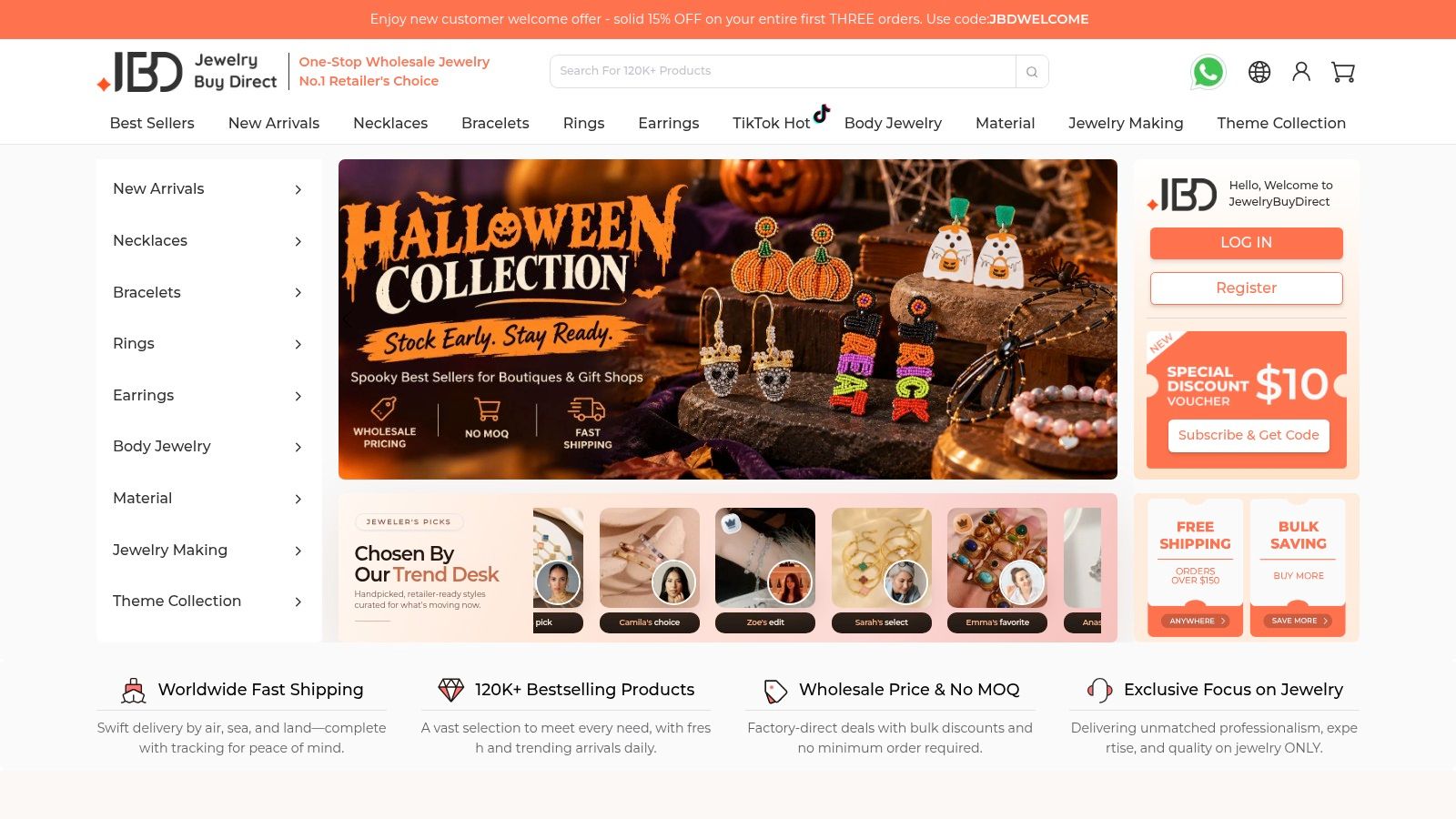
JewelryBuyDirect offers 120,000+ SKUs across bracelets, necklaces, rings, earrings, body jewelry, and jewelry-making components. Its catalog includes 925 sterling silver, stainless and titanium steel, copper, alloy, gold-plated, gemstone, and pearl styles, with 100+ new arrivals daily, according to the publisher information supplied for this article.
The platform works with SGS-certified manufacturing partners and positions its pricing at 15–30% below market averages. Those claims should still be tested against your landed cost and product specifications. A low displayed price doesn't replace sample approval, lot inspection, or a written defect remedy.
Compare the operating model
| JewelryBuyDirect vs Typical Wholesale Platforms | JewelryBuyDirect | Typical Platform | Typical Factory Direct |
|---|---|---|---|
| Catalog breadth | 120,000+ SKUs | Varies by seller | Often narrower by factory |
| Minimum order | No MOQ | Depends on seller | Commonly negotiated |
| Manufacturing network | SGS-certified partners | Supplier-dependent | Factory-dependent |
| Pricing position | Factory-direct pricing, stated at 15–30% below market averages | Varies | May be lower at scale |
| Returns and damage | 7-day returns and full damage protection | Policy varies | Must be negotiated |
| Shipping | Trackable global logistics | Seller-dependent | Buyer often coordinates |
| Support | 24/7 support | Platform or seller-dependent | Direct contact varies |
The no-MOQ structure suits retailers that need to validate a small assortment before scaling. It can also support dropshippers, marketplace sellers, pop-up vendors, and makers who don't want to hold deep inventory across every variation. Free worldwide shipping is available on $150+ orders, and the platform lists buy-now-pay-later options that can help with cash-flow planning.
JBD also states that it serves customers across 46 countries, with a repeat customer rate of 85% and 24/7 support. Those are publisher-provided platform claims, so buyers should still evaluate actual response times, delivery performance, and product quality on their own orders. The practical value lies in comparing those terms with suppliers that require larger commitments or leave returns and damage entirely to the buyer.
Final Checklist Before Placing Your Wholesale Order
Before placing a substantial order, turn every verbal assurance into a written checkpoint. The receiving team should be able to compare the delivered goods with an approved record without relying on memory or a supplier's product page.
Approve the product, not just the photograph
Keep a sample file for every SKU. Include front and back photographs, dimensions, clasp type, charm count, material description, plating or finish requirement, hallmark details, packaging instructions, and the date of approval. If the supplier changes a component, finish, stone, or chain length, require a new sample or written approval before production continues.
Use this pre-order checklist:
- Material evidence: Confirm 925 markings, 14K gold-filled markings, mill reports, or gemstone documentation where applicable.
- Functional testing: Check clasp closure, pull strength, chain movement, stone security, and connector integrity.
- Finish control: Confirm plating thickness or color standard and inspect high-friction areas.
- Dimensional accuracy: Compare bracelet length, charm size, jump-ring diameter, and component count with the specification sheet.
- Supplier identity: Match the invoice entity, bank details, business records, and manufacturing responsibility.
- Quality records: Request raw-material, mid-production, and pre-shipment inspection evidence.
- Acceptance terms: Record the defect threshold, inspection method, evidence required, and replacement or credit process.
- Shipping plan: Confirm packaging, carton labels, tracking, insurance, delivery responsibility, and damage reporting.
- Payment protection: Use an agreed payment route and avoid releasing the final balance before the required inspection condition is met.
- Receiving procedure: Count cartons, photograph packaging, quarantine questionable goods, and log defects by SKU and lot.
Don't mix approved and unapproved variants in one purchase order. That makes disputes harder because neither side can identify which specification governed the production run. Keep a version-controlled order sheet and make the supplier acknowledge it before manufacturing begins.
For the first full shipment, sample across cartons rather than inspecting only the easiest carton to reach. Check repeat SKUs as well as new designs, because production inconsistency can sit inside a single collection. If the result falls outside the agreed standard, stop the release process and document the problem before the inventory enters normal stock.
Demand planning deserves the same discipline. The global charm bracelet market was valued at $6.2 billion in 2025 and is projected to reach $10.1 billion by 2034, with a projected 5.8% compound annual growth rate over that forecast period. Traditional charm bracelets held 38.5% of product share, while Asia Pacific held 42.3% of revenue share in the same market view (Faire's charm bracelet market overview). These figures support a broad category opportunity, but they don't guarantee that every style will sell evenly throughout the year.
Personalization deserves a separate test. Personalized jewelry is forecast to grow at a 15.59% CAGR through 2030, while costume jewelry is estimated at $45.2 billion in 2023 and projected to rise to $86.8 billion by 2033. Online stores held 38.2% of charm-necklace distribution revenue in a separate market summary (personalized and costume jewelry market summary). Build a curated test assortment, measure reorder behavior, and avoid assuming that a large catalog automatically creates healthy turnover.
JewelryBuyDirect offers no-MOQ access to charm bracelets and related jewelry, along with factory-direct pricing, trackable logistics, 7-day returns, and damage protection. Visit JewelryBuyDirect to test a focused assortment, verify product quality, and build a sourcing program that protects your margins as demand develops.