
Gold PVD Plated Jewelry Explained for Retail Buyers
A boutique owner opens a new shipment of gold-plated rings and immediately spots the problem. Several pieces look attractive under showroom lights, but customer returns begin after regular wear because the finish fades, tarnishes, or reveals the base metal. Meanwhile, a smaller selection of gold PVD plated jewelry continues to look polished, giving the owner fewer complaints and more confidence when reordering.

For wholesale buyers, the difference isn't “premium” versus “basic.” It's a sourcing decision tied to product category, base metal, expected wear, retail price, and return risk. PVD can make more sense for a ring or bracelet that faces constant friction, while conventional plating may still suit a low-contact fashion item built around a short trend cycle.
This guide explains what gold PVD plated means, how the vacuum process creates its finish, and what the available wear data means in everyday retail terms. You'll also learn how PVD compares with traditional gold plating and vermeil, why the base metal determines whether a hypoallergenic claim is credible, how care affects service life, and which supplier checks can protect your margins.
Introduction Why Gold PVD Plated Jewelry Matters Now
Plated jewelry often creates a frustrating mismatch between the first sale and the customer's later experience. A necklace may look rich and even at delivery, yet repeated contact with sweat, perfume, skin oils, water, or clothing can gradually change its appearance. A ring has an even harder job because its surface meets desks, bags, keys, soap, and other objects throughout the day.
That creates work for a retailer. You may need to answer complaints, approve returns, replace pieces, or discount stock that no longer looks suitable for display. The cost isn't limited to the item itself. A disappointing finish can also weaken customer trust in the rest of your assortment.
Gold PVD plated jewelry is positioned as a durability-focused alternative because its finish is created through a vacuum deposition process rather than a conventional wet electroplating bath. The result is an ultra-thin film designed to bond closely with the surface. It still isn't solid gold, but it can offer a more wear-resistant presentation while using very little precious metal.
Retail perspective: The right question isn't “Is PVD always better?” It's “Which products justify a harder finish, and which products don't need one?”
That distinction matters for businesses sourcing affordable jewelry and fashion accessories. A low-contact pendant may not need the same coating specification as a ring. An earring may benefit from a skin-friendly base metal more than from maximum surface thickness. A bracelet may need stronger protection at its clasp and underside because those areas receive repeated friction.
The sections ahead move from process to purchasing. You'll see how PVD works, how hardness and abrasion results translate into customer expectations, where traditional plating and vermeil still fit, and how to check base metals, coating specifications, finish consistency, and supplier quality before placing a wholesale order.
What Gold PVD Plating Really Is and How It Works
PVD means Physical Vapor Deposition. In jewelry, it describes a vacuum-based process that vaporizes solid metal into plasma and condenses it onto a jewelry surface as an ultra-thin, molecularly bonded layer. It isn't paint, and it isn't the same as conventional electroplating.
A simple analogy is a fine metallic mist settling onto a prepared object in a controlled chamber. Instead of forming a loose film that merely sits on top, the vaporized material condenses and bonds across the surface. The finished layer is thin, even, and closely attached to the base metal.
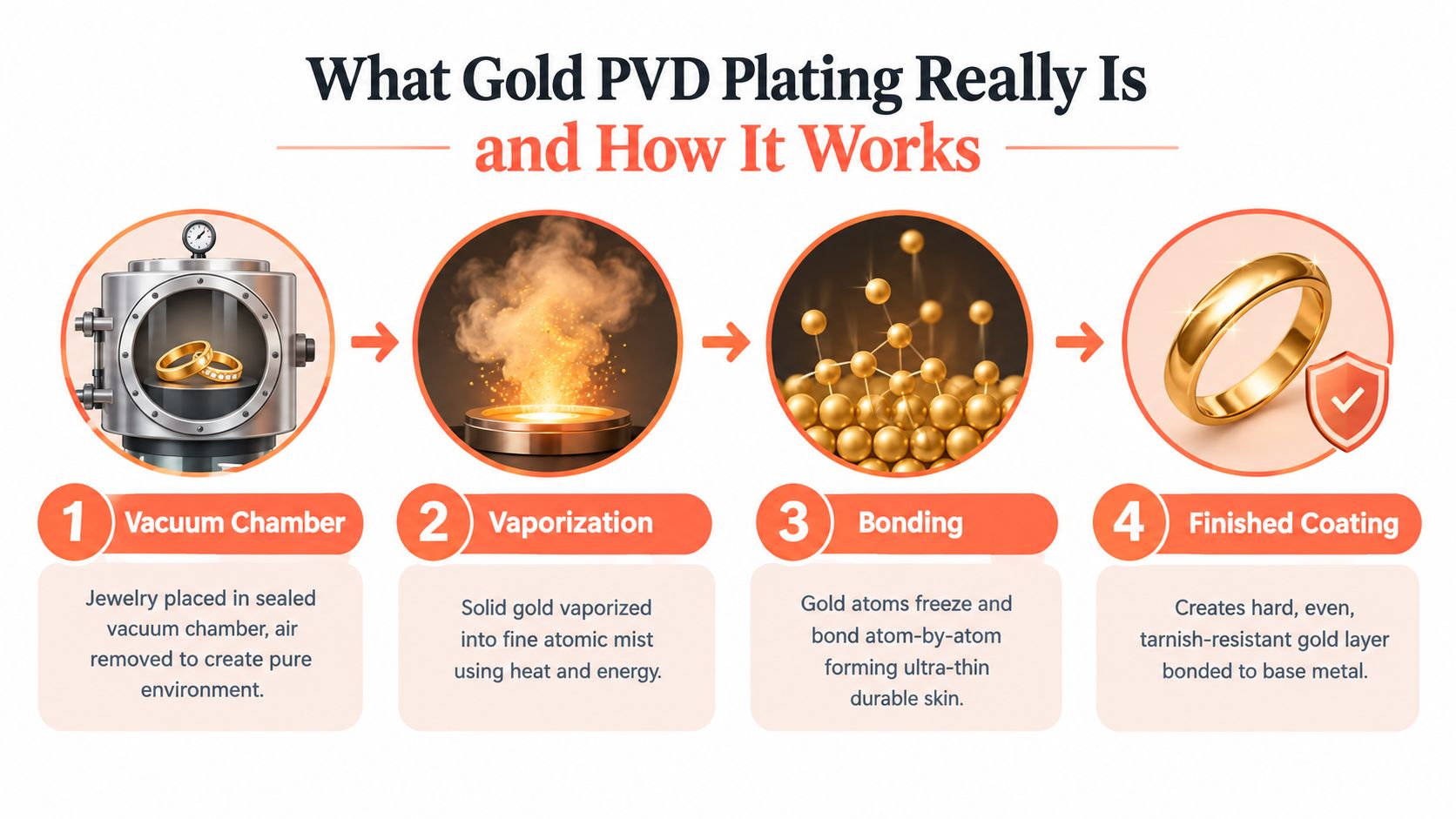
The process in plain language
- Preparation and placement: The jewelry is cleaned and placed inside a vacuum chamber. Removing air creates a controlled environment where the coating material can travel toward the product without the contamination associated with an open-air process.
- Vaporization: A solid metal source is energized until it becomes vapor or plasma. The process can use materials associated with the broader PVD family, including titanium nitride, zirconium nitride, and titanium carbonitride approaches that helped establish industrial coating performance.
- Deposition: The vapor moves toward the jewelry and condenses on its surface. Individual particles form a continuous layer that follows the visible shape of the piece.
- Finished film: The jewelry leaves the chamber with a decorative surface intended to improve wear resistance and color stability compared with older, softer finishes.
PVD became relevant to jewelry after earlier industrial development in the 1980s, when providers began applying TiN, ZrN, and TiCN methods to jewelry applications. That history matters because watches and fashion jewelry adopted a technology originally associated with performance coatings, not merely decorative color. You can read a clear overview of PVD coating on jewelry when training sales staff or preparing product descriptions.
The process doesn't turn stainless steel, titanium, or another base into solid gold. PVD gold is a surface coating, and the final item still depends on the material underneath it. The coating can make an affordable piece look refined and perform better, but retailers should describe it accurately as gold PVD plated rather than solid gold.
How Durable Is Gold PVD Plated Jewelry in Real Wear
A boutique owner choosing finishes for a ring line faces different wear demands than one sourcing earrings or pendants. Gold PVD durability depends on three related factors: hardness, abrasion resistance, and coating thickness. Hardness describes resistance to indentation and surface damage. Abrasion resistance shows how the finish handles repeated rubbing, while thickness indicates how much coating separates everyday wear from the base metal.
One independent comparison reported decorative PVD surface hardness of 800 to 2000 HV, with wear resistance 5 to 10 times higher than conventional gold plating. In the same simulated abrasion test, traditional gold-plated samples showed visible wear and base-metal exposure after 500 cycles. PVD-coated samples retained their shine after 5000 cycles without obvious scratches. The findings appear in this comparison of PVD-coated and traditionally gold-plated jewelry.
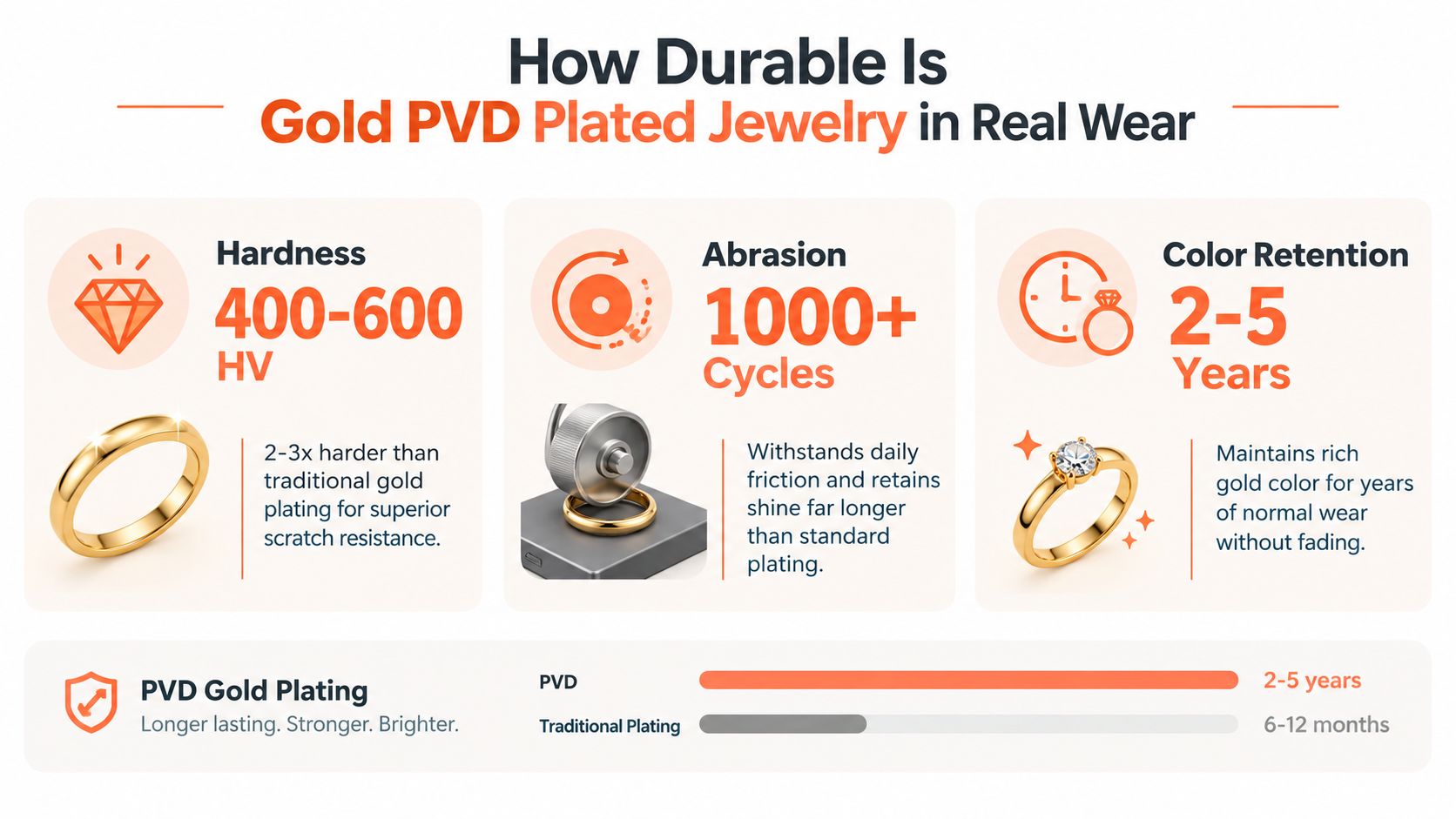
Why the numbers matter at the shelf
Abrasion testing is a guide, not a lifetime promise. A ring edge, bracelet underside, and pendant face encounter different levels of contact. Shape, friction points, coating specification, customer habits, and base material all affect the result.
Industry guidance reports that quality PVD jewelry can maintain its appearance for 2 to 10 years under normal conditions, while some estimates place noticeable everyday durability around 3 to 5 years. For wholesale planning, that range is more useful than one fixed claim. A high-contact item may justify a stronger specification because better wear performance can reduce complaints and support repeat purchases. A low-contact item may not need the same coating investment.
Thickness changes the buying decision
Reported decorative gold PVD thicknesses range from about 0.03 to 0.08 micrometres for finishes intended to preserve fine engraving and texture. Some jewelry applications use thicker coatings in the 0.25 to 5 micrometre range, where additional material can support longer service in high-contact pieces such as rings and bracelets. This guide to PVD coating thickness explains why buyers should request a specification instead of treating “PVD” as a complete quality description.
Use the product category to set the sourcing priority:
- Rings and bracelets: Request a coating specification suited to friction, especially around edges, undersides, and clasp areas.
- Earrings: Review coating quality and the metal used for posts and backs. These parts touch sensitive skin and move repeatedly.
- Necklaces and pendants: Low-contact surfaces may retain their appearance well, although chains and connector points still rub against clothing and skin.
- Engraved or textured pieces: A thinner, detail-preserving finish may protect the design better than the thickest available layer.
PVD gold and color layers are reported around 800 to 2000 HV, while some TiN and ZrN-type systems reach roughly 2000 to 3000 HV. Conventional gold electroplate is reported around 100 to 200 HV. This PVD coating thickness guidance helps explain why hardness can matter when choosing finishes for wholesale margins.
Gold PVD Plated vs Traditional Gold Plating and Vermeil
A boutique owner choosing between these finishes is not selecting three interchangeable shades of gold. Each finish changes the product's material story, expected wear, cost structure, and likely return risk. Gold PVD plated jewelry uses a vacuum-deposited film bonded to the surface. Traditional gold plating applies gold through an electrochemical process. Gold vermeil places gold over sterling silver, making the underlying metal part of the product's identity and value.
PVD uses a very small amount of precious metal because its decorative layer is extremely thin. One explanation describes PVD gold as a vacuum-deposited film typically around 0.1 to 5 micrometres thick. That helps explain how a piece can offer a gold appearance without the material cost of solid gold. This explanation of what PVD gold means clarifies the difference between a surface finish and a solid-gold product.
Gold Finish Comparison for Retail Buyers
| Feature | Gold PVD Plated | Traditional Gold Plated | Gold Vermeil |
|---|---|---|---|
| Process | Vacuum deposition that vaporizes metal and bonds it to the surface | Electrochemical deposition in a plating bath | Gold plating applied over sterling silver |
| Base metal | Commonly stainless steel or titanium, but specifications vary | Several base metals may be used, depending on the supplier | Sterling silver is the defining base |
| Hardness | Generally positioned for greater abrasion resistance than conventional gold electroplate | Softer finish with performance depending on construction and wear | Depends on the gold layer, silver base, construction, and wear conditions |
| Thickness | Varies by finish specification and intended use | Varies by supplier and specification | Varies by supplier and specification |
| Best use | Rings, bracelets, watches, and fashion pieces where repeated contact matters | Trend-led, low-contact pieces where color and price lead the decision | Collections where sterling silver is part of the value proposition |
| Main trade-off | Not solid gold, and results depend on preparation, thickness, and base metal | Lower-cost finish requires more conservative wear expectations | Stronger material positioning, but both the silver base and gold layer need care |
The practical choice depends on where the finish will earn its keep. A PVD finish can support a stronger wholesale proposition for rings and bracelets because those pieces face frequent friction. For earrings, pendants, and seasonal styles with less contact, traditional plating may meet the customer's color and price expectations. The base metal still affects the product story, so the supplier specification should accompany the finish name.
Vermeil fits a different retail conversation. When sterling silver is a central selling point, it gives staff a material distinction to explain rather than presenting the item as only gold-colored jewelry. This guide to vermeil jewelry can help staff describe that difference accurately.
Avoid presenting all three finishes as equivalent. PVD isn't solid gold, and vermeil is not a synonym for gold-colored fashion jewelry. Match the finish to the product's contact level, customer expectation, target price, and potential return exposure.
Base Metals Skin Safety and When Hypoallergenic Claims Fail
A gold PVD surface doesn't automatically make jewelry hypoallergenic. Skin safety depends on the base metal, the integrity of the coating, and the places where the jewelry receives friction. The PVD process itself doesn't use common allergens in the same way some other processes can, but the underlying material still matters if the coating becomes damaged or worn.
A supplier may offer PVD jewelry over 316L stainless steel or titanium, two base choices commonly associated with sensitive-skin positioning. That doesn't mean every wearer will respond identically, and it doesn't remove the need for clear material disclosure. The safer retail approach is to describe the actual base metal rather than relying on an unqualified “hypoallergenic” label.
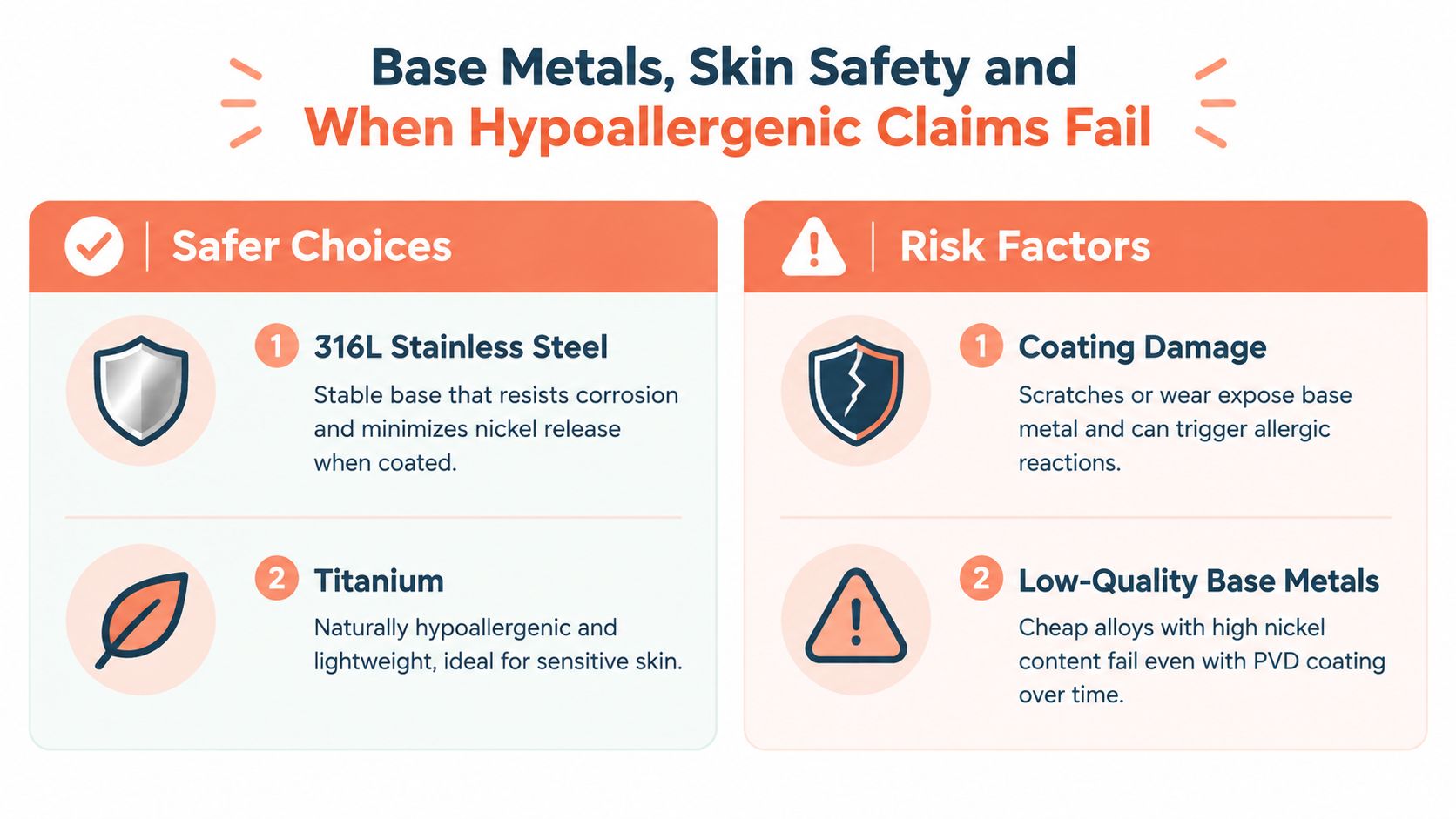
Inspect the areas customers often overlook
Earring posts and backs deserve special attention because they remain in close contact with skin. A necklace pendant may preserve its visible face while its chain or clasp experiences more rubbing. A ring can show wear first on its underside, inner edge, or raised details.
Customer guidance: A coating can provide a protective barrier, but that barrier isn't permanent in every wear location.
Buyers should ask suppliers:
- Base metal: Is the piece made from 316L stainless steel, titanium, sterling silver, copper, alloy, or another material?
- Component material: Do the post, back, clasp, jump ring, and chain use the same base metal as the main body?
- Coating integrity: Has the supplier checked edges, recesses, solder points, and friction surfaces?
- Customer wording: Can product pages state the base metal and avoid promising universal allergy protection?
Once a coating wears through, the underlying metal can contact the wearer's skin. Sensitive customers may react at that point even if the main visible surface still looks attractive. The explanation of hypoallergenic jewelry is useful for training teams to distinguish material facts from broad marketing language.
For boutique assortments, base metal is also a merchandising tool. Titanium may appeal to customers seeking a lightweight option, while 316L stainless steel can support durable everyday styles. Neither choice replaces honest care guidance. Retailers should advise sensitive customers to stop wearing a piece if irritation develops and to seek professional advice when needed.
Care and Maintenance Tips That Extend PVD Jewelry Life
Good care won't make a coating indestructible, but it can reduce avoidable wear and help customers keep the finish attractive for longer. Give buyers a short care card at purchase, especially for rings and bracelets that encounter more friction than necklaces or earrings.
A practical customer checklist
- Clean gently: Use a soft, dry or lightly damp cloth. Avoid abrasive pads, polishing compounds, and rough fabric that can wear the surface.
- Apply products first: Put on perfume, lotion, sunscreen, and hair products before wearing jewelry, then allow them to settle. Direct chemical exposure can affect finishes over time.
- Remove before high-contact activities: Take rings and bracelets off before cleaning, exercise, swimming, showering, or handling household chemicals.
- Store separately: Keep pieces in a dry pouch or divided compartment so chains, stones, and metal surfaces don't scrape against one another.
- Dry after moisture: If jewelry becomes wet, pat it dry rather than rubbing forcefully. Pay attention to clasps, crevices, and earring components.
- Rotate high-contact styles: Alternating rings and bracelets gives each piece a break from continuous friction and helps customers preserve their favorite items.
Lifecycle expectations should follow the product category. Independent guidance notes that high-contact rings may show visible wear in 1 to 4 years, while lower-contact items can last 3 to 10+ years under suitable conditions. Those figures appear in the lifecycle comparison for PVD gold jewelry, and they're better used as planning ranges than as promises.
A retailer can reduce returns by describing care in plain language. Instead of saying “waterproof forever,” explain that PVD is designed for stronger wear resistance, but friction, chemicals, moisture, and individual use still influence appearance. That wording protects credibility while giving customers actions they can control.
Sourcing Gold PVD Plated Jewelry for Your Store With Confidence
Treat “PVD” as a starting point, not a complete quality specification. A reliable wholesale decision combines the coating process with the base metal, thickness, component construction, surface preparation, and color consistency. Ask for written details before you compare unit prices.
Use a supplier verification checklist
- Request XRF testing: X-ray fluorescence can help confirm metal composition and plating thickness, according to this wholesale jewelry quality-control guide.
- Ask for thickness specifications: Request the stated coating range for the exact product, not a general factory claim. Resellers can also review these PVD thickness specifications for resellers when building their own supplier checklist.
- Confirm every component: Check whether posts, backs, chains, clasps, and jump rings use the same disclosed material as the main piece.
- Inspect finishing quality: Look for clean soldering, smooth polishing, even color, and consistent coverage around edges and recesses.
- Order samples first: Wear-test rings, bracelets, earrings, and necklaces differently. A finish that works for a pendant may not be suitable for a ring.
- Match specification to margin: Pay more for protection where returns and visible wear create a real business cost. Don't over-specify every item if the product is low-contact and trend-driven.
For boutiques, online sellers, marketplace retailers, and dropshippers, JewelryBuyDirect offers a catalog of 120,000+ SKUs, including PVD-labeled necklaces, earrings, rings, pendants, bracelets, and jewelry components. The platform combines factory-direct pricing reported at 15 to 30 percent below market averages, no minimum order quantity, SGS-certified manufacturing partners, and 100+ new arrivals daily, giving smaller businesses room to test category-specific PVD assortments without committing to a large opening order.
Build the assortment around use, not just finish language. Choose stronger PVD specifications for high-contact categories, pair sensitive-skin positioning with disclosed 316L stainless steel or titanium bases, and provide care instructions that reflect real wear.
JewelryBuyDirect gives boutiques and online sellers access to affordable PVD jewelry across a broad wholesale catalog, with no minimum order quantity and supplier-quality information to support smarter product selection. Visit JewelryBuyDirect to compare gold PVD plated styles, test category-specific samples, and build an assortment designed to protect margins and reduce avoidable returns.