
Jewelry Drop Ship: How to Build a Profitable Store
Gross margins in jewelry drop shipping can reach 45% to 80%, but net margins often settle at 10% to 30% after shipping, advertising, and platform fees. That narrow window is why a profitable jewelry drop ship store starts with supplier quality, landed costs, fulfillment control, and compliance, not with a large catalog or a clever product name.
You may be looking at a supplier dashboard with hundreds of attractive rings, necklaces, and bracelets, wondering which ones deserve a place in your store. The photos look polished, the wholesale prices look tempting, and the supplier promises quick fulfillment. Then the first returns arrive, a clasp fails, a customer disputes the metal description, and an advertising campaign turns a healthy-looking gross margin into a loss.
Jewelry drop ship can work, but it isn't passive retail. You need to protect every order from poor materials, unclear product claims, slow delivery, preventable returns, and fees that consume contribution margin. The practical question isn't whether you can list jewelry without holding stock. It's whether your supplier, pricing model, images, and operating controls can support a reliable customer experience.
Why Jewelry Drop Ship Stays Worth the Risk in 2026
The demand case is substantial. Worldwide online jewelry sales were projected to rise 13.2% in 2024 to $105.6 billion, while U.S. online jewelry sales were expected to reach $22.5 billion, up 12.1%, according to Oberlo's online jewelry sales data. The same forecast puts global online jewelry sales at $166 billion by 2029 and U.S. sales at $37.9 billion by 2029, which supports catalog-led selling models that don't require you to buy every product in advance.
Dropshipping has expanded beyond a small side-business model. One market estimate places global dropshipping at $351.8 billion in 2024, compared with $284.6 billion in 2023, while another estimates $365.7 billion in 2024 and projects approximately $1.25 trillion by 2030, as reported in coverage of the online jewelry business market. These estimates differ, but both point to a large retail channel with enough activity to support specialized jewelry stores.
The opportunity still comes with operational friction. Customers expect accurate material descriptions, convincing images, dependable tracking, and a return process that doesn't feel adversarial. Suppliers may have inconsistent plating, long transit times, or weak packaging. Marketplaces also react aggressively to counterfeit complaints, especially when sellers use branded-looking charms or descriptions that imply an affiliation they don't have.
Operator rule: Treat the first sale as a quality-control event, not a victory lap.
Your margin decisions should therefore follow a strict order:
- Validate the product: Confirm the metal, finish, stones, dimensions, and supplier documentation.
- Calculate landed cost: Include shipping, payment processing, platform fees, advertising allocation, packaging, refunds, and replacements.
- Control presentation: Use an image set that answers questions about scale, finish, clasp construction, and wear.
- Protect the transaction: Record item identifiers, photograph outgoing orders, and handle disputes quickly.
- Scale only proven SKUs: Don't add volume because a product looks attractive in a supplier catalog.
The model remains worth testing because online demand is expanding and jewelry is compact, giftable, and visually demonstrable. It becomes dangerous when sellers confuse a low wholesale price with a profitable order.
| Category | Typical Gross Margin | Avg Shipping Cost | Returns % | Realistic Net Margin |
|---|---|---|---|---|
| Costume jewelry | 45%–80% | Varies by route and destination | Varies by store policy and product fit | 10%–30% after operating costs |
| Sterling silver | 45%–80% | Varies by weight, route, and service | Varies by product and customer expectations | 10%–30% after operating costs |
| Fine jewelry | 45%–80% | Varies by insurance, route, and carrier | Varies by product value and verification requirements | 10%–30% after operating costs |
The margin ranges in the table reflect recent jewelry dropshipping industry guidance. Shipping and return rates should be calculated from your own supplier, destination, and product data rather than treated as universal benchmarks.
Picking Niches and SKUs That Actually Convert
A jewelry catalog converts when it gives shoppers a reason to buy now and enough information to trust the purchase. Gift intent, symbolism, personalization, and easy styling all help. A generic product called “fashion necklace” has to compete on price. A clearly presented birthstone pendant, initial necklace, or everyday titanium hoop can compete on relevance and confidence.
Personalized products deserve careful handling because they carry emotional value but create fulfillment complexity. Name necklaces, initial pendants, and birthstone pieces can fit gifting occasions, while minimalist stacking rings and layered necklaces encourage customers to build a set. Men's signet rings, chain styles, and bracelets broaden the audience, and titanium or other sensitive-skin positioning can serve buyers who actively avoid uncertain base metals.
The merchandising rule is simple: choose a narrow customer problem before choosing a broad product category.
- Gift-ready selection: Emphasize symbolism, packaging, delivery expectations, and a clear explanation of personalization.
- Everyday wear: Show scale, styling, finish, and how the item sits against clothing or skin.
- Stacking and layering: Present coordinated pieces together so the second and third item feel intentional rather than forced.
- Men's accessories: Use direct sizing information, close-ups of clasps and links, and styling that shows proportion.
- Sensitive-skin positioning: State the actual material and avoid unsupported hypoallergenic claims.
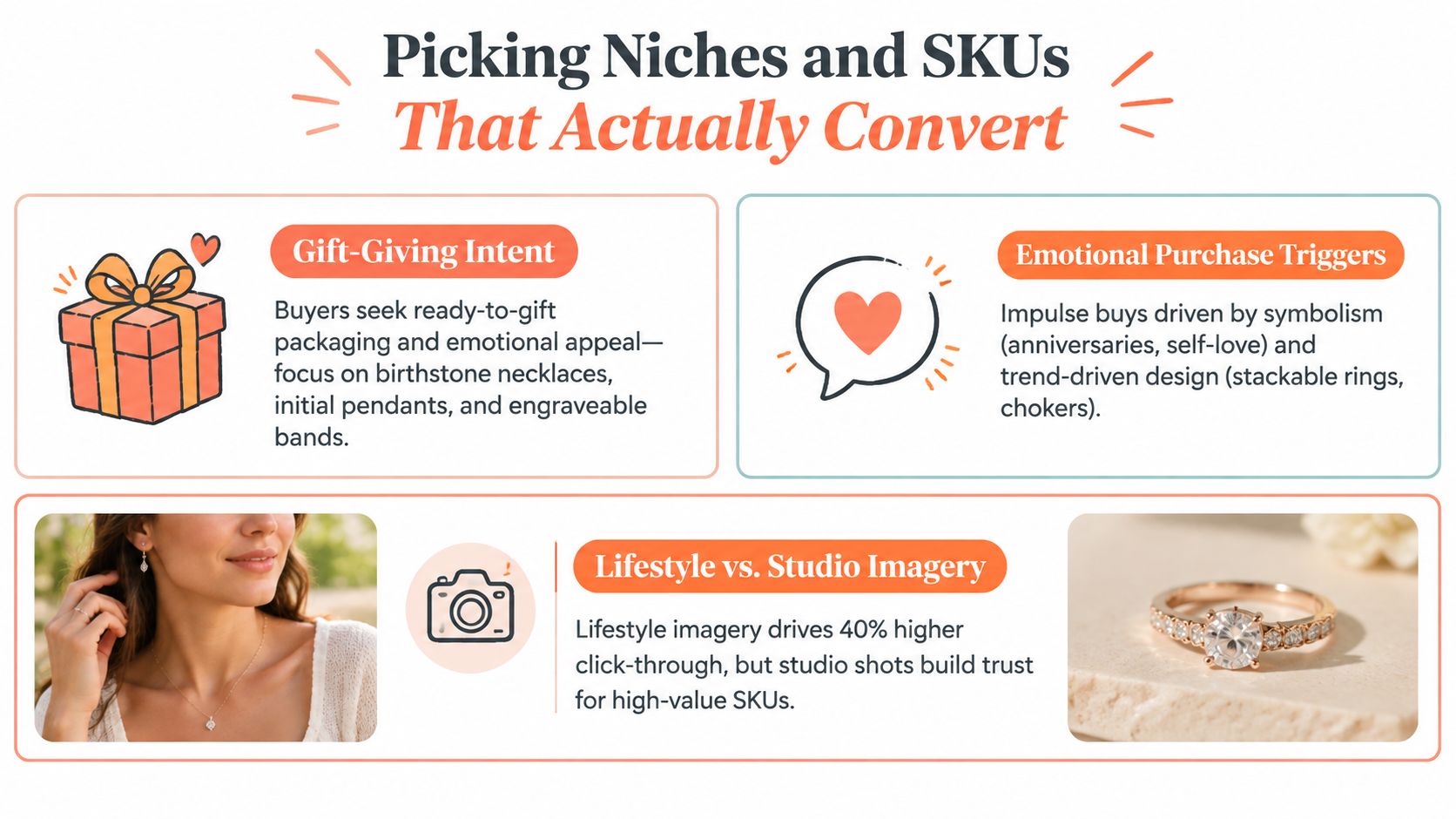
Images do more than decorate a product page. Jewelry creates uncertainty about size, shine, thickness, weight, and how the item looks when worn. A useful image stack includes a hero shot, macro or detail shot, scale shot, clasp or back shot, and on-body image. Independent jewelry commerce guidance reports that professional-quality photos can raise conversion by 33%, broader comparisons cited in the same guidance show gains of up to 94% against low-quality images, and customer photos are associated with a 19% lift. The same source places typical jewelry conversion rates around 0.95% to 1.46%, making image quality a meaningful lever for a low-ticket product page. See the jewelry conversion rate benchmarks and image guidance.
Don't publish every SKU your supplier offers. A curated collection of roughly 30 to 80 products is a practical operating range for a lean store because it limits photo checks, product-page work, stock monitoring, and customer-service complexity. Treat that range as a merchandising discipline rather than a universal performance statistic. Remove items that create repeated questions, inconsistent quality, or weak margins.
Vetting Suppliers Without Getting Burned
Supplier vetting starts before you compare price lists. Ask for the legal business identity, warehouse location, fulfillment route, return address, material declarations, production lead times, and documentation for the claims used in your product pages. A supplier who avoids specific answers during onboarding usually won't become more responsive after a customer receives a defective item.
Build a supplier evidence file
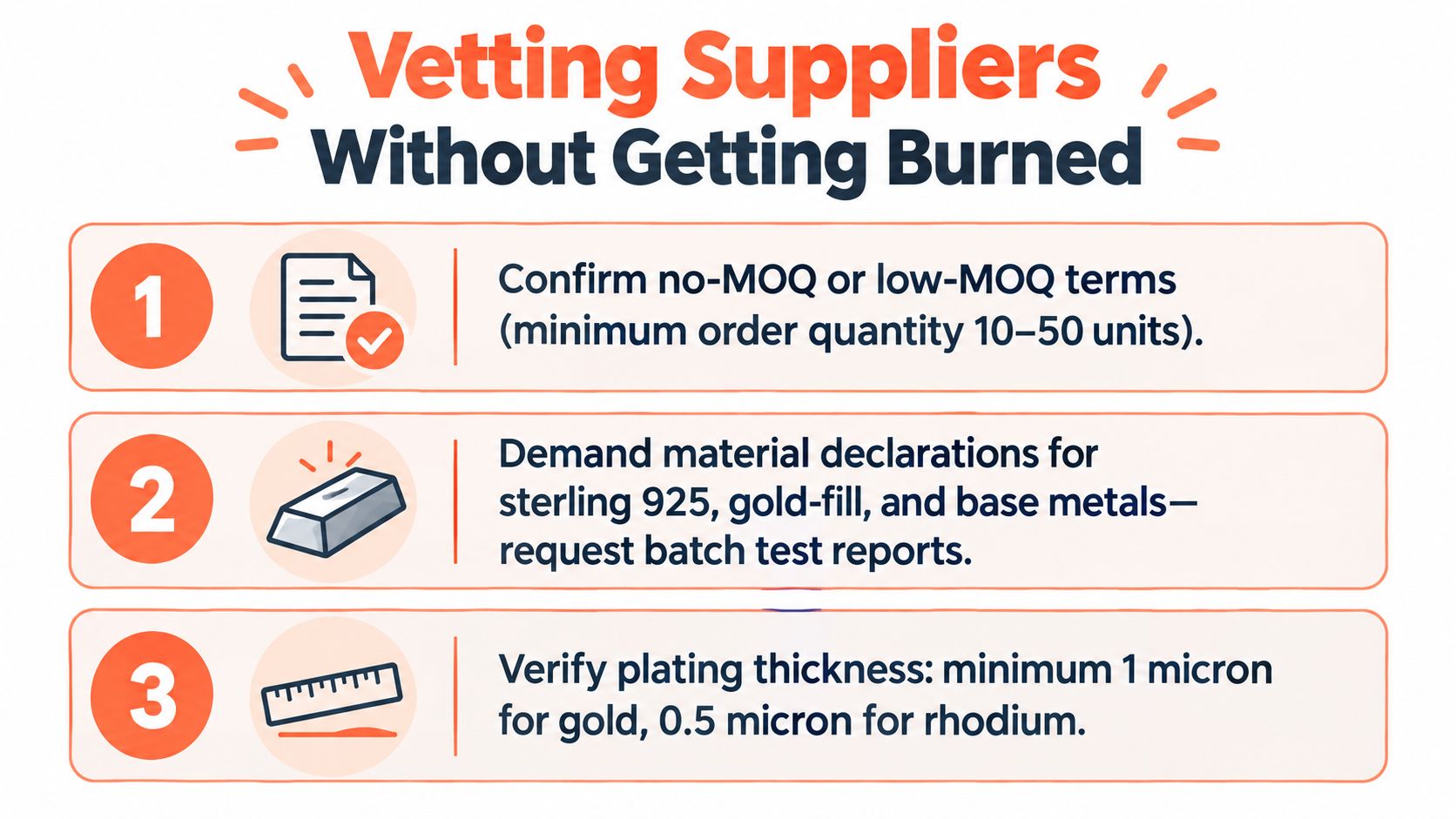
Request written confirmation of whether a product is sterling silver, gold-fill, plated, stainless steel, titanium, copper, alloy, or another base material. For silver, a “925” declaration should match the actual metal content. For plated goods, ask what material is used for the plating and how thickness is measured. “Gold-plated” without a measurable specification tells you very little about durability.
For metal-contact pieces, ask for current third-party testing from SGS, Intertek, or an equivalent provider. The report should identify the tested material or batch, not merely display a generic company certificate. Independent buyer guidance recommends third-party reports for products marketed as hypoallergenic, precious-metal, or gemstone-set, alongside checks against applicable regulations and recall databases. The fashion jewelry quality-control guidance for wholesale buyers is useful when building that checklist.
Start with no-MOQ or low-MOQ terms wherever possible. That lets you test several designs without tying cash to unproven inventory. Order samples across price points and styles, then inspect the finish under magnification, clasp action, stone setting, symmetry, stamp clarity, edge smoothness, and packaging damage.
Test the commercial relationship
Send a deliberately specific defect claim. Ask how the supplier handles a mismatched item, damaged package, wrong size, or missing component. Record response time, requested evidence, refund method, and whether the supplier accepts responsibility without pushing every issue back to you.
The pricing-floor check belongs in the vetting process. If landed cost exceeds 35% of intended retail, the product may struggle once advertising, platform fees, returns, and payment processing enter the calculation. That isn't a guarantee of failure, but it is a warning that the SKU has little room for operational mistakes.
For a broader supplier comparison, review dropshippers for jewelry alongside your own sample results rather than relying on catalog claims alone.
Pricing, Margins, and Fulfillment Workflows
Price from landed cost, not from the nearest competitor's product page. Your starting formula should include product cost, shipping, duty or tax exposure where applicable, payment processing, platform fees, advertising allocation, packaging, customer-service labor, refund leakage, and a replacement reserve.
A worked example makes the discipline clear. Suppose a sterling silver ring costs $6.20 from a Yiwu supplier, and you subsidize $4.80 shipping. A 15% platform fee applies, with $8 allocated to advertising per order. Add payment processing and a returns reserve before deciding whether a $34.95 retail price is viable. Under the assumptions in this example, the resulting net margin can land roughly between 18% and 22%, but the exact outcome depends on the payment rate, refund behavior, replacement cost, and whether the shipping subsidy applies to every order.
The formula matters more than the specific example:
Net contribution = retail price − product cost − shipping − platform fee − payment fee − ad allocation − packaging − returns reserve − replacement cost.
If the result is thin before tax and overhead, a higher sales volume won't automatically fix the problem. It may multiply the number of unprofitable orders.
Compare fulfillment routes
Pure dropshipping through tools such as DSers, Spocket, or Zendrop reduces inventory exposure and can automate order transmission. The trade-off is less control over packaging, stockouts, split shipments, and substitutions. A hands-off workflow still needs daily exception checks.
Small-batch buying from Alibaba can improve unit economics and let you inspect stock before dispatch, but it introduces cash tied up in inventory, customs delays, and the risk of holding designs that stop moving. A hybrid approach often makes more operational sense. Keep proven bestsellers in a controlled small batch, while using drop shipping for slower, seasonal, or experimental products.
| Cost Line | Pure Drop Ship (DSers/Spocket) | Bulk Small-Batch from Alibaba (3-5 pcs) | Hybrid (Bestsellers Bulk, Tail Drop Ship) |
|---|---|---|---|
| Inventory exposure | Low | Higher | Concentrated on proven items |
| Unit cost | Usually higher | Potentially lower | Lower on winners, flexible on tests |
| Fulfillment control | Limited | Higher | Higher where volume matters |
| Stockout risk | Supplier-dependent | Your own reorder risk | Split across both routes |
| Packaging control | Often limited | More control | Selective control |
| Best use | Testing and long-tail catalog | Validated repeat sellers | Stores balancing flexibility and margin |
Physical packaging decisions also affect damage rates and perceived value. If you're sourcing protective packaging, compare shop bubble pouches online to your supplier's standard mailers and test the actual fit around boxes, pouches, and inserts.
For the calculation process, use this jewelry profit margin guide as a reference, then replace assumptions with your own order data. The right fulfillment model is the one that preserves contribution margin while keeping delivery, packaging, and defect handling predictable.
Compliance, Counterfeits, and Return-Fraud Risk
A product can be inexpensive, attractive, and still be unsafe to sell under its current description. Jewelry sellers often focus on whether an item looks like a branded design, but compliance also covers metal descriptions, hallmarking, import documentation, product claims, and evidence that the item matches the listing.
In the UK, precious-metal jewelry sold as gold, silver, platinum, or palladium must meet hallmarking requirements when it exceeds the applicable minimum weight. The thresholds stated in the UK government's hallmarking guidance are 7.78 grams for silver, 1 gram for gold, 0.5 gram for platinum, and 1 gram for palladium. Lightweight fashion pieces may fall below a threshold, but a heavier sterling-silver item can require compliant marking before resale.
U.S. descriptions also need precision. Under 16 CFR 23.5, silver-plated articles can't be stamped or described as “sterling,” “solid silver,” or “Sterling Silver” unless the item is at least 925/1,000ths pure silver. A supplier's use of “925” isn't enough by itself. You need documentation and a product record that supports the claim.
Return fraud adds another layer. Industry guidance states that 9% of all retail returns are fraudulent, and 64% of retailers tracking incidents report increasing decoy returns, according to jewelry return and fraud guidance. Jewelry-specific schemes include counterfeit swaps, stone substitution, wear-and-return claims, and returning a different item in the original packaging.
Use serial-numbered intake where possible, photograph the item before pack-out, preserve packaging records, and open disputes immediately when a return doesn't match the outgoing evidence. Sellers handling multiple channels should also review practical controls for how to secure an online store against fraud.
Compliance warning: Never use “925,” “hypoallergenic,” “solid,” “genuine,” or branded language because a supplier used it first. Your store owns the customer-facing claim.
Counterfeit risk is especially serious with branded charms and lookalike designs. Recent U.S. customs reporting described $3.5 million in counterfeit jewelry seizures connected to shipments between China and Puerto Rico, as reported by UPI's coverage of the seizure. Avoid “Pandora-style,” “Tiffany-style,” logo copies, and supplier photos that imply affiliation. A takedown can erase the margin from many successful orders.
Quality Control, Branding, and Private-Label Options
Quality control begins with a sample, but it shouldn't end there. Suppliers change batches, plating can vary, stones can loosen, and packaging can be substituted. Create a repeatable intake record for every active SKU, with the product code, material claim, measured weight, dimensions, sample photographs, and date of inspection.
A practical inspection sequence looks like this:
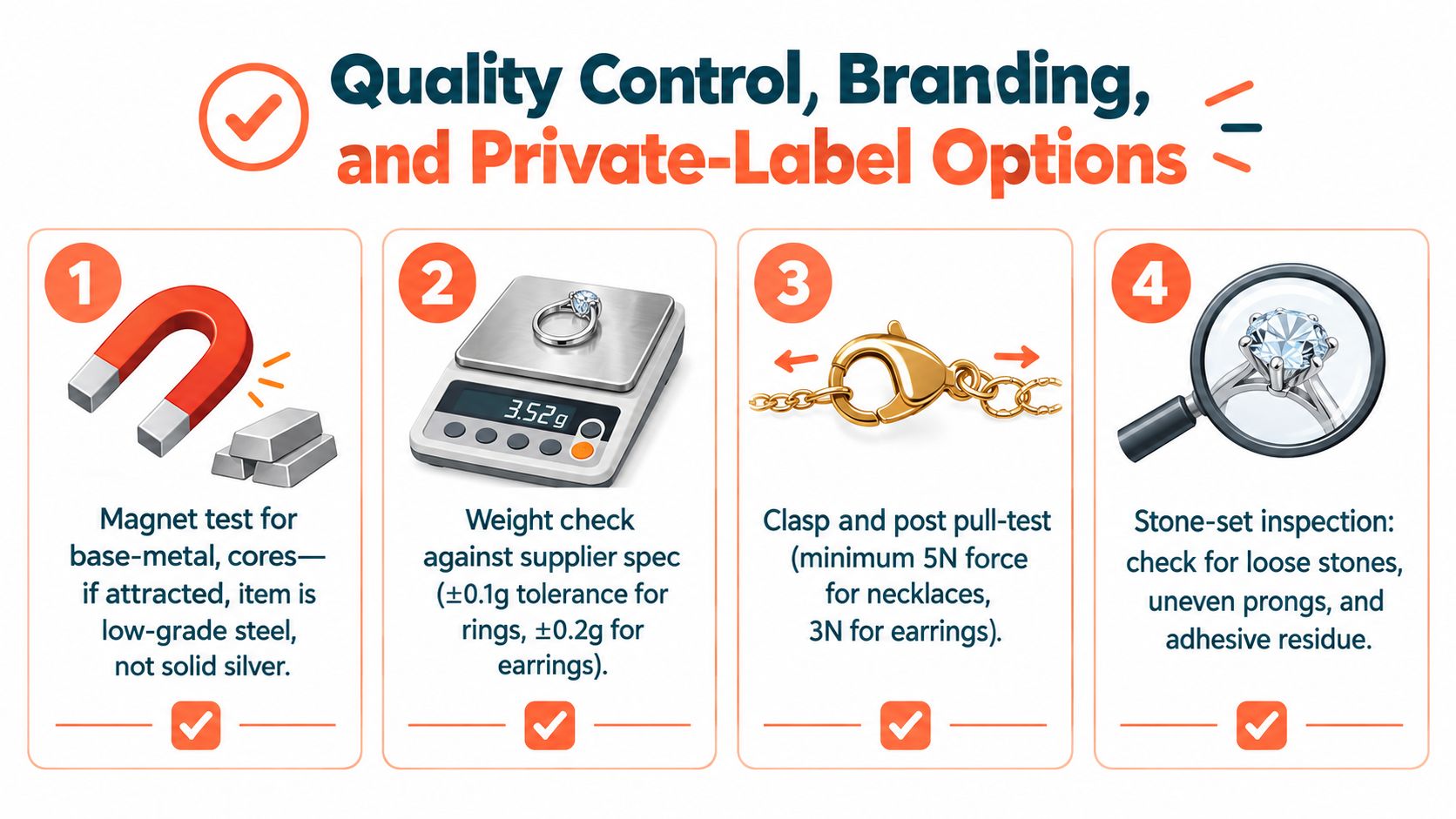
- Magnet check: Look for unexpected attraction that conflicts with a solid-silver claim. Treat the result as a screening signal, not a laboratory test.
- Weight comparison: Compare the received item with the supplier specification and investigate material changes or hollow construction when the difference is meaningful.
- Clasp and post test: Operate clasps repeatedly and apply controlled tension to chains, earring posts, and connectors.
- Stone inspection: Check for loose stones, uneven prongs, visible adhesive, chips, and inconsistent settings.
- Finish review: Examine plating, edges, solder points, polish, and color consistency under bright light.
- Photo evidence: Photograph the item, identifier, packaging, and final parcel before the SKU goes live and before customer orders leave.
Don't rely on one photograph for every marketplace. The hero image should communicate shape and finish, while detail, scale, clasp, back, and worn images answer the objections that stop jewelry purchases. The cover image ratio should be 383:204. Otherwise, the content or text might be cropped when displayed on your website.
Add branding in controlled stages
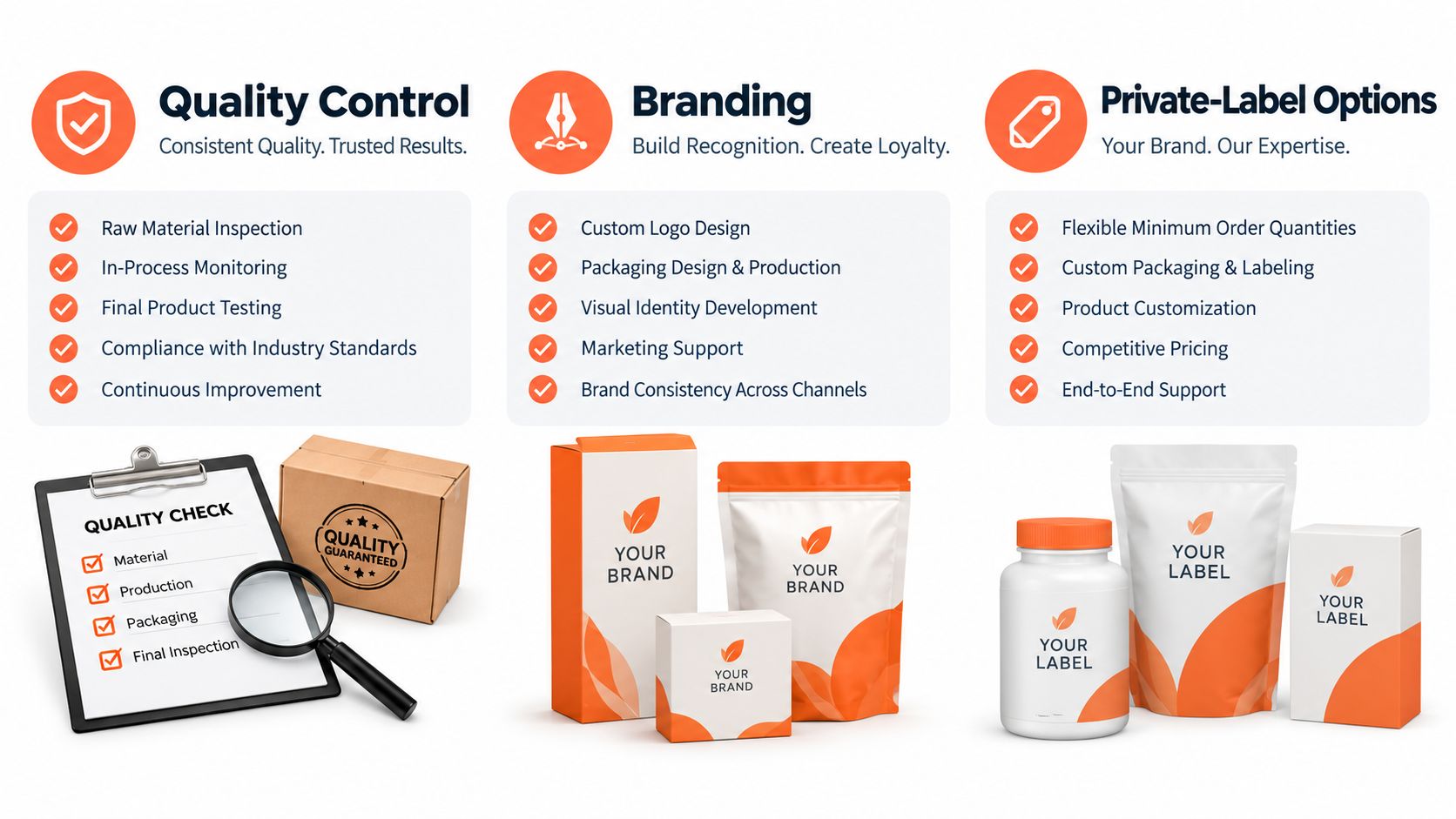
Start with cost-neutral branding: a supplier stock pouch, branded sticker, and simple insert card. That gives the order a coherent identity without forcing a large packaging commitment.
The next tier adds custom poly mailers, foil-stamped cards, branded tissue, or a better polishing cloth. These upgrades can improve unboxing, but test whether they increase repeat purchases or reduce damage before adding several components to every order.
Private label belongs after the product passes quality and margin checks. Custom-cast pieces commonly require 50 to 200 units, while stamped or plated runs may start at 20 units. Larger 500-plus unit minimums can trap early-stage sellers in stock they haven't validated. Negotiate around the specific component, finish, packaging, and reorder terms rather than accepting a supplier's full custom package.
Keep a dispute file for each defect. Include the product code, inspection images, customer photos, shipping record, and supplier response. That file helps you decide whether to request replacement, remove the SKU, change the description, or move the product to a different fulfillment route.
Launch Checklist and Scaling Playbook
A jewelry drop ship launch should move through validation, acquisition, and retention in sequence. Trying to scale paid traffic before you know whether the product arrives intact is how sellers buy customer-service work at retail prices.
Days 1 through 30
Select a focused collection and write 12 product titles around specific, long-tail search intent. Install tracking pixels, place sample orders to your own address, test the delivery experience, and verify the product against the listing. Create styling content that shows scale, layering, gifting, and everyday wear rather than posting only supplier studio shots.
Seed social content with user-generated styling photos and short demonstrations. Don't claim a performance target before you have enough store-specific data to judge click quality, conversion, refunds, and contribution margin.
Days 31 through 60
Test TikTok Shop and Pinterest alongside your owned storefront. TikTok Shop can suit discovery-led, visual products, while Pinterest can support styling, gifting, and search-like browsing. Shopify gives you stronger brand control, Etsy fits handcrafted or design-led positioning, and Amazon serves shoppers with clear search intent. Each channel has different fees, listing rules, customer expectations, and counterfeit enforcement exposure.
Use a channel-level profit sheet rather than comparing revenue alone. Record advertising cost, platform deductions, refunds, replacements, shipping subsidies, and customer-service time. A campaign that produces sales but leaves no contribution after fees isn't a winning campaign.
Days 61 through 90
Build email and SMS flows for abandoned carts, post-purchase education, review requests, and complementary products. Offer a second item that makes sense with the first, such as matching earrings for a necklace or a stacking ring beside an everyday band. Watch the reorder window, identify the SKUs that bring customers back, and negotiate volume terms only after quality remains stable across repeat orders.
Move to blind dropshipping or private-label packaging when order volume, defect handling, and supplier communication justify the added coordination. Hire a virtual assistant for QC photos and catalog checks when those tasks delay listings or consume your customer-service hours.
Before signing manufacturing, exclusivity, or marketplace agreements, understand when to hire a business lawyer for supplier contracts, intellectual-property questions, and channel compliance.
For a Shopify-specific operating path, review this guide to Shopify jewelry dropshipping. Then choose one channel, one customer promise, and a small collection you can inspect properly.
JewelryBuyDirect offers no-MOQ access to more than 120,000 jewelry and fashion accessory SKUs, including 925 sterling silver, stainless steel, titanium, plated, gemstone, pearl, and component lines for dropshippers and small brands. Visit JewelryBuyDirect to compare supplier-ready assortments, review material options, and build a jewelry drop ship catalog around quality, traceability, and workable margins.