
Jewelry Making Supplies List: Source Quality Inventory
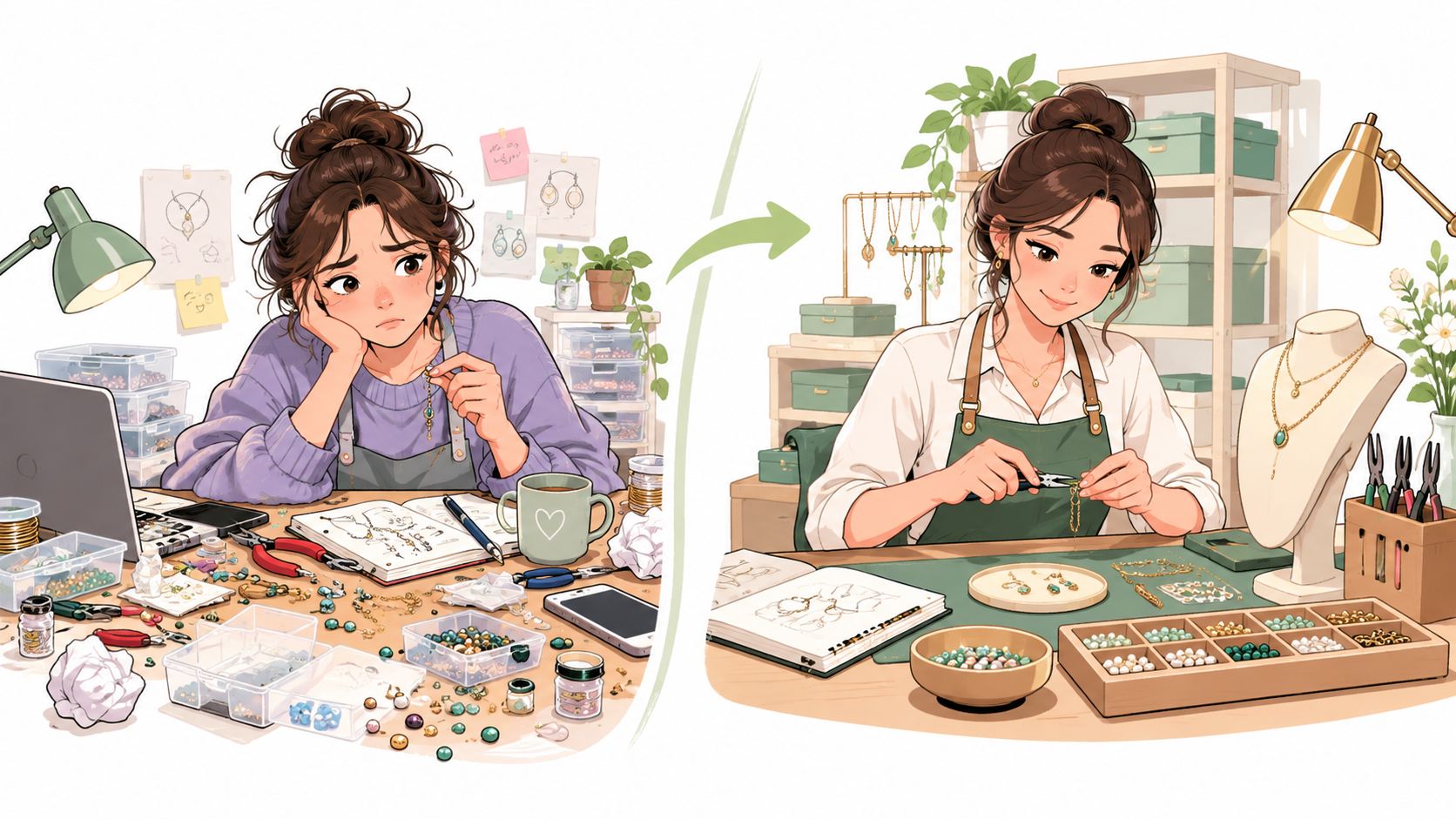
You've probably learned this the expensive way. A clasp arrives with a finish that looks acceptable in the package, then tarnishes after assembly. A supplier calls a component “sterling silver,” but provides no fineness documentation. Customers ask whether an earring is safe for sensitive skin, and the only answer you have is a vague product label.
A professional jewelry making supplies list must solve those problems before they reach the customer. It should help you select materials, verify claims, calculate the true cost of inventory, meet safety expectations, and create products that photograph and sell well online. For a wholesale buyer, the list isn't a hobby checklist. It's an operating system for purchasing, production, merchandising, and brand protection.
Rethinking the Jewelry Making Supplies List
A wholesale order can look profitable until a clasp fails, a finish discolors, or a supplier cannot support a material claim. Every bead, chain, solder, and finding becomes part of the product promise. Returns, replacements, customer-service time, and lost trust can erase the margin on an entire batch.
Build the jewelry making supplies list around business decisions rather than shopping categories. For every item, record its material, alloy or fineness, dimensions, finish, intended use, supplier, batch information, and role in the finished design. Add the expected yield, landed cost, and visual requirements when the component will appear in product photography. This record turns an anonymous jump ring into a controlled inventory item that supports purchasing, production, pricing, and merchandising.
Practical rule: If you cannot explain what a component is made from, where it belongs, how you will verify it, and what it costs after delivery, keep it out of your core inventory.
Treat purity marks as working specifications that drive pricing, soldering behavior, and listing wording. Sterling silver is commonly identified as 925, meaning 92.5% silver. Gold fineness marks such as 585 and 750 indicate 58.5% and 75% gold respectively, as described in the FTC's hallmark research material. These differences affect hardness, color, soldering behavior, price, tarnish response, and the claims you can make in a product listing.
Build the list around risk
Prioritize items that can create complaints, production failures, or compliance problems:
- Skin-contact parts: Ear wires, body-jewelry components, chains, and clasps need clear material and finish documentation because they remain against the wearer's skin.
- Structural parts: Thin wire, crimp tubes, jump rings, and chain links must perform mechanically, not merely look consistent in the package.
- High-value materials: Sterling silver, gold-filled parts, gemstones, pearls, and plated components require specifications before retail pricing is set.
- Production consumables: Solder, flux, polishing compounds, adhesives, and plating supplies affect the finished piece, worker handling, and repeatability.
This risk-based structure exposes false savings. A lower-priced finding may require extra inspection, produce more defects, or need replacement after discoloration. A component with reliable specifications can cost less across the complete order, production time, delivery, and after-sale workload. Keep supplier records and batch details with the inventory so a problem can be traced, explained, and addressed quickly.
Four Essential Categories of Jewelry Components
A useful supplies list follows the function of each item in production. This structure prevents a common buying mistake, collecting attractive materials without knowing which part of the assembly they support.
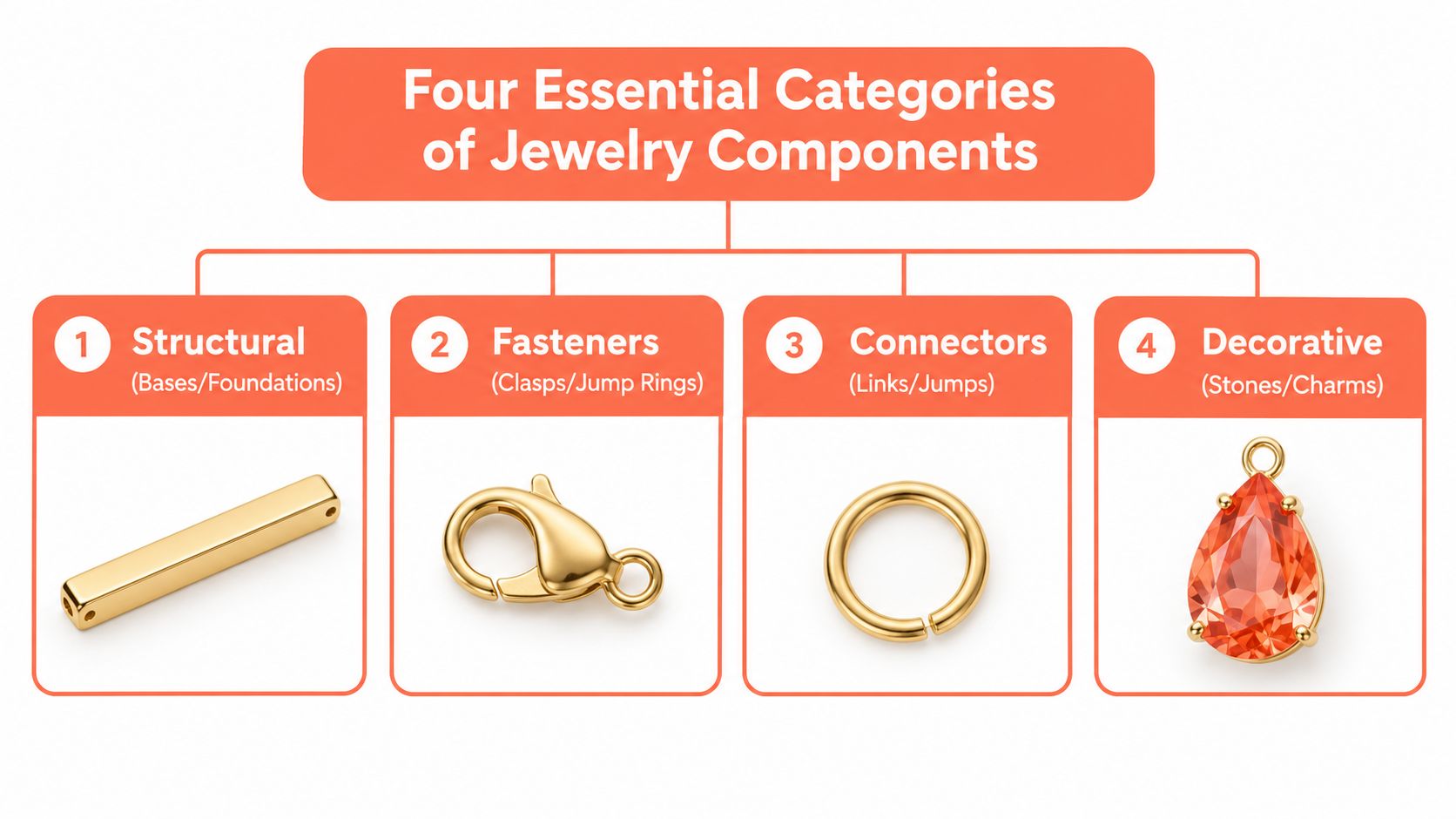
Structural materials
These create the physical foundation of a design:
- Wire and sheet: Use them for wrapped designs, formed components, metalwork, frames, and custom shapes.
- Chain and cord: Select them according to drape, strength, attachment method, and the weight of the finished design.
- Base components: Bead strands, leather or textile cord, and prepared lengths support repeatable production.
Structural materials determine how much a piece can flex, bend, carry weight, and withstand handling. Keep dimensions and material content visible in your inventory records. A wire gauge or sheet thickness that works for earrings may be unsuitable for a pendant or bracelet.
Joining supplies
Joining supplies hold the structure together. Solder, flux, crimps, jump rings, cord ends, and connectors all belong here. A design can use beautiful beads and high-grade wire, yet still fail because a crimp is soft, a jump ring doesn't close cleanly, or the solder doesn't flow as expected.
For wholesale production, classify findings by the job they perform. A lobster clasp, ear wire, toggle, jump ring, and crimp tube aren't interchangeable just because they're all small metal parts. The jewelry findings and components guide is useful when mapping these parts to specific construction methods.
Forming and finishing tools
Tools include pliers, cutters, hammers, files, saws, mandrels, torches, polishing equipment, and testing tools. Buy tools according to the techniques you intend to repeat, not according to an oversized starter kit.
A wholesale operation needs consistency. Smooth-jaw pliers protect finished wire, sharp cutters reduce crushed ends, and correctly sized mandrels improve repeatability. Finishing tools also influence perceived quality. Customers notice rough edges, uneven bends, tool marks, and poorly polished surfaces even when they can't describe the technical problem.
Decorative inputs
Gemstones, synthetic stones, pearls, beads, charms, pendants, plating, coatings, and surface treatments provide visual identity. Historical records identify the early twentieth century as a major turning point because synthetic stones and post-war chain-making machines expanded the range of affordable components available to makers, as documented in this history of jewelry making.
That history explains why modern suppliers offer both workshop materials and standardized findings. Your list should include both, but separate them in purchasing records. Decorative inputs drive style and merchandising. Structural and joining supplies determine whether the product survives real use.
Building a Compliance and Skin-Safety Layer
The most dangerous assumption in jewelry sourcing is that safety belongs to finished-product inspection. It starts much earlier, when you choose the alloy, coating, solder, charm, chain, clasp, ear wire, or piercing component.
For jewelry intended for prolonged skin contact in the EU, nickel release must not exceed 0.5 micrograms per square centimeter per week. Parts used in piercings face a stricter limit of 0.2 micrograms per square centimeter per week, and the relevant restrictions also cover lead below 0.05% by weight and cadmium below 0.01%, according to the National Association of Jewellers product-safety guidance.
Children's jewelry adds another layer. The CPSC identifies ASTM F2999 for adult jewelry and ASTM F2923 for children's jewelry as industry consensus standards representing best practices for safety testing. ASTM F2923 includes screening for total cadmium and limits nickel migration from components intended for direct and prolonged skin contact to no more than 0.5 micrograms per square centimeter per week. It also identifies a 75-parts-per-million cadmium threshold for certain covered components that may avoid additional migratable-cadmium testing under the standard's conditions, as explained by the CPSC jewelry FAQ.
Replace labels with evidence
“Stainless steel” and “hypoallergenic” are not complete sourcing records. They may describe a broad category without telling you the exact alloy, coating durability, solder content, or test method.
Use a verification checklist for every supplier:
- Material declaration: Record the base metal, alloy, fineness, coating, and any known plating thickness.
- Testing evidence: Request nickel-release results, lead and cadmium results, or laboratory documentation tied to a recognized method such as EN 1811.
- Use-case mapping: Mark whether the component is intended for earrings, body jewelry, children's products, prolonged skin contact, or general fashion use.
- Traceability: Keep supplier names, lot numbers, certificates, and purchase records so you can identify affected inventory if a material changes.
- Assembly review: Check whether solder, adhesives, coatings, or added charms alter the finished product's safety profile.
Use the explanation of hypoallergenic jewelry to educate customers, but don't let the phrase replace supplier documentation.
A component's appearance can remain unchanged while its compliance performance changes. Treat every alloy, coating, and supplier substitution as a new purchasing decision.
This layer protects more than regulatory standing. It gives marketplace sellers, boutiques, and pop-up vendors a defensible answer when customers ask what a product contains. It also helps you avoid selling plated parts as solid precious metal or making skin-safety claims that the available evidence can't support.
Evaluating Total Landed Cost in Jewelry Sourcing
Unit price is the easiest number to compare and one of the least useful. A component quoted cheaply can become expensive after shipping, duties, inspection, repacking, defects, delays, and customer returns enter the calculation.
Build a supplier scorecard with these fields:
| Cost or risk field | What to record |
|---|---|
| Item price | Price by component, pack, or production unit |
| Material specification | Alloy, fineness, coating, treatment, and dimensions |
| Logistics | Packaging, shipping, duties, taxes, and expected delivery reliability |
| Quality control | Inspection cost, defect allowance, and replacement process |
| Reordering | Availability, lead time, consistency, and supplier communication |
| Commercial terms | Payment terms, return conditions, and damage protection |
This is the difference between cheap sourcing and low-cost inventory. Cheap sourcing asks, “What does one clasp cost?” Low-cost sourcing asks, “What will this clasp cost after it arrives, passes inspection, enters production, and reaches the customer?”
The OECD describes mineral supply chains as vulnerable to illegal trade, human-rights abuses, conflict financing, and other financial crimes. Its responsible-minerals framework recommends management systems, supply-chain controls, traceability, supplier engagement, risk assessment, mitigation reporting, and independent third-party audits at relevant points, as outlined in the OECD responsible-minerals framework.
Compare measurable specifications
Ask suppliers for sterling-silver content, plating descriptions, gemstone treatments, dimensions, weights, country of origin, and production details. Broad language such as “premium,” “luxury,” or “high quality” doesn't help you compare inventory. The FTC Jewelry Guides require business descriptions to accurately represent a product's type, grade, quality, metallic content, size, weight, and durability.
For broader supplier research, the Headline Marketing Agency guide offers useful context on evaluating wholesale sources for marketplace businesses. Use that kind of resource to expand your supplier pool, then apply your own scorecard before placing an order.
A reliable supplier should answer specific questions without hiding behind catalog language. If the supplier can't provide the information needed for an accurate product description, the low quote isn't a bargain. It's an unresolved liability.
Selecting Materials for High-Demand Techniques
Build your supply list around techniques that can support repeat orders. A hobbyist kit collects possibilities. A professional wholesale inventory assigns each component a production role, records its specifications, and limits stock that cannot serve more than one design.
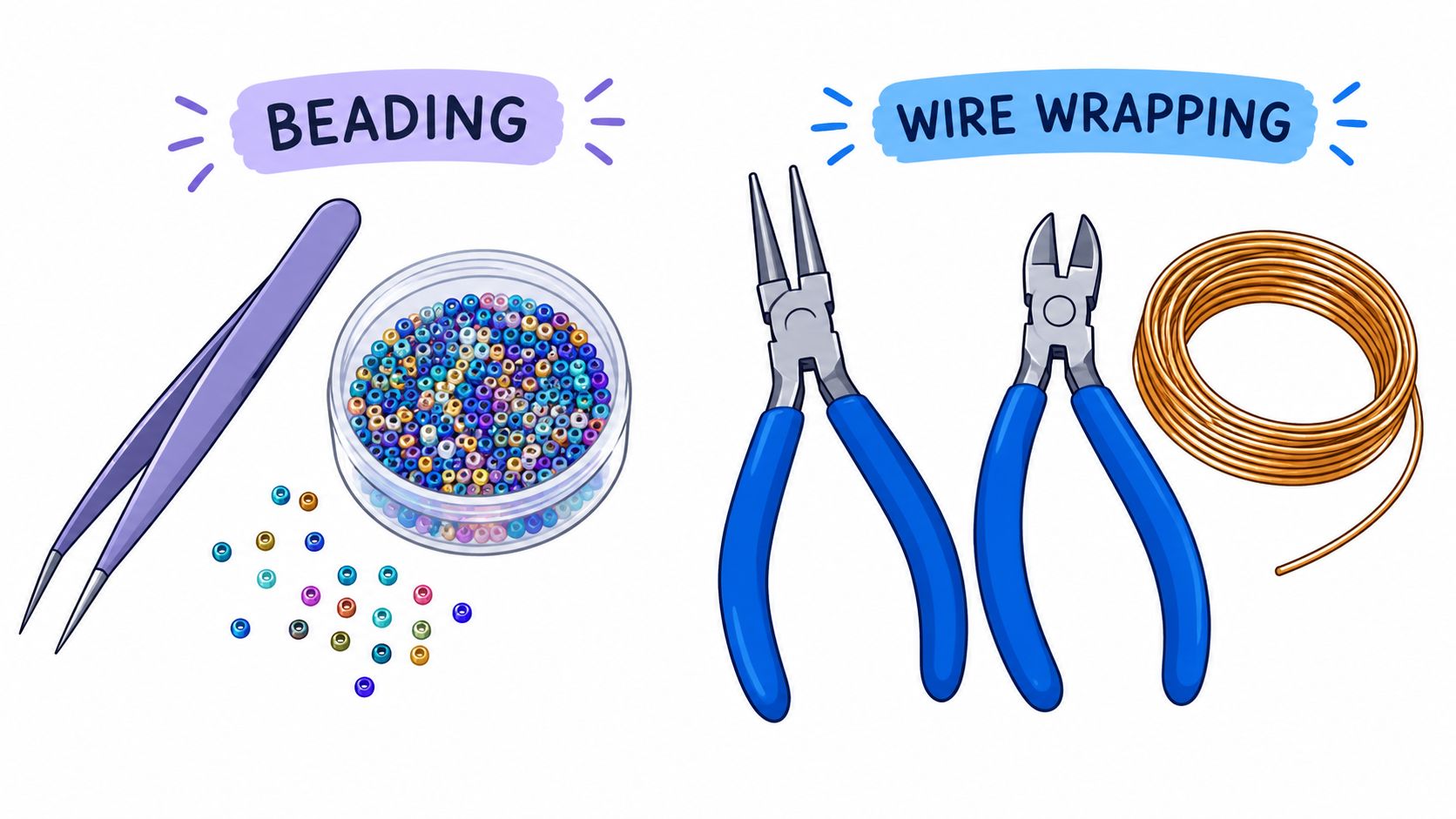
Beading and stringing
Beading requires compatible bead holes, cord or thread, needles, crimps, cutters, bead stoppers, and finishing components. Measure the hole diameter first. Then choose cord that passes through cleanly without excessive friction. For clasp-style designs, match crimps and cord ends to the cord size and the finished piece's weight.
Your inventory file should separate beads by material, finish, color, supplier, and product-use notes. Natural gemstones, synthetic stones, glass beads, pearls, acrylic, and plated beads create different descriptions, care instructions, customer expectations, and photography needs. Record dimensions and surface finish so product images and listings represent the actual component.
Wire wrapping
Wire wrapping depends on wire hardness, diameter, mandrels, round-nose pliers, chain-nose pliers, and cutters. Annealed copper suits practice and some craft production. Silver wire fits designs that require a precious-metal specification. Choose the wire for the intended bend, structural load, finish, and selling price after landed cost, not for the lowest unit quote.
Record the 925 fineness in your purity file. That composition governs hardness, solder flow, and tarnish behavior in wrapped designs. Keep the same specification in purchasing records, product data, and any customer-facing material claim.
This short demonstration can help you review the relationship between tools, wire handling, and repeatable technique:
Metalwork and mixed techniques
Metalwork may require sheet metal, saws, files, hammers, forming tools, solder, flux, torches, testing equipment, and polishing materials. Match each tool and consumable to the metals, thicknesses, joints, and production volume you handle. A cheap torch or solder can become the expensive option if it creates rework, inconsistent joints, or wasted material.
Gold-filled materials require precise records. The FTC describes gold-filled, gold overlay, and rolled-gold-plate products as having at least 10-karat gold mechanically applied to a base metal. If the gold layer is below 1/20 of the item's total metal weight, the marking should disclose the applicable karat fraction, as detailed in the FTC guidance on buying platinum, gold, and silver jewelry.
Before adding a technique to your range, document its materials, tools, consumables, inspection points, finishing steps, landed cost, and image requirements. If one component supports several designs, it earns a larger test order. Otherwise, buy controlled quantities until sales justify deeper stock.
Merging Sustainability with E-commerce Readiness
Sustainability claims need evidence, and online presentation needs discipline. Treat both as part of merchandising rather than as separate marketing tasks.
A supplier describing metal as recycled should provide usable information about recycled content, certification or audit type, processing location, chain-of-custody evidence, and the date of the documentation. Also record whether the claim applies to the entire product or only one element, such as the chain, clasp, packaging, or decorative metal.
The jewelry trend analysis from KunstPlaza reports growing interest in recycled metals, ethical sourcing, and traceable origins. It also cites a survey in which only 4% of respondents considered sustainability important for jewelry, showing why vague “eco-friendly” language is a poor substitute for clear product information.
Turn sustainability into product data
Use a claim-evidence column in your inventory file:
- Recycled content: Record the percentage only when the supplier substantiates it.
- Responsible sourcing: Note the certification, audit, chain-of-custody record, or supplier policy.
- Durability: Track plating description, repairability, expected use, and replacement options.
- Packaging: Record packaging materials and whether the claim applies to the product or the shipment.
- Origin: Capture the country of processing and the available documentation date.
This lets you answer a customer's question without improvising. It also prevents a common mistake, treating every recycled or alternative material as automatically superior. Environmental impact can vary by material and manufacturing route, so compare sustainability evidence alongside price, durability, repairability, and design flexibility.
Prepare visuals at the purchasing stage
A product that looks inconsistent online loses value before a buyer reads the specifications. Create a repeatable photography and design system for every collection. Shopify allows product and collection images up to 5,000 by 5,000 pixels or 25 megapixels, and identifies 2,048 by 2,048 pixels as a size that generally displays well for square product images in its product media guidance.
For the required cover format, use a 383:204 ratio, approximately 1.877:1. Keep jewelry, text, and logos inside a central safe area because inconsistent framing or edge placement can result in cropping when the image renders across website layouts. Shopify also advises using a consistent aspect ratio across featured images.
For social selling and live commerce, the HiveHQ social-commerce guide provides useful context on presenting products across commerce channels. Your supply records should support that presentation with consistent names, dimensions, materials, finishes, and image references. A traceable component and a clean image work together. One proves what the product is, and the other helps the customer understand it quickly.
Executing Your Professional Supply Strategy
A professional supplies list should change as your assortment, suppliers, and customer questions change. Don't treat it as a document you create once and abandon. Review it after every meaningful quality issue, supplier substitution, compliance update, or product-line expansion.
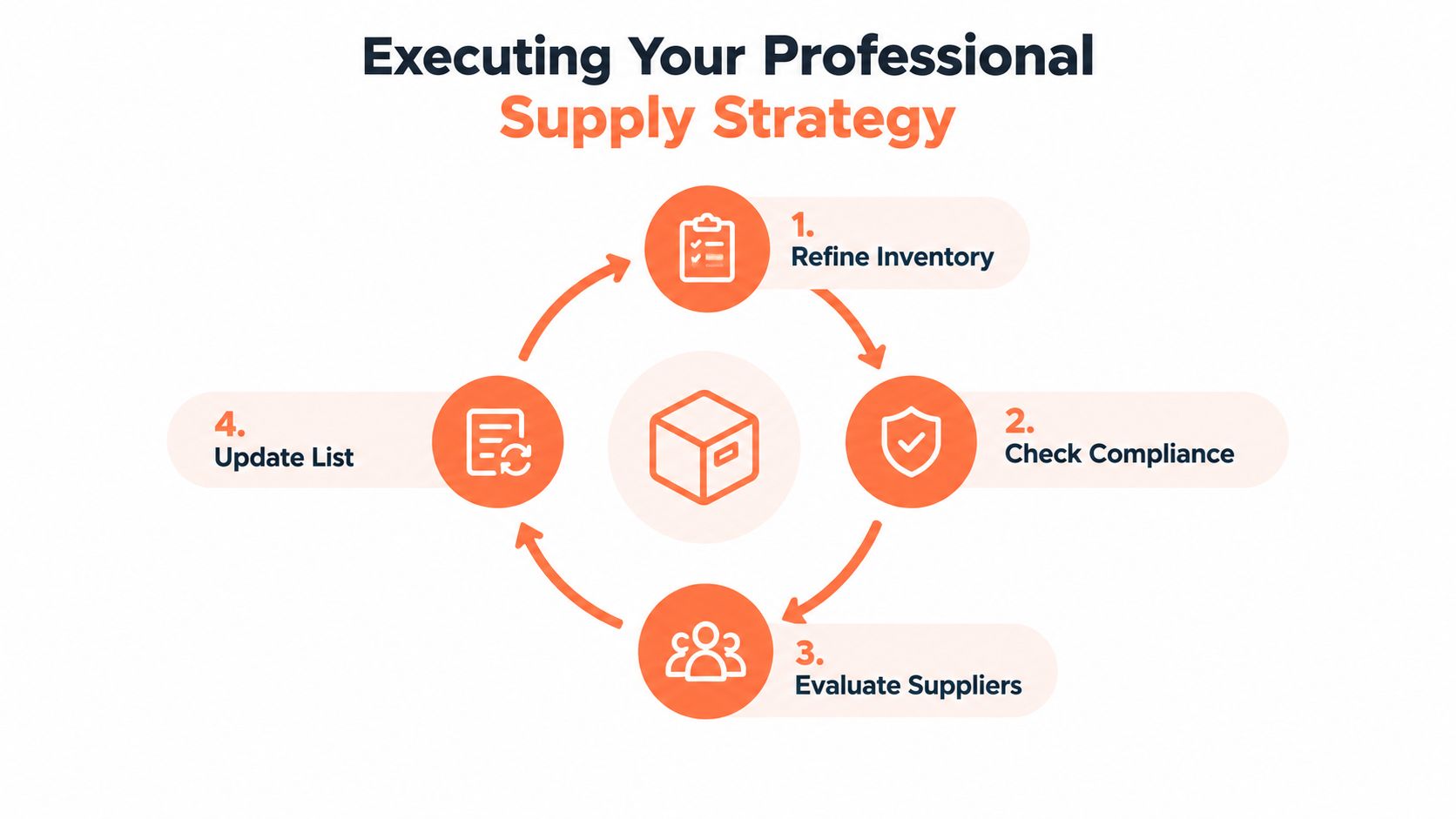
Refine the inventory
Remove components that don't support a current technique or product line. Consolidate duplicate findings where possible, but don't substitute materials without checking the effect on fit, appearance, safety, and product descriptions.
Keep core records for:
- Structural materials: Wire, sheet, chain, cord, and bases.
- Joining supplies: Solder, flux, crimps, jump rings, clasps, and connectors.
- Tools: Pliers, cutters, saws, files, mandrels, torches, and finishing equipment.
- Decorative inputs: Beads, gemstones, pearls, charms, plating, and coatings.
- Evidence: Material declarations, test reports, origin records, lot numbers, and supplier correspondence.
Check compliance before scaling
Don't wait until a marketplace complaint or customer reaction forces a review. Screen new components before they enter a repeatable product. Check whether the supplier has changed the alloy, coating, solder, production location, or packaging. A visual match doesn't prove material continuity.
Evaluate suppliers on performance
Score suppliers by specification accuracy, defect handling, communication, logistics, reorder reliability, documentation, and total landed cost. The OECD's risk-based due-diligence approach supports this broader view of procurement. A supplier that offers a low quote but creates uncertain origin records or inconsistent quality may expose your business to costs that never appear on the invoice.
Use forecasting tools to connect purchasing with actual sell-through. A resource on how to cut inventory costs with AI forecasts can help you think beyond manual reorder habits, particularly when seasonal products and fast-moving accessories compete for cash.
Update the list after every buying cycle
Record what sold, what stalled, which components caused rework, and which supplier answers arrived too late. Update product descriptions when specifications change. Review image templates so every new assortment follows the 383:204 cover ratio and keeps important elements inside the safe area.
For businesses that need bulk components, the jewelry-making supplies bulk guide can help organize purchasing around chains, clasps, beads, and specialized findings. The strategic point is simple: your list should make the next order more accurate than the last one.
A carefully managed jewelry making supplies list protects margin in three ways. It reduces avoidable defects, gives you evidence for accurate product claims, and helps your team buy only the materials that support profitable designs. Pair that discipline with a B2B source that offers wholesale jewelry, fashion accessories, and jewelry-making components such as clasps, chains, beads, and findings, and you can keep your assortment flexible without surrendering quality control.
JewelryBuyDirect offers wholesale jewelry, fashion accessories, and jewelry-making components for boutiques, online sellers, and independent makers, including chains, clasps, beads, findings, and finished styles. Visit JewelryBuyDirect to compare materials and build a documented, affordable inventory around the techniques and product lines you sell.