
Moon and Stars Charm Bracelet: Sourcing & Selling Guide
The popular advice is to treat a moon and stars charm bracelet as a seasonal novelty, buy a small batch, and wait for celestial interest to return. That approach leaves money on the table. The stronger business case is to source celestial pieces as durable add-on inventory, products that sit beside everyday bracelets, encourage personalization, and give customers a reason to return for another charm.
The category still needs discipline. A beautiful crescent can become dead stock if the clasp fails, the plating wears quickly, the sizing is unclear, or the imagery makes the product look more expensive than it is. Retailers who protect cash flow start with construction, compliance, assortment architecture, and merchandising, then use the celestial story to support the sale.
Why Moon and Stars Charm Bracelets Belong in Wholesale Strategy
Celestial jewelry has more staying power than a short-lived aesthetic label suggests. The crescent and star motif has roots in ancient Mesopotamia, where the crescent was associated with the moon god Sin, known as Nanna in Sumerian tradition, while the star connected with Ishtar and Venus. Jewelry-history sources also describe crescent-and-star jewelry worn across North Africa and Southwest Asia for at least 2,000 years (Zevira's history of crescent moon and star jewelry).
That history matters commercially because customers don't encounter the motif as a completely unfamiliar design. The symbolism can support gifting, self-expression, romance, spirituality, or a simple preference for delicate night-sky imagery. In Europe, moon-and-stars jewelry became especially popular during the 19th century, when Victorian pieces used the crescent as a sentimental symbol connected with romance and female agency (The Zay's overview of skies in jewelry). The motif also appeared in Roman jewelry and remained popular from the 17th century onward, giving retailers a deep visual vocabulary to work with.

Trend item or personalization anchor
The question for 2026 isn't whether celestial jewelry exists. It's whether it has a distinct role beside the broader charm-bracelet comeback. Current trend coverage points in two directions. Snake-chain and chunky curb-link bracelets are prominent styling choices, while celestial motifs remain a persistent sub-trend that's becoming more refined and layered (Exponation's charm-bracelet trend coverage).
That combination favors an add-on strategy. A moon and stars charm bracelet can function as a complete gift, but it may work harder as a base for additional symbols, initials, birthstones, or travel charms. Keep the core design wearable enough for daily use, then make the celestial elements distinctive enough to justify a second purchase.
Sourcing rule: Treat the bracelet as the platform and the moon-and-star charms as the opening conversation, not the entire lifetime value of the product.
For retailers building a cohesive story, a related symbolic sterling silver ring guide can help connect star motifs across categories without forcing every customer into a matching set. The category earns year-round shelf space when the chain is comfortable, the finish fits everyday wardrobes, and the charm architecture supports personalization. Reserve highly ornate, heavily themed versions for limited tests or seasonal gifting rather than making them the foundation of the buy.
How to Source Quality Moon and Stars Charm Bracelets Wholesale
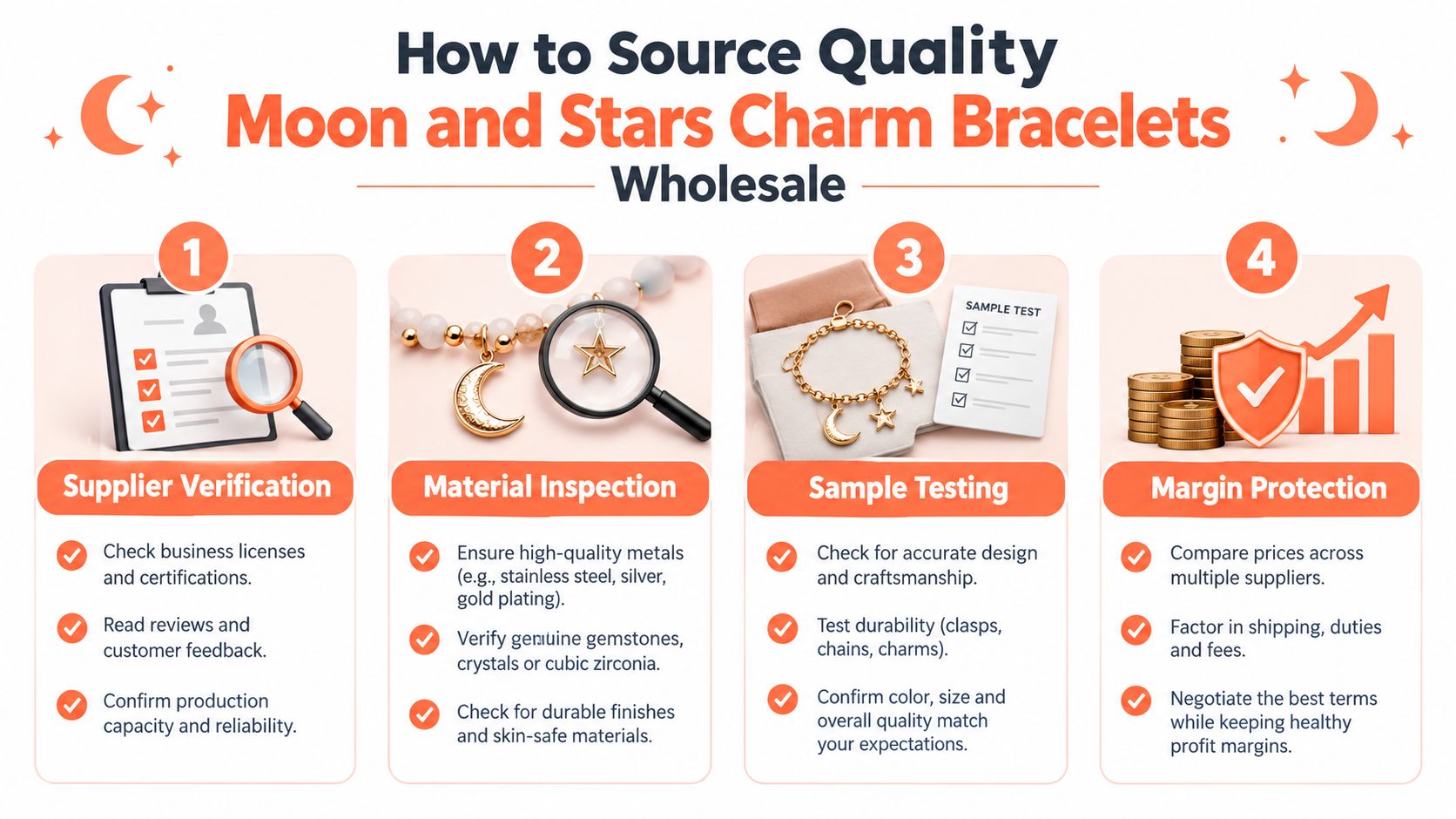
A supplier's catalog photo tells you what the piece is meant to look like. It doesn't tell you whether the clasp, jump rings, solder points, plating barrier, or charm attachment will survive customer use. The sourcing workflow should move from the material claim to the finished assembly.
Start with the customer promise
Sterling silver, stainless steel, and plated alloy can all serve different retail positions. Sterling silver supports a stronger material story, stainless steel often suits customers seeking a durable everyday option, and plated pieces can offer accessible styling when the finish and care expectations are communicated plainly. The mistake is treating the metal name as a substitute for inspecting the construction.
Ask the supplier for the exact alloy description, plating information, dimensions, clasp type, charm attachment method, and care guidance. Then order samples from the same production route used for the proposed bulk order. A polished sample from a different batch won't protect you from inconsistent findings.
The most important technical control point for skin-contact jewelry is nickel release, not just the nominal base metal. Under EU REACH Annex XVII, items in prolonged skin contact must release no more than 0.5 µg/cm²/week, while items inserted into pierced ears are limited to 0.2 µg/cm²/week (Deechy Silver Jewelry's REACH compliance guide).
Inspect the finished bracelet
A .925 stamp doesn't guarantee skin safety. Nickel can enter through clasps, jump rings, solder, or a plating barrier layer, and commercially labeled sterling silver earrings have been reported with detectable nickel above EU thresholds. For a retailer, the practical response is straightforward:
- Verify the alloy certificate: Match the document to the supplied model and production batch.
- Map every exposed component: Include the clasp, jump rings, solder, extender, charm loops, and plating.
- Test the finished assembly: Raw material testing alone can miss problems introduced during assembly.
- Request explicit documentation: “No intentionally added nickel” claims or verified nickel-release results are more useful than a vague “hypoallergenic” label.
For broader category context, review wholesale charm bracelets while comparing component layouts and supplier descriptions. The goal isn't to find the cheapest bracelet. It's to find the lowest landed cost that still supports a defensible customer promise, manageable replacement rates, and consistent replenishment.
Pricing and Margin Strategies for Charm Bracelet Retailers
Wholesale cost is only the first line in the pricing decision. A bracelet's real margin must absorb payment processing, marketplace commissions, packaging, shipping contributions, returns, damaged units, customer service time, and any discount needed to reach a buying threshold. If you price from unit cost alone, a product can appear profitable while steadily consuming cash.
Wholesale marketplaces show that fashion-jewelry sourcing is broad and price-sensitive, with bracelets, necklaces, rings, and earrings available across affordable price points (Faire's wholesale jewelry marketplace). That makes comparison shopping easy for retailers, but it also creates a race to the bottom if every supplier is judged by the lowest listed unit price.
Use tiers instead of one universal price
| Tier | Typical Wholesale Range | Suggested Retail Focus |
|---|---|---|
| Entry fashion | Affordable, budget-oriented sourcing | Impulse purchase, pop-up display, and charm add-on |
| Core everyday | Mid-range sourcing with stronger construction and finish | Repeatable boutique pricing, gifting, and daily wear |
| Premium material | Higher-cost sterling silver or carefully finished construction | Material-led storytelling, elevated gifting, and curated collections |
The table is a positioning tool, not a reason to invent a markup formula. Build your price from landed cost, then compare the finished product with competing bracelets in the same channel. A low-cost plated bracelet may suit a high-volume social-commerce offer, while a better-finished sterling silver piece can justify a slower, more deliberate sale if the product page explains the material and care clearly.
Protect the price before discounting
Start with a regular price that leaves room for a controlled promotion, not an inflated price that customers immediately distrust. Test bundles with a second charm, a matching ring, or gift-ready packaging before cutting the bracelet's headline price. Bundling preserves perceived value and makes the add-on strategy visible.
For marketplace sellers, include platform fees and return handling in the initial model. For physical stores, account for display space and staff time. For pop-ups, consider whether the bracelet can be shown beside modular charms so one sale can create a follow-up purchase rather than ending at the counter.
Margin test: If the bracelet only works financially when every unit sells at full price and no customer asks for an exchange, the buy is too fragile.
Premium positioning makes sense when the finish, documentation, packaging, and product story support it. Volume pricing makes more sense when the construction is consistent, the design is easy to replenish, and the customer expects accessible fashion jewelry. In both cases, avoid placing a large reorder until the first batch has generated useful feedback on clasp durability, sizing, returns, and charm demand.
Building the Right Inventory Mix for Your Store Format
A boutique, marketplace shop, and social-commerce seller shouldn't carry the same celestial assortment. The right depth depends on how customers discover the product, how much display space you have, and how quickly you can reprice or bundle slow-moving units.
An independent boutique can carry a polished core bracelet, a lighter everyday version, and a small selection of extra moon, star, initial, or symbolic charms. That mix gives staff room to sell the meaning without tying the store to one dramatic design. A marketplace seller may need fewer base styles but stronger listing coverage, because each variation requires photography, copy, inventory tracking, and customer support.
For modular options, explain the architecture thoroughly before buying. One Italian charm bracelet example holds 18 charm links and recommends removing the piece before showering or swimming, while another standard bracelet example includes 17 blank or engraved charms and supports building from scratch (CheriCheri Lady's moon-and-stars charm product information). Those details affect the number of charms a customer can use, the value of an add-on sale, and the care message you'll need on the product page.
Match the assortment to the format
- Boutique: Lead with a refined core bracelet and display compatible charms nearby. Use the counter conversation to build a personalized stack.
- Marketplace store: Keep the core range tight, but photograph each finish and charm configuration clearly. Avoid variations that look identical in search results.
- Pop-up or social selling: Choose visually distinct pieces that can be explained quickly on camera. Demonstrate how a charm attaches instead of relying on a romantic product name.
- Jewelry maker: Source individual charms and components when assembly control matters more than immediate finished inventory.
A lean assortment protects cash flow better than a broad celestial wall. Use limited releases for elaborate finishes, oversized charms, or unusual color combinations. Keep simple stars and crescents in the core range only when they pair naturally with other symbolic charms and everyday outfits. For component planning, wholesale charms for jewelry offers a useful reference point for comparing standalone charm options with finished bracelet purchases.
Product Photography and Descriptions That Convert
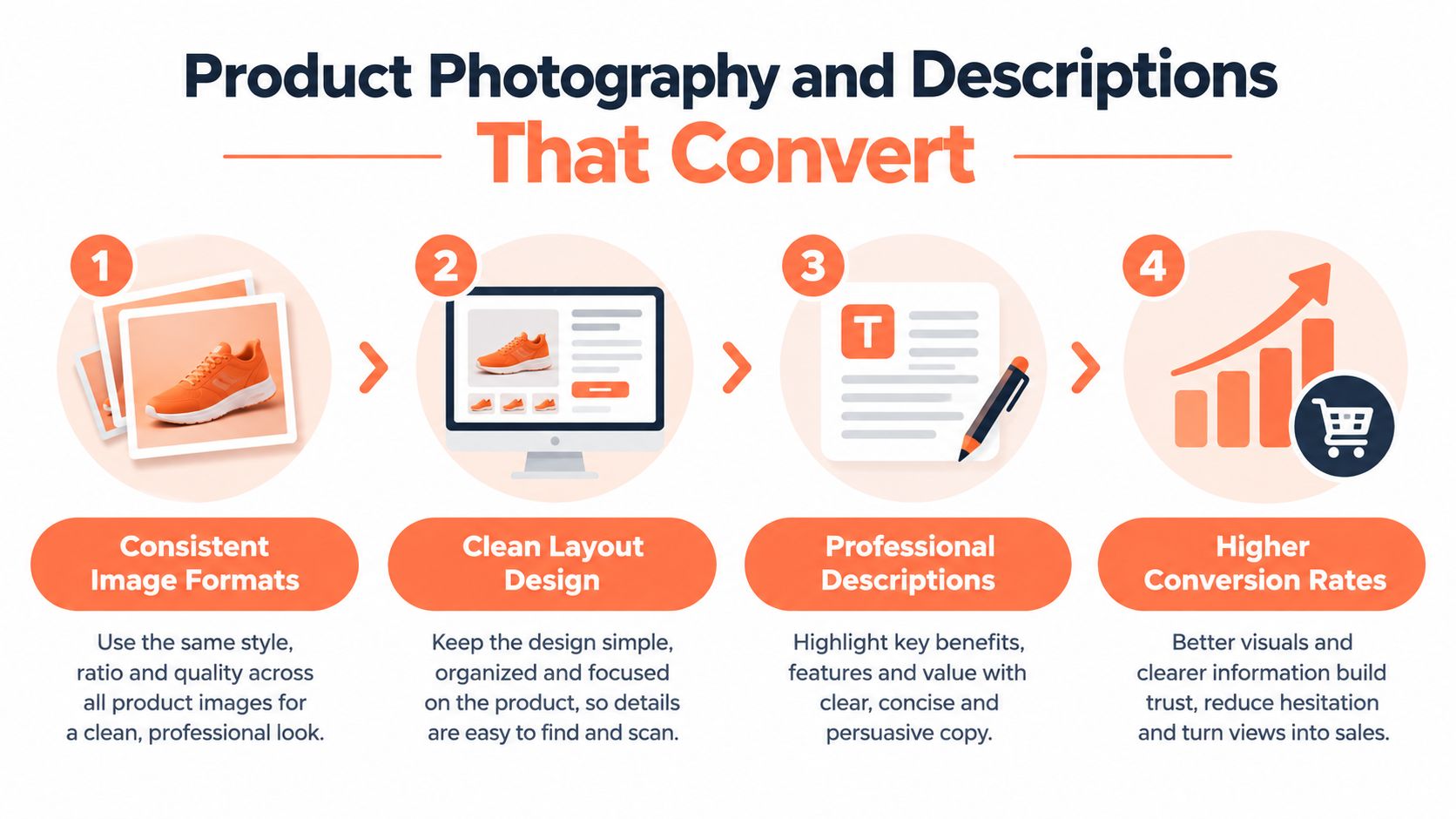
A customer can't feel a clasp or judge a charm's scale through a screen, so photography must remove uncertainty. Keep every product image on the same aspect ratio within a collection. Shopify recommends square product images at 2048 x 2048 px and notes that collection pages display best when featured images share the same height-to-width ratio (Shopify's product-media guidance).
A square 1:1 format is also a practical default for listings and thumbnails, with around 2000 x 2000 px or 2048 x 2048 px commonly used to preserve detail and support zooming (Omi's product-photography resolution guide). For multi-market catalogs, a master canvas of 2200 x 2200 px can support crops for common outputs such as Amazon and Walmart at 1:1, Etsy at 4:3, and portrait marketplace formats (Pixofix's marketplace image guide).
Photograph the product customers will receive
Use a clean hero image, a clasp detail, a side angle showing thickness, a worn image that establishes scale, and a charm-attachment view for modular pieces. Keep lighting and background consistent across the collection. Soft lifestyle styling can communicate sentiment, but it shouldn't replace a direct product image that shows metal color, proportions, and finish.
Your website's cover image ratio is 383:204. Prepare the cover asset in that ratio so the bracelet, model, and surrounding negative space don't get cropped in the website layout. Product-grid images can remain square, but promotional banners need their own composition.
For social crops, a practical export workflow matters as much as the shoot. Instagram export settings for RAW photos can help photographers preserve detail while preparing images for platform display. For additional jewelry-specific shooting guidance, use these jewelry photography tips.
Write for decisions, not fantasy
Describe the material, finish, bracelet length, extender, charm dimensions, closure, weight if available, and whether the piece is intended for everyday wear. Explain what customers should avoid, such as showering or swimming when the supplier provides that guidance. Use emotional language as a supporting layer, not as a replacement for specifications.
A strong description answers the questions that produce returns: Will it fit? Is the bracelet adjustable? Are the charms fixed or removable? What does the customer receive? How should it be stored? Clarity sells the product to the right buyer and discourages the wrong expectation.
Merchandising Tactics and Return Policies That Protect Margins
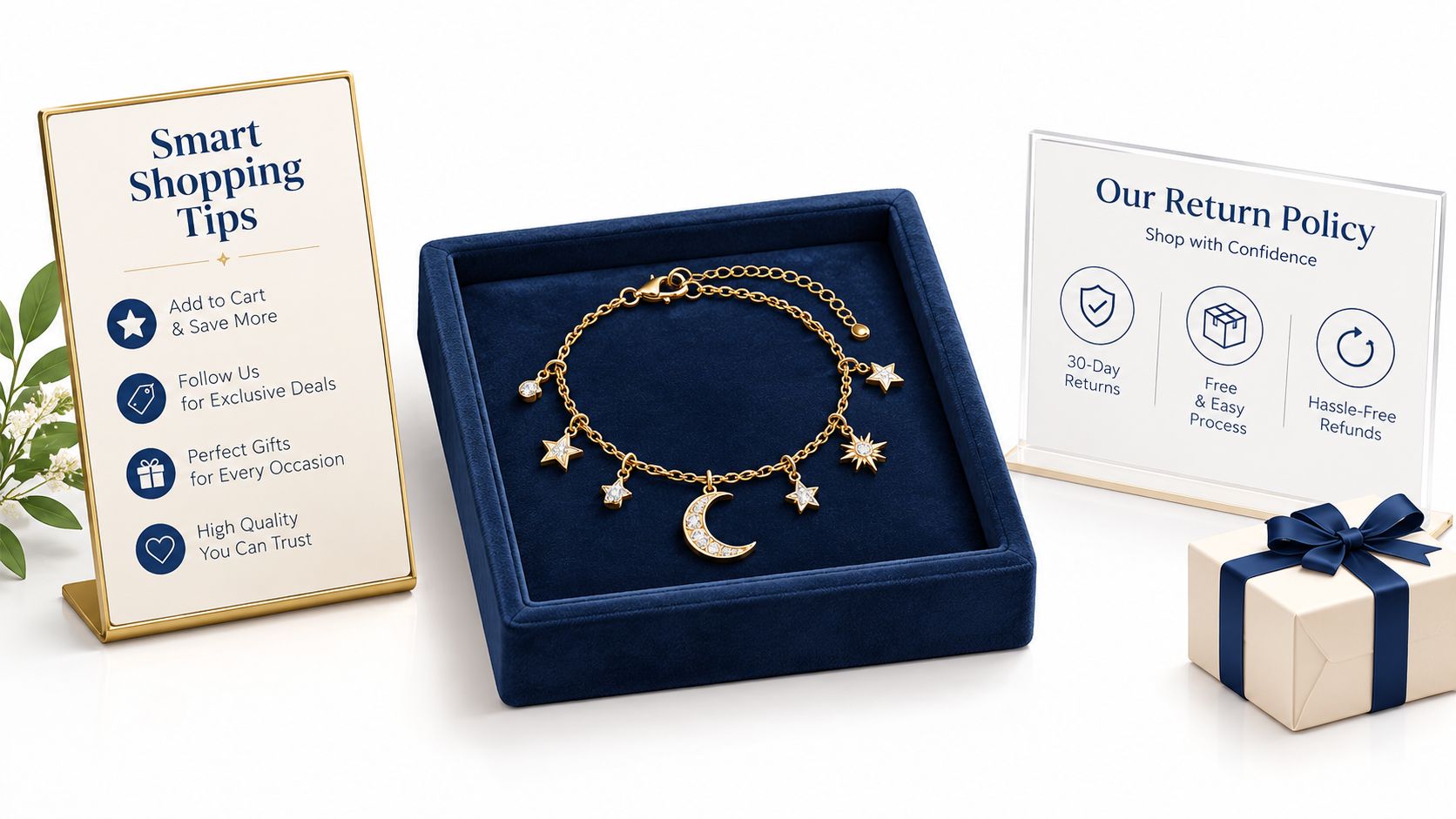
A celestial bracelet should appear where customers already shop for personalization, gifting, and everyday layering. Put the base bracelet beside compatible charms, not isolated on a “trend” table that tells shoppers the product has a short life. Online, use related products to show a star charm, symbolic ring, or complementary chain after the customer views the bracelet.
Sell the stack, then explain the care
In-store, let customers handle the modular mechanism if the design supports removable charms. Online, show the same information through a close-up image and a short demonstration. A moon and stars charm bracelet becomes more commercially useful when customers understand how it can sit beside initials, birthstones, or other personal symbols.
Product cards should state the material, sizing method, closure, and care instruction before the symbolic story. Gift buyers need confidence that the item will arrive as described, while repeat customers need a clear reason to add another charm later.
The following video can support visual merchandising or staff training, especially when your team needs a quick demonstration of presentation and product handling.
A return policy should be easy to understand before checkout. State the eligible condition, the return window, the process for damaged goods, and whether worn or altered charms can be returned. Don't hide care requirements in a long policy page. Put them beside the product details and in the order confirmation.
Policy principle: Make legitimate returns simple, but make the product expectation even clearer before the purchase.
For exchanges, consider directing customers toward a different length or charm configuration when the issue is fit rather than product quality. For damage claims, ask for clear photos and use batch records to identify recurring clasp or plating problems. A fair policy protects trust, while accurate descriptions protect the margin behind that trust.
Care Guidance, Quality Signals, and Long-Term Resale Viability
A customer may buy a moon and stars charm bracelet for its sentiment, but sentiment doesn't prevent friction at the clasp. A plated finish can change with repeated exposure to water, fragrance, sweat, or abrasion. A delicate chain can also suffer when a customer sleeps in it, catches it on clothing, or overloads a connector with charms.
Retailers should give customers a short care card that matches the actual construction. Recommend removing the bracelet before showering or swimming when the supplier specifies that precaution, storing it separately to reduce scratching, and wiping it gently with a soft cloth. Avoid promising permanence if the product uses plating or lightweight findings.
Turn quality signals into support language
Explain why the clasp feels secure, how the extender works, whether charms are fixed, and which parts customers should inspect. If the bracelet uses sterling silver, describe that material accurately without implying that a .925 stamp alone guarantees skin safety. If the product is stainless steel or plated alloy, lead with honest wear guidance rather than hiding the construction behind celestial wording.
Resale viability depends on condition, documentation, and customer perception. A simple, well-maintained bracelet with an intact finish and recognizable design is easier to gift or resell than an overloaded piece with missing charms. Premium material and strong construction can support a longer ownership story, while low-cost fashion versions should be positioned as accessible, replaceable accessories rather than archival heirlooms.
One useful support pattern is to separate defect claims from normal wear. A loose clasp, missing charm, or uneven finish at delivery requires a service response. Gradual plating wear after unprotected water exposure calls for care education, an exchange decision based on policy, and better product instructions for future orders. Track those conversations by SKU. If the same finding fails repeatedly, the cheapest fix is usually to stop reordering it, not to write a more persuasive description.
The profitable program is built after the sale. Source a bracelet that customers can understand, show its scale accurately, document its care, and keep compatible charms available. That combination gives celestial inventory a practical role beside everyday jewelry instead of leaving it dependent on a single trend cycle.
JewelryBuyDirect offers wholesale Italian charm bracelets, moon-and-star styles, individual charms, and jewelry-making components through a catalog designed for boutiques, marketplace sellers, and small brands. Visit JewelryBuyDirect to compare celestial bracelet formats and build an affordable add-on assortment with sourcing flexibility.