
Ring Blanks Wholesale: A Practical Buyer's Guide
A U.S. jewelry wholesaling market estimated at $90.9 billion in 2025 and $87.5 billion in 2026 puts ring blanks in perspective. They aren't a fringe craft product. They sit inside a mature distribution system serving jewelers, resellers, makers, boutiques, and online brands. IBISWorld market context and the established ring-blank supply chain show why sourcing them should be treated as an operations decision, not a search for the cheapest unfinished band.
A good blank protects your finishing labor, reduces sizing complaints, and makes the next reorder predictable. A poor one creates sorting, rework, returns, and dead stock. The practical question isn't only what a ring blank costs. It's whether the supplier can deliver the same dimensions, surface, material, and finish across the entire batch.
Why Ring Blanks Wholesale Is a Proven Sourcing Channel
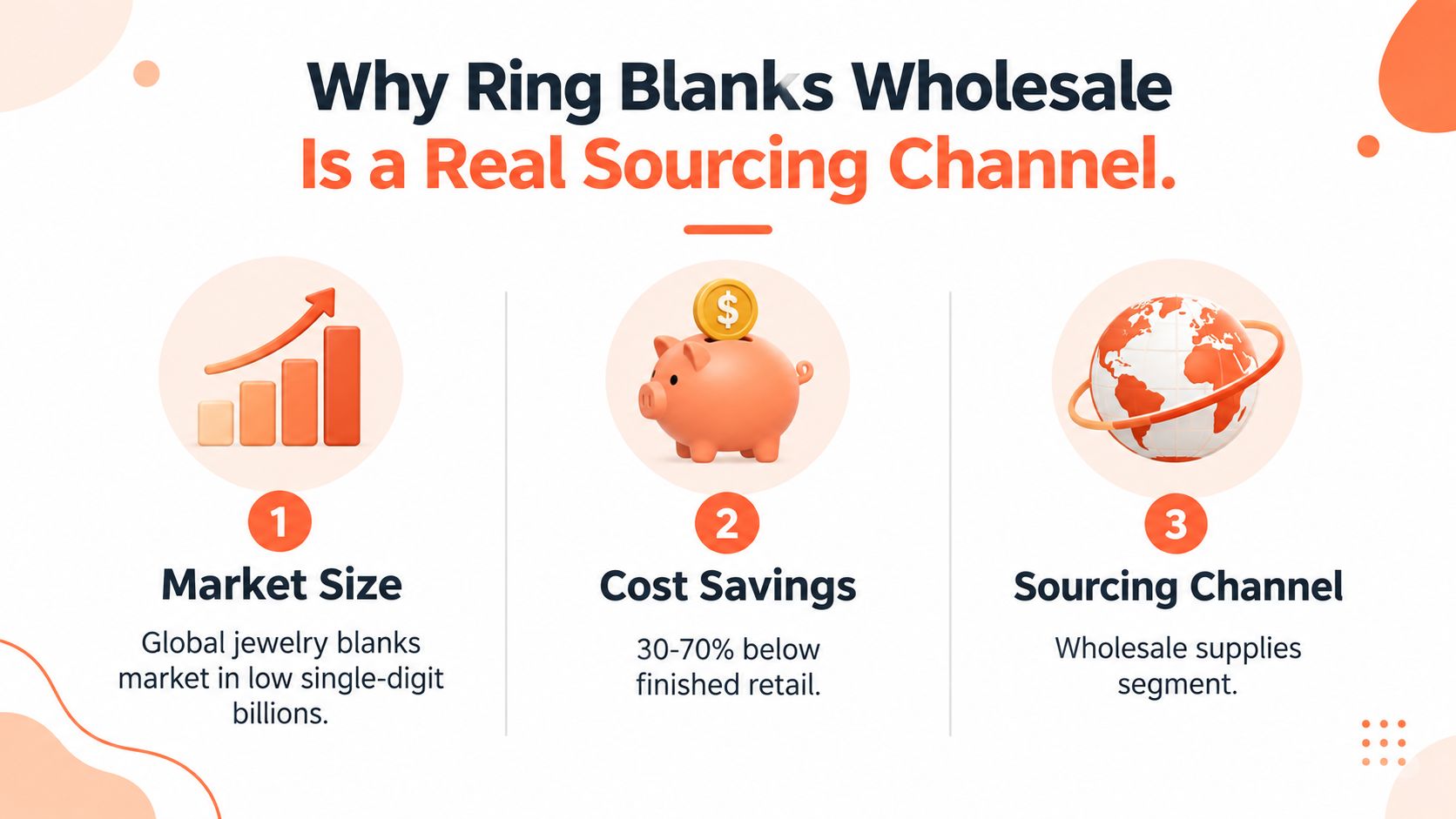
Ring blanks wholesale operates as a production channel because suppliers already manage forming, repeat orders, inspection, and shipment at commercial scale. Kemp Metal Products says it has served jewelry wholesalers in America since 1945 and describes itself as a three-generation family manufacturing business. Its typical order turnaround averages two to four days to process and ship, showing how established manufacturing systems can support replenishment rather than occasional craft production. Kemp's wholesale jewelry background and processing information gives buyers a useful benchmark for evaluating supplier capacity and lead time.
The channel also works for smaller buyers. Faire's ring-blank marketplace lists opening orders starting at $65 and more than 600 low-minimum options. Boutiques and online sellers can test designs, measure sell-through, and check finishing requirements before committing to deeper inventory. Faire's ring blanks wholesale marketplace shows how online purchasing has widened access to a category once tied more closely to factory relationships and larger commitments.
The supply-chain decision
A finished ring combines forming, sizing, polishing, decoration, packaging, and merchandising. Buying a blank separates forming from the downstream work, so your business can control stamping, engraving, inlay, enamel, plating, or minimal finishing while the supplier repeats the base component.
That separation creates operational trade-offs:
- Inventory exposure: Low-minimum channels let you validate a style before holding deep stock.
- Cash timing: You pay for unfinished components before finishing and resale revenue arrive.
- SKU breadth: More sizes and finishes expand customer choice, but inconsistent batches increase inspection, sorting, and dead-stock risk.
Dimensional tolerance and batch consistency determine whether the margin survives a reorder. A ring that arrives slightly different in width, profile, or finish can require extra sorting, create sizing complaints, or force rework before sale. Record the approved specification, inspect samples from each batch, and compare reorder results against the first shipment, not only the invoice price.
Practical rule: Buy ring blanks wholesale as a controlled production input. Approve the specification, inspect the batch, and judge the supplier by repeatability, defect handling, and lead time.
Wholesale jewelry sales, excluding costume jewelry, reached $162.9 billion across 195 countries in 2026, placing ring blanks within an international supply network rather than a hobby-only category. Faire's global wholesale jewelry context helps frame the channel, but supplier fit still depends on measurable consistency and workable fulfillment terms.
What a Ring Blank Actually Is
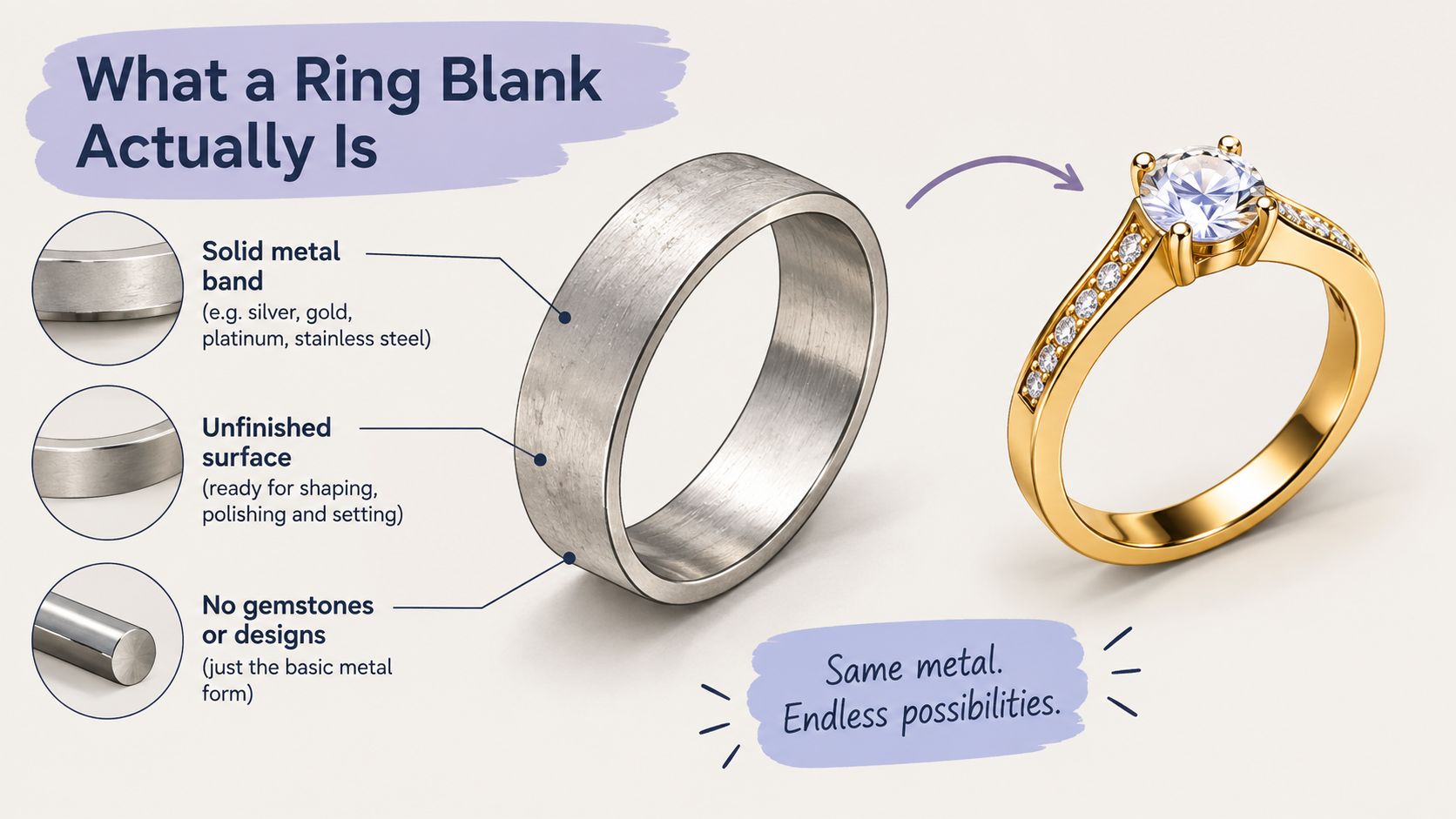
A ring blank is a pre-formed metal ring without its final stones, engraving, decorative treatment, or consumer-ready polish. It isn't raw wire or sheet, and it isn't a completed ring. It occupies the middle position between mill or factory production and the finished product that reaches a customer.
That position matters because the blank determines much of the work that follows. A flat band may be ready for stamping or laser engraving. A domed comfort-fit band may need only deburring and polishing. A bezel or channel blank needs dimensions that match the stone, inlay, or trim placed into it.
Three structural families
Flat bands have a relatively even cross-section and a broad working surface. They suit stamped names, coordinates, symbols, and simple signet-style treatments. A 6 mm stainless flat band is a practical entry SKU because its face gives engravers usable space without requiring a complex setting.
Domed comfort-fit blanks curve on the exterior and interior. They work well for plain bands and wedding-style resale, but the inside profile changes how the ring feels and how a sizing tool reads it. The same nominal size can feel different from a standard-fit band if the inner edge is rounded.
Bezel and channel blanks contain a defined area for a cabochon, stone, resin, or inlay material. Their wall thickness and opening dimensions control security, finishing time, and usable material volume. A small dimensional change can turn a clean setting into a rework item.
How the production route changes buying risk
Manufacturers commonly form blanks by stamping metal strip, machining from bar or tube, or casting from a model. Stamping can produce efficient repeat runs for simple profiles. CNC work can offer tighter control on selected geometries but may carry more setup cost. Lost-wax casting supports more sculptural designs, although it requires closer inspection for porosity, shrinkage, and surface variation.
For a first purchase, compare the 6 mm stainless flat band with a 4 mm sterling domed band. They aren't interchangeable just because both are rings. The stainless band may favor repeatable industrial production and engraving, while the sterling band may offer a more traditional customization base with different documentation and finishing needs. Buyers who want more detail on engraving applications can review this guide to blanks for engraving.
Materials, Finishes, and Which Ones to Stock
Material choice should follow the sales channel, customer expectations, compliance obligations, and finishing process. A low-cost brass blank may look attractive on a purchase order, but it can create more customer-service work if the finish changes or a wearer experiences irritation. Stainless steel, sterling silver, titanium, copper, and coated brass each solve a different merchandising problem.
316L stainless steel is particularly useful for everyday, fast-moving collections. A wholesale listing describes it as hypoallergenic, resistant to tarnish and staining, and suitable for comfort-fit construction. The same listing specifies an 8 mm blank with a 4 mm inlay channel and 2.5 mm thickness, while a 6 mm version uses a 3 mm channel and the same thickness. The technical dimensions for 316L inlay blanks show why width isn't just an aesthetic choice. It changes inlay volume, labor, polishing, and the finished ring profile.
Sterling silver 925 remains flexible for engraving, soldering, and detailed finishing, but it brings hallmarking and assay considerations in markets where those requirements apply. Fine silver 999 can suit enamel work, though its softness makes handling and structural decisions more important. Titanium offers a lightweight, durable option, but many titanium designs are difficult or impossible to resize after production.
| Material | Best Finish Match | Hypoallergenic | Tarnish Resistance | Typical Resale Price Tier |
|---|---|---|---|---|
| 304 stainless steel | High-polish, brushed | Depends on specification and testing | Strong | Accessible |
| 316L stainless steel | High-polish, brushed, PVD gold, PVD rose | Stronger candidate when properly documented | Strong | Accessible |
| Brass | PVD gold, PVD rose, oxidation-blackened | Requires careful claim support | Limited without protective coating | Budget |
| Sterling silver 925 | High-polish, hammered, oxidation-blackened | Depends on alloy and customer sensitivity | Requires care | Mid to premium |
| Fine silver 999 | High-polish, enamel-ready | Generally favorable, subject to product testing | Softer and more reactive in use | Specialty |
| Titanium | Brushed, high-polish, selected PVD finishes | Strong candidate for sensitive-wearer channels | Strong | Mid |
| Copper | Oxidation-blackened, antique finishes | Not ideal for broad sensitive-skin claims | Limited | Budget and craft |
Brass is often the lowest-priced option, but uncoated surfaces can discolor and plated surfaces can wear. PVD can improve finish durability, yet the supplier still needs to specify the base metal and coating process. Copper works for artistic and antiqued collections, not for every customer or channel.
A focused assortment is easier to control than a thin spread across every metal and finish. Start with two metals and three finishes, then add variations only after the first batch proves its sell-through and return profile. Buyers evaluating 316L terminology should also review this explanation of what 316L stainless steel jewelry means.
Sizing, Fit Geometry, and Tolerance That Decide Your Margin
Ring sizing becomes an operations problem as soon as you buy multiple sizes in one batch. Customers may order by US whole or half size, while factories may document inside diameter in millimeters and international buyers may use UK or Australian letter equivalents. Your purchase order should state the sizing system, inside diameter, band width, wall thickness, and fit profile together.
Comfort-fit and standard-fit rings deserve separate inspection standards. A comfort-fit interior has more rounding and can feel roomier than a standard interior at the same nominal size. If your product page uses one sizing chart while the supplier manufactures another geometry, the resulting complaints won't be solved by better photography.
Write the specification before the quote
Ask the supplier to confirm:
- Nominal size: US whole and half sizes, plus the factory's conversion chart.
- Inside diameter: Measured at the specified point, not estimated from an old sample.
- Width: The finished band width at the top and side if the profile tapers.
- Thickness: The minimum wall thickness, not only the thickest point.
- Fit: Standard or comfort fit, with a reference sample retained by both parties.
- Tolerance: The acceptable dimensional range for each measurement.
Stamping and CNC production can produce different tolerance outcomes, and the quoted tolerance matters more than the process label. For premium blanks, buyers may request a tolerance band of ±0.1 mm, while mid-tier products may be quoted at ±0.2 mm. Those figures should be treated as negotiated specifications, not assumptions.
A ring mandrel doesn't make an inspection objective by itself. Calibrate the mandrel, use the same measurement method for every batch, and keep the approved sample beside the inspection station.
The planned sizing mix should follow your sales history. A core assortment from US sizes 6 through 9 can cover roughly 70% of demand in the planning model described here, with sizes 7 and 8 acting as anchor SKUs. This is a useful starting point, but your own order history should replace the estimate as soon as it becomes available.
| US Size | Inside Diameter (mm) | Circumference (mm) | Recommended Tolerance | Typical Stock Demand |
|---|---|---|---|---|
| 6 | Verify with supplier chart | Verify with supplier chart | Use PO specification | Core |
| 7 | Verify with supplier chart | Verify with supplier chart | Use PO specification | Anchor |
| 8 | Verify with supplier chart | Verify with supplier chart | Use PO specification | Anchor |
| 9 | Verify with supplier chart | Verify with supplier chart | Use PO specification | Core |
| 10 | Verify with supplier chart | Verify with supplier chart | Use PO specification | Extended |
| 11 | Verify with supplier chart | Verify with supplier chart | Use PO specification | Extended |
| 12 | Verify with supplier chart | Verify with supplier chart | Use PO specification | Extended |
| 13 | Verify with supplier chart | Verify with supplier chart | Use PO specification | Extended |
The table deliberately leaves measurements for the supplier's approved chart. Conversion tables vary by geometry and source, so copying an unverified diameter into a purchase order creates avoidable risk.
Pricing, MOQ, Samples, and Private Label
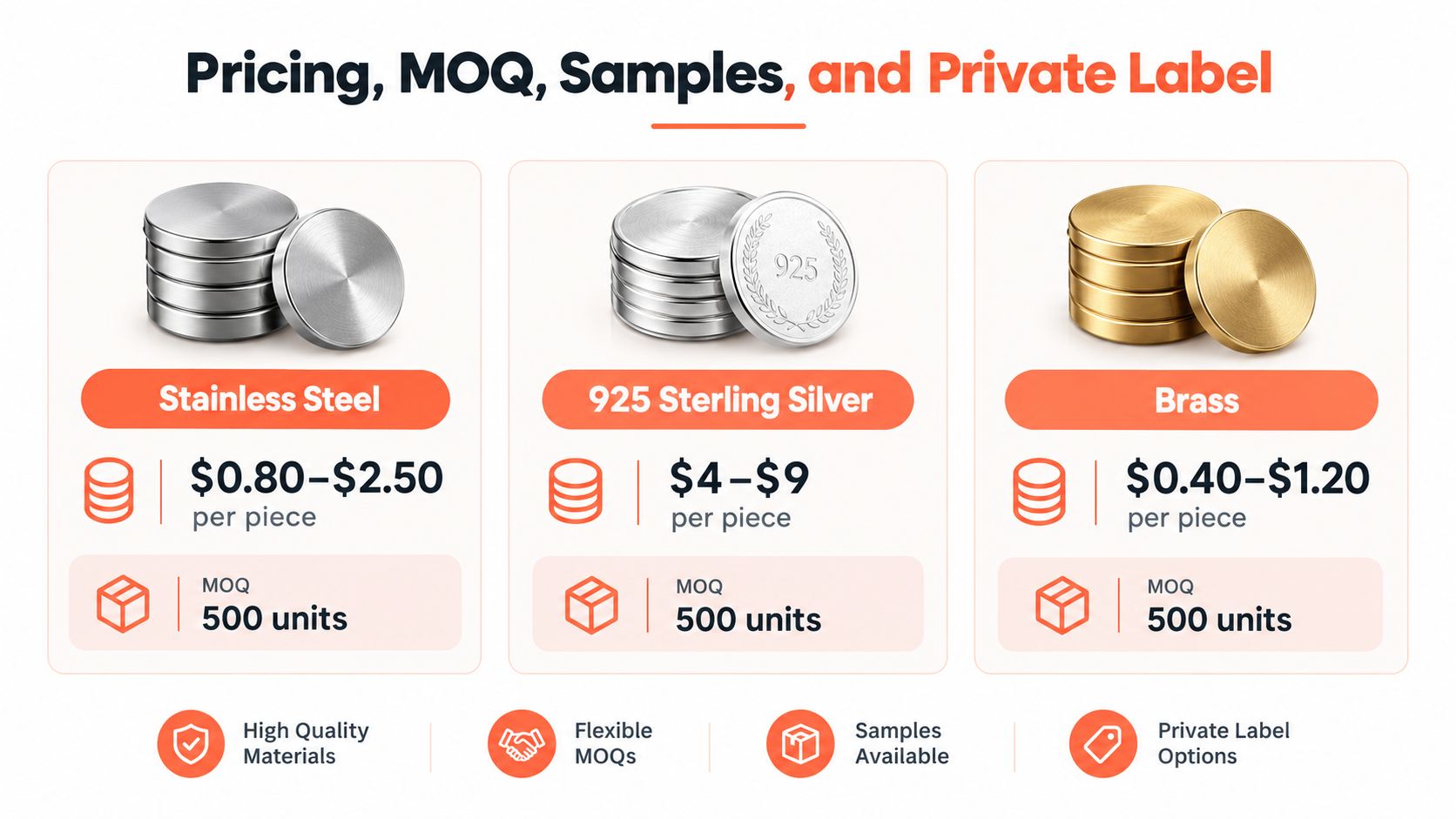
Price comparisons are useful only when unit, material, finish, quantity, and landed cost match. As planning assumptions, not market quotes, stainless steel blanks may be modeled at $0.80 to $2.50 per piece at a 500-unit MOQ, 925 sterling blanks at $4 to $9, and brass blanks at $0.40 to $1.20. Confirm every range against a current supplier quotation before setting a margin target.
The material gap can narrow after finishing, inspection, freight, duties, packaging, and rework. A lower-priced brass blank that needs sorting or produces more finish complaints may cost more to operate than stainless steel with stable dimensions and a durable surface. Compare expected sellable units, not just the invoice price.
MOQ follows factory setup
Treat MOQ figures as purchasing assumptions for early planning. A silver program may require 200 to 500 pieces per size per finish, while a brass program may fall to 100 pieces when the supplier already runs the base shape. Stainless programs often suit larger repeat volumes because tooling and finishing can be standardized. Ask whether the MOQ applies per size, finish, material, or total purchase order.
Samples need their own budget. A sterling sample may cost $20 to $60, and some suppliers waive or credit that amount against a first production order above $1,000. Put the credit terms in writing before approval, including whether freight and custom finishing qualify. Use the sample to check dimensions, finish uniformity, edge comfort, and packaging fit, then record the approved version against the purchase order.
Negotiate the full commercial package
Useful terms include mixed-size purchase orders, repeat-order price locks, extended payment terms, sample credits, packaging changes, and a written replacement policy. Private-label options may include engraved logo plates, laser-etched interior stamps, branded inserts, and custom packaging. Custom runs often begin near 300 to 500 pieces, depending on tooling and decoration.
Check freight, duties, brokerage, and handling before accepting a quote. A landed-cost calculator can help reveal hidden export fees before a low unit price distorts the margin model. For private-label work, document artwork approval, sample signoff, tooling ownership, and the remedy if the finished mark differs from the approved proof. See this guide to private-label jewelry manufacturers for supplier-selection considerations.
Quality, Certifications, and the True Cost of Cheap Blanks
A cheap blank is only cheap when it arrives within specification and stays consistent across reorders. Consider a 3% defect rate on a 1,000-piece order at a $5 landed cost. The direct product loss is $150, before inspection labor, customer-service time, replacement shipping, and the reputational cost of sending inconsistent rings to buyers. Market context from the broader jewelry-making supplies market helps explain why consistency matters as competition increases, but the worked example is the practical margin test.
The most expensive defects may not appear in supplier photographs. Thickness variation changes comfort and inlay volume. Uneven polishing makes pieces from one collection look unrelated. A small difference between the approved sample and the production run can leave your team sorting sellable stock from pieces requiring rework.
Match documentation to the destination
| Standard / Certification | What It Covers | Required For | Verification Method |
|---|---|---|---|
| ISO 9001 | Factory quality-management processes | Buyers seeking documented process control | Request current certificate and scope |
| REACH | Chemical restrictions for relevant markets | EU-bound products where applicable | Review supplier declaration and test records |
| RoHS | Restricted substances in covered products | Applicable regulated shipments | Review test documentation |
| California Proposition 65 | Warnings and chemical exposure obligations | Relevant U.S. retail channels | Obtain product-specific compliance review |
| 925 marking | Silver fineness claim | Sterling products sold in markets with marking rules | Verify composition with XRF |
| EN 1811 testing | Nickel release performance | Products making supported sensitive-skin claims | Request current test report |
| Salt-spray and tarnish tests | Finish durability | Plated or treated finishes | Review method, duration, and result |
A visible 925 stamp does not prove silver content. Request X-ray fluorescence testing or a comparable third-party report tied to the batch. Treat “hypoallergenic” the same way. The claim should connect to a documented alloy, plating specification, and relevant nickel-release testing, not a generic product description.
Inspect before the goods disappear into stock
Use a written pre-shipment plan covering the sampling method, defect categories, plating adhesion test, surface standard, and corrective action. A buyer may specify 2% AQL sampling, a cross-hatch adhesion test for plating, and a corrective-action process tied to the supplier agreement. Match the inspection plan to product risk and destination requirements.
A low unit price becomes a false saving when staff must inspect every piece manually. Pay for a process that makes inspection efficient, rather than a quote that leaves quality uncertain. Record defect types by batch, because dimensional drift, finish failure, and missing marks require different supplier remedies.
Logistics, Lead Times, and Tracking Your Order
Freight belongs in the product cost from the first quotation. A supplier can offer an attractive ring blank price while the final expense rises through packaging, export handling, duties, brokerage, and domestic delivery. Buyers who separate those charges from the SKU cost often underprice finished rings.
Use four checkpoints for every purchase order:
- Factory production: Allow 7 to 25 days, depending on metal, finish, tooling, and whether the SKU is in stock.
- Sample production: In-stock samples may take 3 to 10 days, while custom stamping can take longer.
- Transit: Air freight may take 5 to 9 days. Sea freight may take 25 to 40 days to the U.S. West Coast or 30 to 45 days to the East Coast.
- Customs clearance: A bonded broker may clear the shipment in 2 to 5 business days, assuming the documents are complete.
These are planning windows, not promises. Production pauses, inspection holds, port congestion, and documentation issues can move the arrival date.
Keep one tracking sheet
Record the PO number, supplier code, quantity by size, metal, finish, estimated departure date, estimated arrival date, freight mode, broker, and current status. Update it weekly and require the supplier to report changes rather than waiting for a missed ETA.
For a first import, DDP can make the total delivered cost easier to understand because the supplier manages more of the delivery chain. Once volume justifies your own broker and shipping process, compare that arrangement against supplier-managed delivery rather than assuming one term is always cheaper.
| Shipping Mode | Production Lead | Transit Time | Customs Clearance | Best For |
|---|---|---|---|---|
| Air freight | 7 to 25 days | 5 to 9 days | 2 to 5 business days | Samples and urgent replenishment |
| Sea freight to U.S. West Coast | 7 to 25 days | 25 to 40 days | 2 to 5 business days | Planned bulk inventory |
| Sea freight to U.S. East Coast | 7 to 25 days | 30 to 45 days | 2 to 5 business days | Larger planned orders with longer runway |
Photograph the pallet wrap, cartons, labels, and inner boxes when the shipment arrives. If cartons are crushed or wet, note the damage on the bill of lading before signing. Carriers often require dock-side documentation before they will consider a damage claim.
Vetting Suppliers and Placing Your First Order
A supplier's catalog proves that it can display products. It doesn't prove that it can reproduce your approved ring blank. Before sending a deposit, use the same vetting grid for every prospect, whether the factory is an Asian manufacturer, a domestic mill, or an online wholesale distributor.
Verify the business before evaluating the price
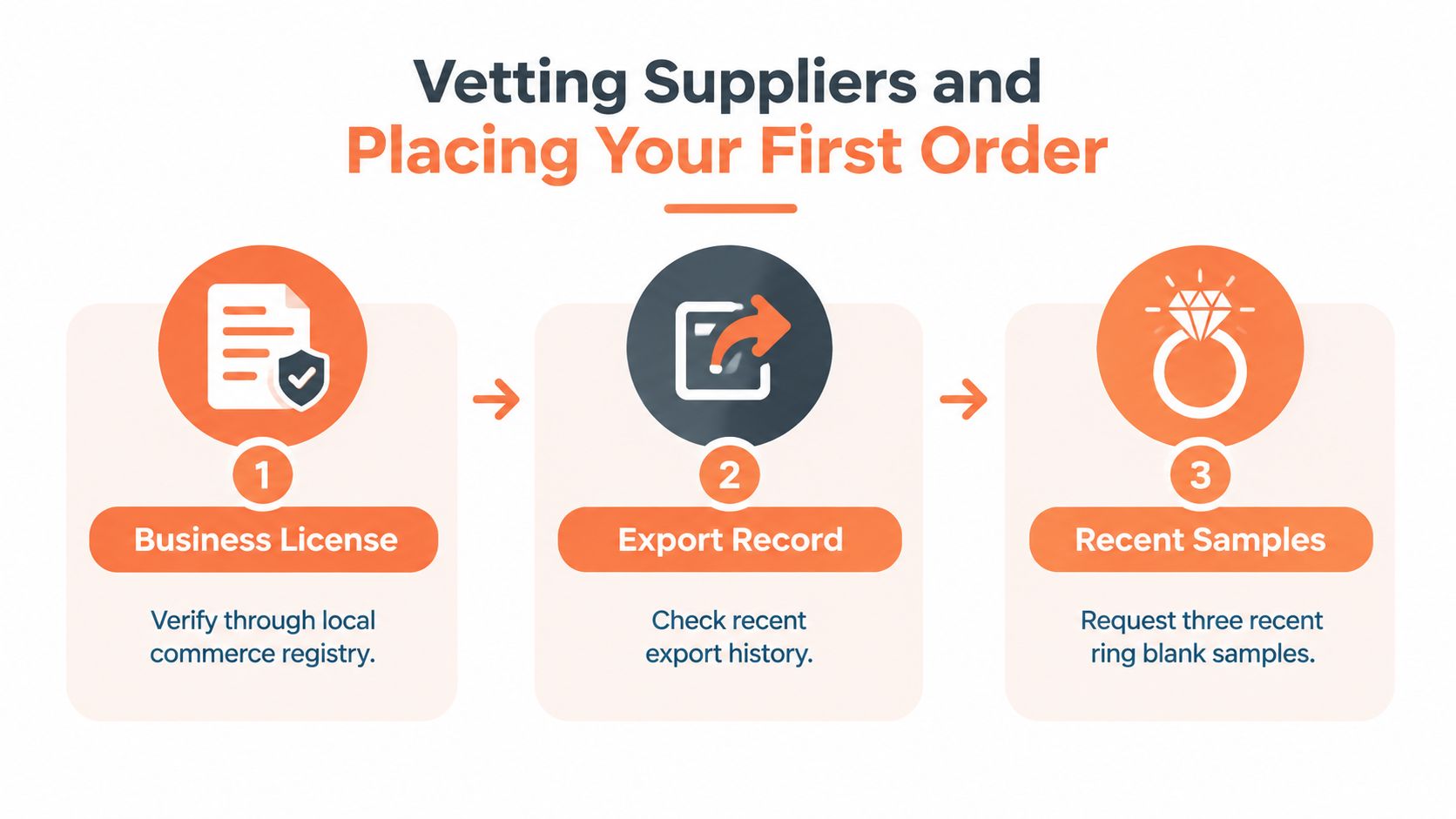
Ask for the business license, factory address, export record, material declaration, and current certifications. Verify the company through the relevant local commerce registry where possible. Then request contact details for three recent ring blank clients and confirm that those references are genuine businesses with relevant purchasing experience.
For silver or titanium claims, request third-party mill test reports tied to the stated material. A polished product photograph can't confirm alloy content, wall thickness, or batch consistency. If freight planning is unfamiliar, use a practical guide to find freight from China while comparing supplier quotes and delivery terms.
Audit the sample lot, not one perfect sample
Order a lot of 30 to 50 blanks for in-house review. Weigh 10 pieces against the stated gram weight, measure band width and inner diameter with calibrated calipers, inspect the finish under consistent lighting, and use a nitric acid spot test for sterling where appropriate and safe. A weight variance above ±5% should trigger questions about the specification, though weight alone doesn't replace composition testing.
Keep one approved sample as a physical reference. Mark it with the supplier code, finish, size, date, and PO specification. That sample becomes the comparison point for the production lot and the reorder.
Put commercial protection in the purchase order
Negotiate payment and quality terms before production begins:
- Payment structure: Use 30% deposit and 70% against a bill of lading copy when the supplier accepts those terms.
- Sample credit: State the exact credit amount and the qualifying first-order value.
- Defect remedy: Request a 2% replacement allowance for plating defects within 90 days, with the defect definition written clearly.
- Order size: Keep the first order to 500 to 1,000 pieces until the second batch confirms consistency.
- Approval control: Require written approval for changes to alloy, tooling, finish, packaging, or subcontractors.
This process balances price against operational certainty. The best supplier isn't always the one with the lowest quote. It's the one whose specifications, inspection records, documentation, lead time, and corrective action remain reliable when your first successful design becomes a reorder.
JewelryBuyDirect offers ring blanks, jewelry-making components, and fashion accessories through a broad B2B catalog with no minimum order quantity, making it easier to test sizes, metals, and finishes before scaling. Visit JewelryBuyDirect to compare wholesale options, build a controlled first order, and source the components your business can reorder with confidence.