
Signet Ring Blanks: A Complete Sourcing Guide
Your launch date is circled, three supplier quotes are open in separate tabs, and one factory promises delivery in two weeks while another quotes six. The cheaper option looks attractive until the first engraved batch arrives with uneven faces, thin rims, and plating that fails inspection. Signet ring blanks aren't generic jewelry components. Their dimensions, metal, finish, and production tolerance determine whether your customized product earns repeat orders or becomes a return problem.
For a small brand, the blank is the inventory decision made before the customer sees your engraving. It ties up cash, sets your quality-control workload, and determines how much room you have for a healthy margin. This guide takes the buyer's view, with practical recommendations for sourcing signet ring blanks that are affordable, engravable, and ready for retail.
Why Signet Ring Blanks Are a Sourcing Decision First
A signet ring blank is the foundation of the finished product. The face must be broad and stable enough for a monogram, crest, logo, or symbol. The shank must feel substantial without making the ring uncomfortable. The alloy must accept the engraving method you plan to use, and any coating must survive ordinary handling after customization.
That combination makes signet blanks different from simple bands or pendant components. A generic ring can hide minor inconsistencies under a stone or decorative feature. A signet face can't. Engraving exposes uneven polish, pits, soft edges, and inconsistent depth immediately.
The category also carries unusual historical weight. Mesopotamians used cylindrical seals around 3500 BC, and the practice later evolved into rings in Ancient Egypt. Some of the earliest surviving Egyptian signet rings are about 4,000 years old, according to The History Press's account of signet rings. The function eventually moved from sealing clay tablets and wax documents toward symbolic and decorative wear, particularly after the 19th century reduced the ring's legal role.
The wrong blank creates costs everywhere
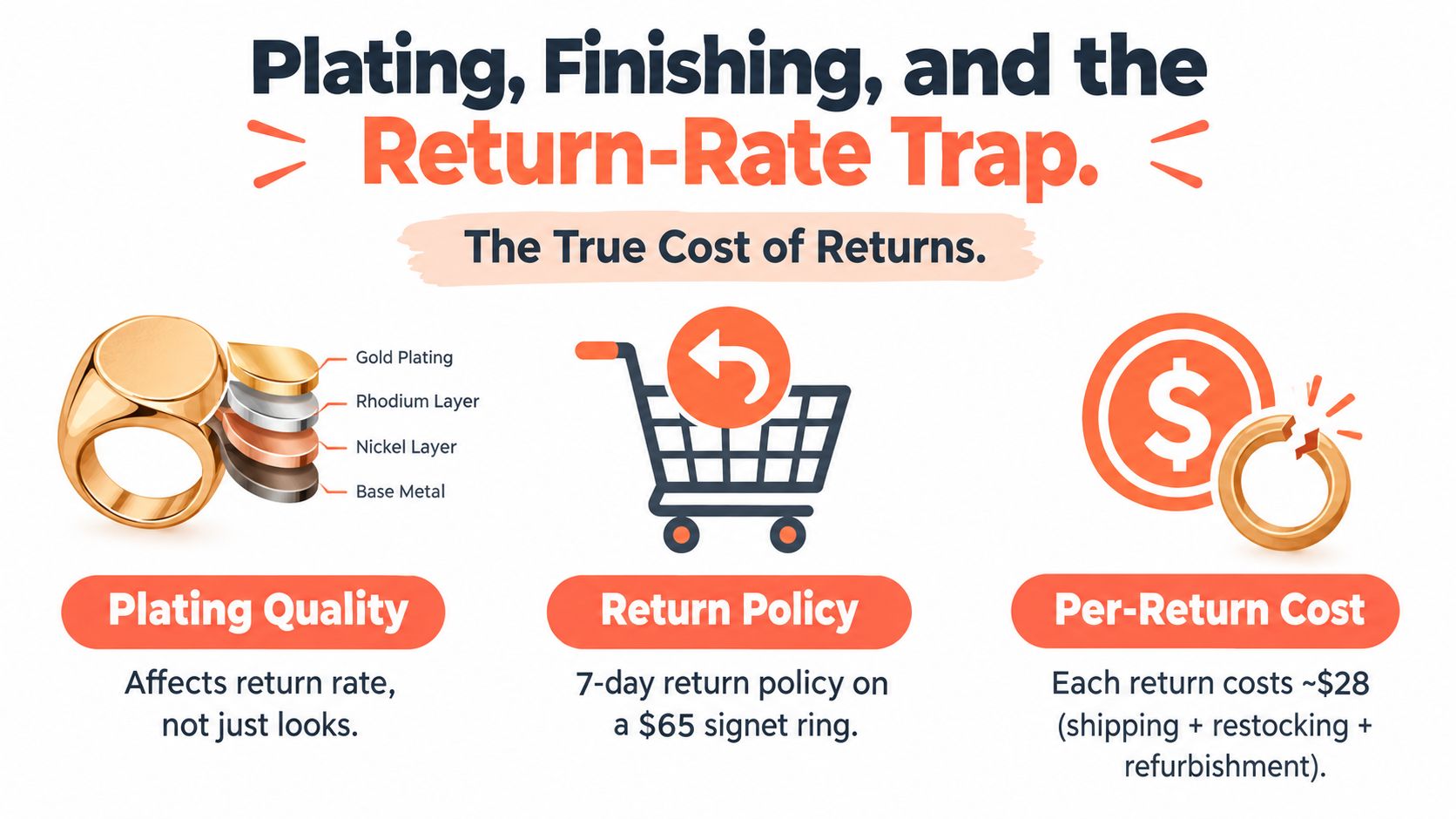
Suppose you're preparing a $65 retail signet and your return policy allows returns within 7 days. A 12% return rate can erode margin faster than a modestly higher purchase price, especially when the returned item needs inspection, repolishing, recoating, or re-engraving. Those figures are part of the sourcing scenario every buyer should model, not an excuse to chase the lowest quote.
Before placing a purchase order, ask what happens after engraving:
- Face quality: Is the bezel flat enough for your artwork, or will the engraver need to level it?
- Wall thickness: Can the rim withstand polishing and daily wear?
- Alloy consistency: Will samples and production pieces behave the same way under laser, rotary, or hand engraving?
- Finish compatibility: Does the coating tolerate engraving, or will customization expose a visibly different base metal?
- Sizing accuracy: Will the internal diameter match the listed size after casting, machining, and finishing?
Practical rule: A blank is retail-ready only when it can move from incoming inspection to engraving without corrective work that destroys your planned margin.
A useful starting point is this factory-direct jewelry sourcing guide, but don't treat any supplier's catalog description as a substitute for samples. Order representative sizes, test the face, inspect the inside of the shank, and document defects before negotiating a larger run.
Sizing, Profile, and Face Dimensions That Actually Sell
A ring can match the buyer's size and still become a poor retail SKU. A narrow shank under a large bezel feels unbalanced, while a tall face can catch on clothing and make the piece uncomfortable. Treat the inside measurement, face, and band as separate sourcing decisions before approving a production sample.
Choose the face around the engraving
Keep the engraving face within 12 to 18 mm for a practical core range, according to the Signet Ring Blanks buying guide. That span gives a monogram or simple symbol room to remain legible without pushing the ring into oversized statement territory. Flat faces are easier to fixture and reproduce consistently. Domed faces can support a higher-priced look, but they require tighter control of the tool path and artwork.
A real tungsten example has an oval face measuring 18 mm by 13 mm, with a depth of 1.8 mm, as shown by Opal and Findings' tungsten signet ring blank. It is a compact profile for a bold oval design. A stainless steel listing shows the lighter end of the market, with an engravable area of 4.5 mm by 14 mm, a 2 mm band width, and a weight of 3.5 g, according to Faire's signet-style blank listing.
Band width affects comfort, perceived value, and the number of designs the blank can support. 2 to 6 mm bands are common. For heavier daily wear, choose 3 mm or thicker shanks, as outlined in the available ring-blank sizing guidance. A 2 mm shank can work for a lightweight fashion SKU, but it may look weak beneath a broad face. For a dependable unisex core style, select a band that feels present on the finger without competing with the bezel.
Calculate the blank before ordering
For a formed ring, apply inside diameter plus metal thickness, multiplied by π. Add 0.5 mm when the band width exceeds 4 mm, following Rio Grande's ring blank sizing guide. That allowance helps prevent an undersized finished ring after forming and finishing.
Size labels alone do not protect your purchase order. A U.S. size 5 corresponds to a 49.0 mm metric circumference and a 15.6 mm inside diameter in Hauser and Miller's ring blank reference. Specify the internal diameter, request measured samples, and check the fit again after polishing. A supplier that cannot provide consistent dimensions is offering a return problem, not a finished product.
| Dimension | Standard Range | Why It Matters |
|---|---|---|
| Engraving face width | 12 to 18 mm | Balances artwork legibility with wearable proportions |
| Band width | 2 to 6 mm | Controls comfort, visual weight, and structural support |
| Heavier-wear band | 3 mm or thicker | Gives the shank more support during daily use |
| Wide-band allowance | Add 0.5 mm | Helps compensate when the band exceeds 4 mm |
| Example oval face | 18 mm by 13 mm | Shows a compact production-ready engraving profile |
Comparing Base Metals for Engraving and Retail
Metal choice should follow your customer and price architecture, not a supplier's default catalog option. The same engraving can look crisp on tungsten, practical on stainless steel, refined on sterling silver, or inexpensive on brass. The after-sale experience changes with each material.
| Metal | Engraving Response | Plating & Wear | Retail Price Ceiling |
|---|---|---|---|
| Tungsten | Sharp detail, but brittle under impact | Durable surface, difficult to repair or resize | Premium fashion and statement positioning |
| Stainless steel | Consistent for laser and machine engraving | Strong daily-wear performance and compatible with PVD | Accessible everyday retail |
| Sterling silver | Excellent engraving response and easy adjustment | Tarnishes and scratches, requiring more care | Mid-range and artisan positioning |
| Brass | Soft and easy to stamp | Needs reliable sealing and can discolor skin if plating fails | Entry-level or limited-run fashion |
Tungsten and ceramic can produce sharp engraving, but their hardness creates a repair problem. They can crack under impact, and they can't be resized. That means an exchange may require a replacement rather than a simple workshop adjustment. Use these materials when the buyer accepts a fixed size and the design benefits from a heavier, modern feel.
Stainless steel, particularly 316L when the supplier verifies the grade, is my default for accessible retail. It holds laser detail, works with PVD coatings, and handles daily wear better than softer entry-level metals. For brands building a dependable core collection, stainless steel gives the cleanest balance between engraving performance, durability, and manageable customer expectations. You can also review this guide to engravable stainless steel when evaluating blank construction and customization options.
Match the metal to the buyer
Sterling silver is the better choice when the product depends on a precious-metal story or a softer, more traditional engraving character. It engraves beautifully and can be resized cleanly, but it scratches and tarnishes more readily. Your product page must explain care, or customers may interpret normal oxidation as a defect.
Brass keeps unit cost low and works well for hand stamping. It becomes a liability when the plating system is weak. Skin discoloration, uneven sealing, and rapid surface change will overwhelm the advantage of the lower blank price.
My buying position: Choose stainless steel for the dependable everyday range, sterling silver for an intentional precious-metal line, tungsten for fixed-size statement pieces, and brass only when you control finishing and can explain the product honestly.
Engraving Techniques and Production Workflows
Choose the engraving process before placing a blank order. A flat, polished stainless-steel face supports a different production setup than soft brass or a domed silver bezel. Buying the ring first and solving production later creates avoidable equipment, fixturing, and labor problems.
Laser engraving
A 30W fiber laser gives small brands repeatable detail on sterling silver and stainless steel. It suits logos, monograms, fine linework, and personalization. In-house cost can run roughly $2 to $5 per blank, and monthly throughput can exceed 300 pieces, based on the workflow guidance in this blank engraving resource.
The face must stay stable and correctly focused. A domed bezel needs more setup than a flat face. Coated blanks may require masking or a controlled pass to prevent a dirty halo around the design. Test the exact coating before production. The same base metal does not guarantee the same laser result.
Hand stamping
Hand stamping costs only pennies per mark, but labor and rejects determine the cost. The operator needs a flat face, relatively soft metal, controlled hammer force, and a jig that keeps every mark aligned. Brass and silver suit short runs, especially limited drops of 25 to 50 blanks. At higher volume, consistency becomes the constraint because each impression depends on operator technique.
Use stamping when the irregularity looks intentional. Do not use it for a private-label collection that promises identical personalization across every order.
Rotary and diamond drag engraving
Rotary and diamond drag machines fit between manual stamping and laser production. Outsourced work often lands around $1.50 to $3 per blank, making this route suitable for crests, monograms, and designs on hardened steel. It requires more setup than a basic stamp, but produces a traditional cut character that can suit heritage-focused collections.
| Method | Best Metals | Per-Piece Cost | Equipment / Skill | Ideal Batch Size |
|---|---|---|---|---|
| Fiber laser | Sterling silver, stainless steel | About $2 to $5 in-house | 30W fiber laser, artwork setup, fixturing | Repeated production |
| Hand stamping | Brass, sterling silver | Pennies per mark | Stamps, hammer, skilled operator | 25 to 50 blanks |
| Rotary or diamond drag | Hardened steel, silver, stainless steel | About $1.50 to $3 outsourced | Engraving machine and setup skill | Small to medium runs |
Buy the blank around the finished design, not the other way around. Dense crests need enough face area and depth for clean detail. Fast personalization needs consistent flatness and fixture-friendly geometry. Before committing to a private-label run, test a production blank, inspect the edges and contrast, and confirm that the engraved result still looks retail-ready after finishing.
Wholesale Sourcing Without Getting Burned
A cheap unit quote can hide slow-moving sizes, missed launch dates, and delivery charges your margin cannot absorb. Treat procurement as a B2B margin decision. Approve the blank only after checking demand by size, production timing, and the full delivered cost.
Typical minimums range from 50 to 200 pieces per size with domestic casters and 300 to 500 pieces per size from overseas factories. Suppliers may offer better pricing at 1,000 units, but that discount matters only when the inventory will sell. The required MOQ and pricing breakdown infographic summarizes these ranges.
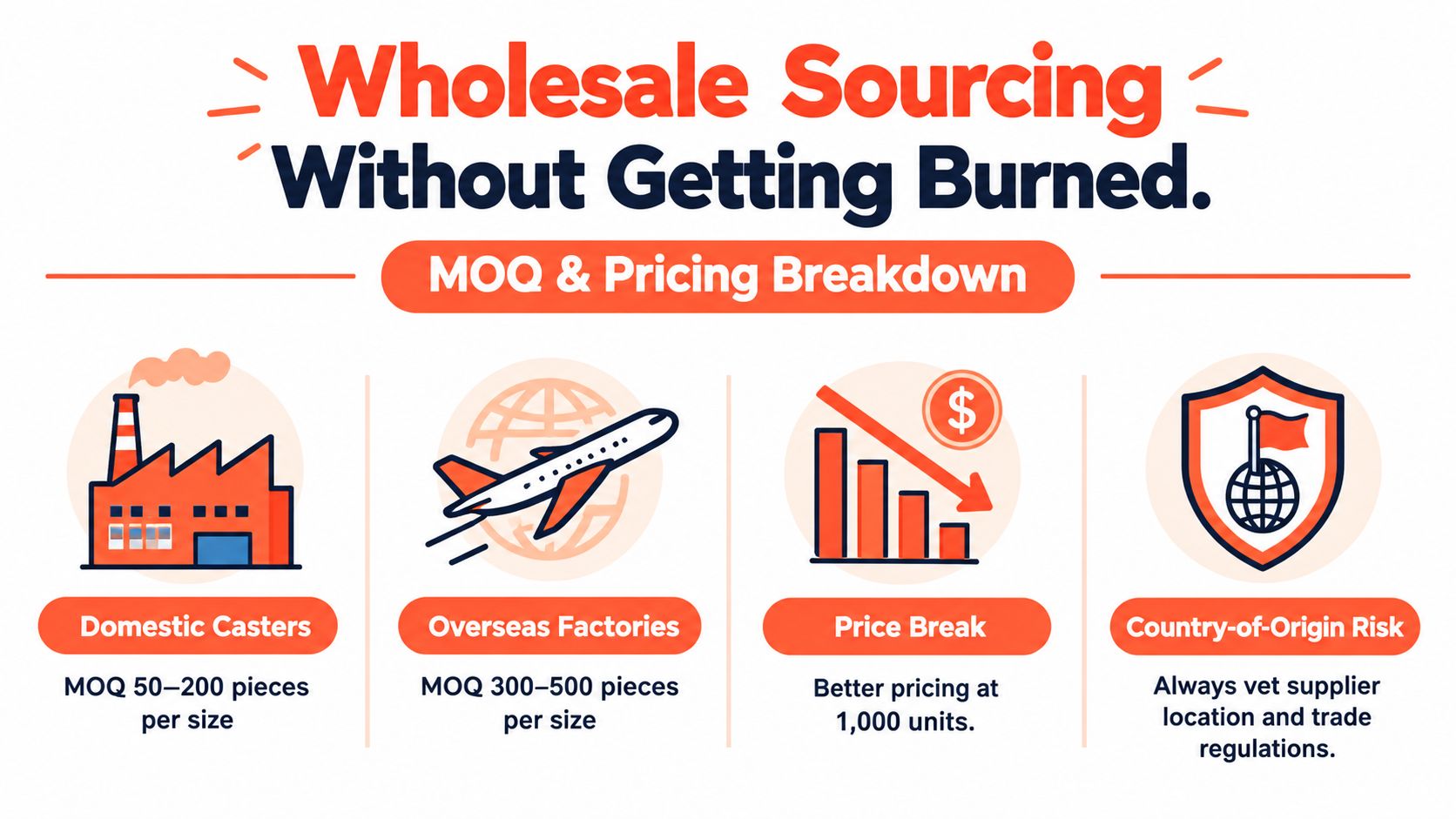
Origin changes the landed-cost calculation. Independent reporting on tungsten supply estimates that China supplies 80% of tungsten raw material, while the United States imports roughly 90% of tungsten articles. Proposed tariffs could add 7% to 10% to landed cost, according to the supplier and sourcing report on blank stainless steel jewelry. Verify those figures against your product classification and shipment. They are risk inputs, not a reason to reject an entire material category.
Questions that expose supplier risk
Request mill test reports, plating thickness certificates, a written size chart, and a sample-production timeline. Test production samples before placing a wholesale order. On selected pieces, check the coating, cut edge, inside diameter, face flatness, and engraved result after finishing.
- Ask about MOQ by size: A manageable total can become expensive when the supplier applies the minimum separately to every size.
- Ask for the Incoterm: FOB and DDP can shift landed cost by 8% to 12%, so compare the complete delivered cost with the factory quote.
- Ask about payment stages: Tie final payment to inspection and documented approval to protect cash flow.
- Ask about lead-time triggers: Confirm whether production starts after the deposit, artwork approval, or sample sign-off.
- Ask about replacement policy: Require a written definition of acceptable defects before production begins.
For specialized production networks, American Additive Manufacturing suppliers can provide additional manufacturing contacts. Use directories only to build a shortlist. Qualify each supplier through samples, documentation, destructive testing, and a controlled purchase order. A retail-ready blank has consistent dimensions, a clean face, predictable engraving behavior, and a defect policy you can enforce. Anything less becomes a private-label liability.
Plating, Finishing, and the Return-Rate Trap
A ring can engrave cleanly and still become a return problem. Coating that chips around the face, wears through at the rim, or reveals a contrasting base metal makes the finished piece look used before the customer has worn it. Treat plating as a sourcing specification, not a cosmetic add-on.
A 7-day return policy on a $65 signet ring can make each return cost roughly $28 after shipping, restocking, and refurbishment. The true cost of returns infographic shows how those costs build. Paying for proper surface preparation is cheaper than absorbing returns caused by a weak finish.
Specify the coating, not just the color
Ask whether the supplier uses flash plating, thicker decorative plating, IP plating, or PVD. A color name reveals nothing about layer thickness, adhesion, surface preparation, or expected wear. Require the supplier to document the finish and provide production samples. Thin plating on a poorly polished substrate will expose defects quickly, while a thicker, well-adhered coating gives a retail blank a better chance of surviving regular contact.
Validate the finish with your own wear test. Inspect the rim, underside, and engraved face separately because each area experiences different contact. If the blank arrives pre-engraved, confirm whether the face needs recoating. If you laser-mark a coated area, mask zones that should not receive another finishing pass.
Sequence controls the result
Brushed matte, high polish, and antiqued finishes behave differently after engraving. High polish highlights shallow scratches and pits. Brushed finishes can lose their direction across the face. Antiquing can settle into the cut, yet appear muddy when the engraving is too shallow.
Write the production sequence into the purchase specification. It might be polish, plate, engrave, clean, and inspect, or engrave, clean, and selectively finish. Do not assume the supplier's standard process suits your artwork. Approve a finished sample showing the actual engraving, coating, edge treatment, and packaging inspection before releasing a larger order.
The cheapest blank is expensive when your customer receives a ring that looks worn before they've worn it.
JewelryBuyDirect offers a B2B catalog of signet-style stainless steel rings and other ring blanks. Boutiques, online sellers, and small brands can compare materials, test a smaller assortment, and build a collection around defined engraving and finish standards without a minimum order quantity. Visit JewelryBuyDirect to review the available blank options.