
Wholesale Belly Button Rings: A Retailer's Sourcing Guide
You've found the tray with the lowest unit price. The photos look polished, the assortment is broad, and the supplier promises fast dispatch. Then the shipment arrives. Some bars don't match the listed gauge, several pieces use inconsistent threading, and the finish begins to flake after customers wear them. The cheap order isn't cheap once returns, replacements, complaints, and lost trust enter the calculation.
That's the core buying problem with wholesale belly button rings. The category is affordable, compact, and easy to merchandise, but its profit depends on what arrives at your warehouse and how reliably customers can wear it. The smart buyer checks material, fit, threading, documentation, and reorder consistency before chasing the lowest quote.
Why Belly Button Rings Deserve a Spot in Your Wholesale Mix
A mixed tray can look like an easy win until it reaches your warehouse. The invoice shows a low unit cost and plenty of designs. The receiving team finds inconsistent bars, vague material descriptions, uneven polishing, and dangles that do not suit the customers who shop your store.
That is the risk surface in wholesale belly button rings. Your margin depends on more than price per unit. Verify the material, confirm gauge and wearable length for healed versus fresh piercings, and check threading before you commit to volume. A catalog photo cannot show whether the finish will last, the bar will fit, or the piece will arrive with clean, consistent construction.
A ring can look excellent online and still generate returns because the gauge is wrong, the wearable length is too short, the threading snags during insertion, or the plating deteriorates quickly. The margin is in the wearable units, not the units printed on the purchase order.
Demand exists beyond seasonal fashion
Belly button rings belong to a broader body-piercing jewelry market valued at USD 6.79 billion in 2025, projected to reach USD 10.84 billion by 2034, with a projected 5.47% CAGR. North America represented 43.3% of the market in 2025, giving suppliers serving boutiques, online retailers, and piercing-focused businesses a substantial customer base. These figures come from Fortune Business Insights' body piercing jewelry market analysis.
Navel jewelry also has demand beyond short-lived fashion cycles. Navel piercings account for 33% of body piercings performed in the United States, while a Harris Interactive poll in 2010 found that about 36 million Americans had at least one body piercing excluding earlobes, as summarized by the ASINsight belly button jewelry report. The category therefore supports both initial purchases and replacement demand.
Buy for repeatability
Build the range around high-velocity, low-cost-SKU inventory. Stock dependable curved barbells, verified materials, consistent specifications, and a controlled selection of dangles and charms. No-MOQ platforms let retailers test trend-led SKUs in shallow quantities instead of tying margin up in unproven designs.
Keep the core dependable, then measure fashion pieces by sell-through, returns, and reorder performance. A supplier that cannot reproduce the same fit, finish, and construction on the next order is not a reliable wholesale partner, regardless of the first quote.
Warehouse rule: Judge every wholesale order by cost per sellable, correctly specified piece, not by the invoice total.
Getting the Specs Right Before You Click Add to Cart
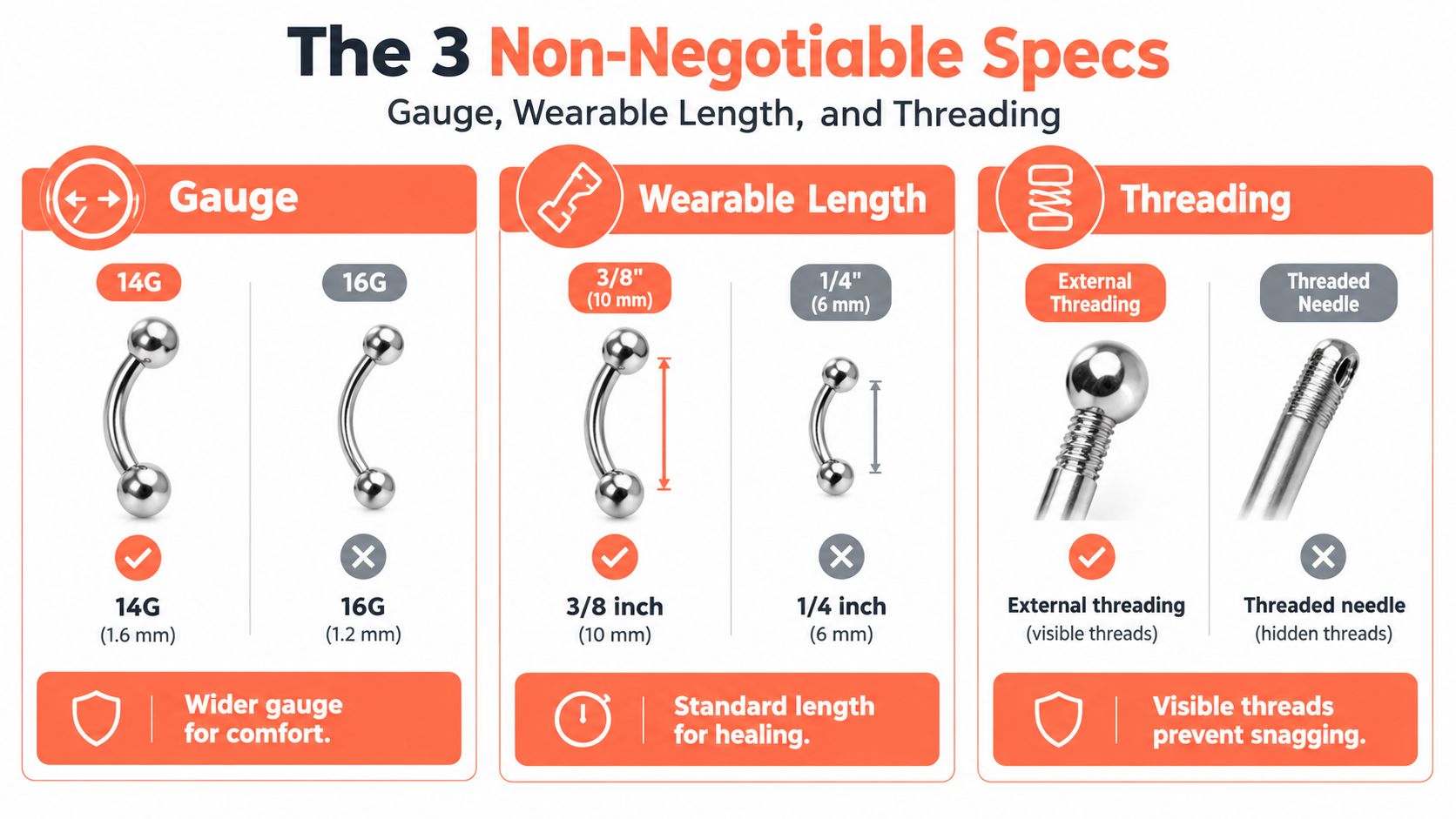
Three specifications decide whether a belly button ring sells smoothly or comes back as a return: gauge, wearable length, and threading. If a supplier's listing doesn't state all three clearly, don't treat the product as ready for a serious purchase order.
The standard baseline is 14G, or 1.6 mm, with a 3/8 inch, or 10 mm, wearable length commonly used for healed navel piercings. Catalogs also commonly show 5/16 inch, 8 mm, 7/16 inch, 11 mm, and sometimes 1/2 inch, 12 to 14 mm, depending on anatomy and swelling. The sizing guidance is documented in Body Candy's body piercing jewelry size chart.
Read the listing like a buyer
Gauge describes the thickness of the post. Don't assume a thinner bar will serve the same customer. If your audience expects the common American navel-jewelry standard, a listing that swaps in a thinner size can create fit confusion and dissatisfaction.
Wearable length is the part of the bar that sits inside the piercing. It isn't always the same as the full barbell length, particularly when decorative ends are included in the supplier's measurement. Ask the vendor to identify the measurement points and provide a physical sample before you commit.
Threading determines how the decorative end connects to the bar. Internally threaded jewelry generally offers a smoother insertion profile because the threads aren't exposed along the post. External threading can create rougher contact and more snagging risk, especially when the jewelry is intended for a fresh piercing. For retail, internally threaded pieces are the safer default when the supplier can document consistent machining and finishing.
Use a purchase-order habit
Write every SKU as gauge, wearable length, threading, material, finish, and end design. Then compare the purchase-order description with the sample, the packaging, and the supplier's invoice. Never approve a listing that uses “standard size” without defining the actual measurements.
Choosing Materials That Sell and Stay Safe
A low unit cost can become an expensive SKU once finish wear, comfort complaints, and returns reach your warehouse. Material choice sets the product's price tier, channel fit, expected lifespan, and the claims your team can make. Review the actual alloy and finish before approving a trend-led belly button ring.
Implant-grade titanium, specified as ASTM F136 or Ti-6Al-4V ELI, is the strongest premium default for fresh or sensitive piercings. It is nickel-free by specification and offers strong corrosion resistance, according to this implant-grade titanium jewelry guide. Request material documentation with the sample. A catalog title that only says “titanium” is not enough.
Match the material to the customer
316L stainless steel works as the core option for healed-piercing fashion assortments when the supplier identifies the alloy and maintains consistent finishing. Use this 316L stainless steel jewelry reference for background while evaluating steel options, then rely on the vendor's own product documentation for the order.
Solid 14K or 18K gold belongs in a premium or studio-oriented tier when the piece is solid gold and properly documented. Gold-plated alloy fits the fashion tier only when the vendor states the plating process and thickness. Copper and mystery alloys should stay out of a sensitive-piercing assortment. Discoloration, finish loss, and irritation complaints can remove the margin that made them look cheap.
| Material | Wholesale Cost Tier | Biocompatibility | Best Channel Fit |
|---|---|---|---|
| Implant-grade titanium | Premium | Strong choice for fresh or sensitive piercings when verified | Piercing studios, premium DTC, safety-led boutiques |
| 316L stainless steel | Core | Suitable for many healed-piercing fashion uses when documented | Mainstream retail, marketplaces, accessory stores |
| Solid gold | Luxury | Strong option when purity and construction are verified | Premium boutiques and high-end studio channels |
| Gold-plated alloy | Fashion | Depends heavily on base metal and plating quality | Trend-led retail with clear product disclosure |
| Copper or mystery alloy | Low | Higher complaint and finish risk | Avoid for a responsible core assortment |
Use a clear commercial rule: titanium and verified solid gold for the top tier, documented 316L for the core, and plated pieces only where the customer accepts fashion pricing and finish limitations. This structure lets a retailer test unproven dangles through small-batch or no-MOQ purchasing without placing the core margin at risk. A low quote never replaces material verification.
Safety Standards and Compliance You Cannot Afford to Skip
Compliance depends on intended use. A ring marketed for a healed piercing still needs accurate material disclosure, a durable finish, and a product description that matches the item in the package. A piece presented for a fresh piercing or sensitive skin demands stronger documentation, tighter dimensional control, and clearer limits on its use.
For European sales, jewelry inserted into pierced body parts must meet the applicable EN 1811 nickel-release limit. Treat that requirement as a release test, not permission to label every inexpensive alloy safe. Your supplier must connect the tested material and finish to the exact products you are ordering. Gauge and wearable length matter too. Fresh and healed piercings may require different specifications, so do not approve a SKU on appearance alone.
Request documents before the first purchase order
Request a material certificate identifying the alloy, a test report relevant to the destination market, and a country-of-origin declaration. For titanium, ask for documentation tied to ASTM F136, not a generic “implant grade” statement. Store these files with the purchase order and product photographs. That record lets your team compare the paperwork with the shipment that arrives.
| Standard / Regulation | Material Scope | Document to Request |
|---|---|---|
| EN 1811 nickel-release limit | Jewelry inserted into pierced body parts | Current nickel-release test report |
| ASTM F136 | Implant-grade titanium | Mill certificate or material certificate |
| Material disclosure rules | Base metals, plating, and finishes | Alloy declaration and finish specification |
| Market-specific chemical rules | Products sold through regulated retail channels | Supplier test reports covering the destination market |
| Country-of-origin requirements | Imported jewelry and packaging records | Written country-of-origin declaration |
Keep claims narrower than the evidence
Do not copy “hypoallergenic,” “implant safe,” or “medical grade” from a marketplace listing. Use only wording supported by the documents you hold. For a practical explanation of material claims, see this hypoallergenic jewelry guide.
For plated items, document the base alloy, plating composition, surface preparation, and testing. Keep compliance files for small-batch and no-MOQ trend tests as carefully as those for container-load orders. Unverified inventory can trigger irritation complaints, marketplace disputes, chargebacks, and refunds that erase the apparent unit-price advantage. Be especially strict with dangles and other trend SKUs, where a small test order should limit financial exposure, not lower your documentation standard.
How to Vet Suppliers Without Getting Burned
A supplier's catalog tells you what it wants you to see. A sample order tells you what your customers will receive. Use both, but give the sample more authority.
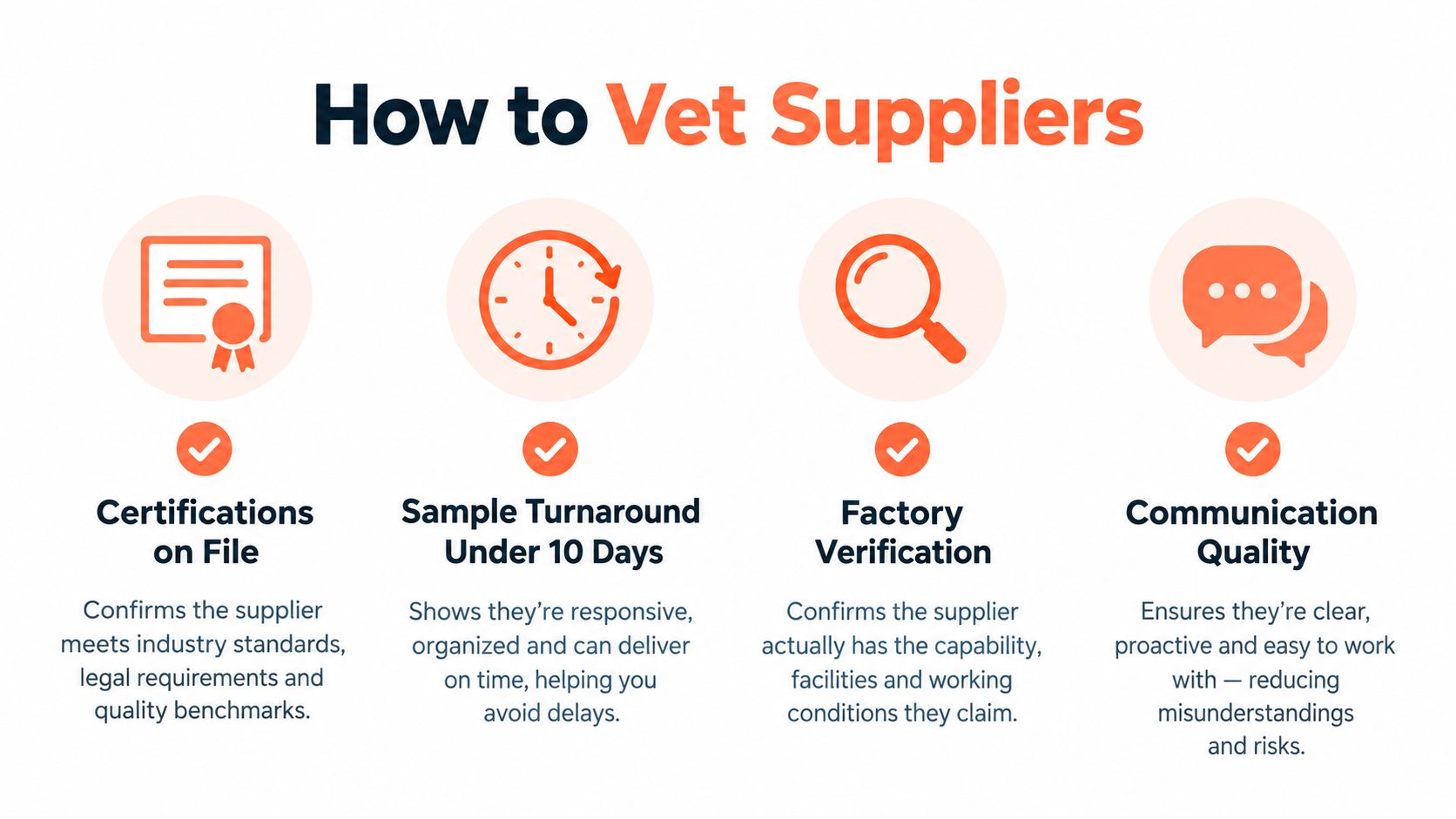
Start with four checks. First, require certifications on file for any material positioned as implant grade or suitable for sensitive use. Second, demand a sample process with a clear turnaround commitment. Third, assess whether the sales contact answers technical questions directly rather than sending another catalog link. Fourth, ask how the vendor checks a full production batch, including whether it can provide clear quality-control records.
Test the physical product
Order representative pieces across your intended range. Inspect the curve, polish, threading, stone setting, closure strength, color consistency, and packaging. Measure gauge and wearable length instead of trusting the product page. If the supplier sends a sample that differs from the listing, stop the evaluation until it explains the discrepancy.
A traditional factory-direct relationship may offer deeper customization and better economics at larger commitments. A no-MOQ platform gives a smaller retailer a different advantage, the ability to test several designs without placing a large bet on an unproven dangle. Neither route removes the need for verification.
Watch the behavior, not just the price
Refusal to provide material certificates is a clear warning. So is a quote that seems incompatible with the claimed material, pressure to pay outside standard protections, or an unwillingness to confirm specifications in writing. You should also be able to trace the sample back to the catalog listing and later shipment.
Use this wholesale jewelry supplier guide as a starting point for comparing supplier credentials, quality, shipping, and inventory fit. Your first partner should survive a controlled sample evaluation, a documented quality review, and a small reorder before receiving a larger commitment.
Pricing, MOQ, and Margin Strategy
Wholesale pricing only matters after you define the sellable unit. A ring that arrives with the wrong gauge, a damaged finish, or an inconsistent closure isn't inventory you can count at full value. Build your margin model around landed cost, inspection time, expected defects, returns, shipping allocation, and the cost of replacing a disappointed customer.
A wholesale purchasing guide cites a potential 40% to 70% discount from retail prices for wholesale jewelry, which explains the channel's appeal. Treat that range as a sourcing benchmark, not as guaranteed margin. The supplier, material, finish, order size, shipping arrangement, and product consistency determine whether the discount survives in practice. See this wholesale jewelry pricing guide for the benchmark.
Compare tiers without pretending every quote is equal
Recent wholesale listings show titanium belly rings ranging from about US$0.50 to US$9.99 per piece, depending on MOQ and finish, as shown in Made-in-China's piercing jewelry listings. That spread is too broad for a simple “cheapest supplier wins” decision. Compare like with like, including alloy documentation, threading, finish, packaging, and freight.
| Material Tier | MOQ 50 | MOQ 250 | MOQ 1,000 |
|---|---|---|---|
| Fashion alloy | Best for testing, usually higher cost per piece | Better assortment economics if quality holds | Only sensible when sell-through is proven |
| 316L stainless steel | Useful for a controlled core test | Practical core replenishment level | Stronger negotiating position, with quality checks |
| Implant-grade titanium | Appropriate for premium sample validation | Suitable for proven core styles | Consider only after repeat quality is established |
| Solid gold | Premium test or special-order approach | Requires careful cash planning | Commit only against clear demand and documentation |
Low or no-MOQ buying is valuable because it lets retailers test colors, dangles, and motifs without overstocking. Supplier roundups report that some wholesalers offer no minimum order quantities on eligible orders, while others use a low $50 minimum, according to this jewelry wholesaler roundup. Use that flexibility for trend SKUs, not as an excuse to avoid a core replenishment plan.
Margin discipline: A cheap tray with returns is more expensive than a correctly specified assortment with a higher invoice cost.
Building an Assortment That Performs Across Channels
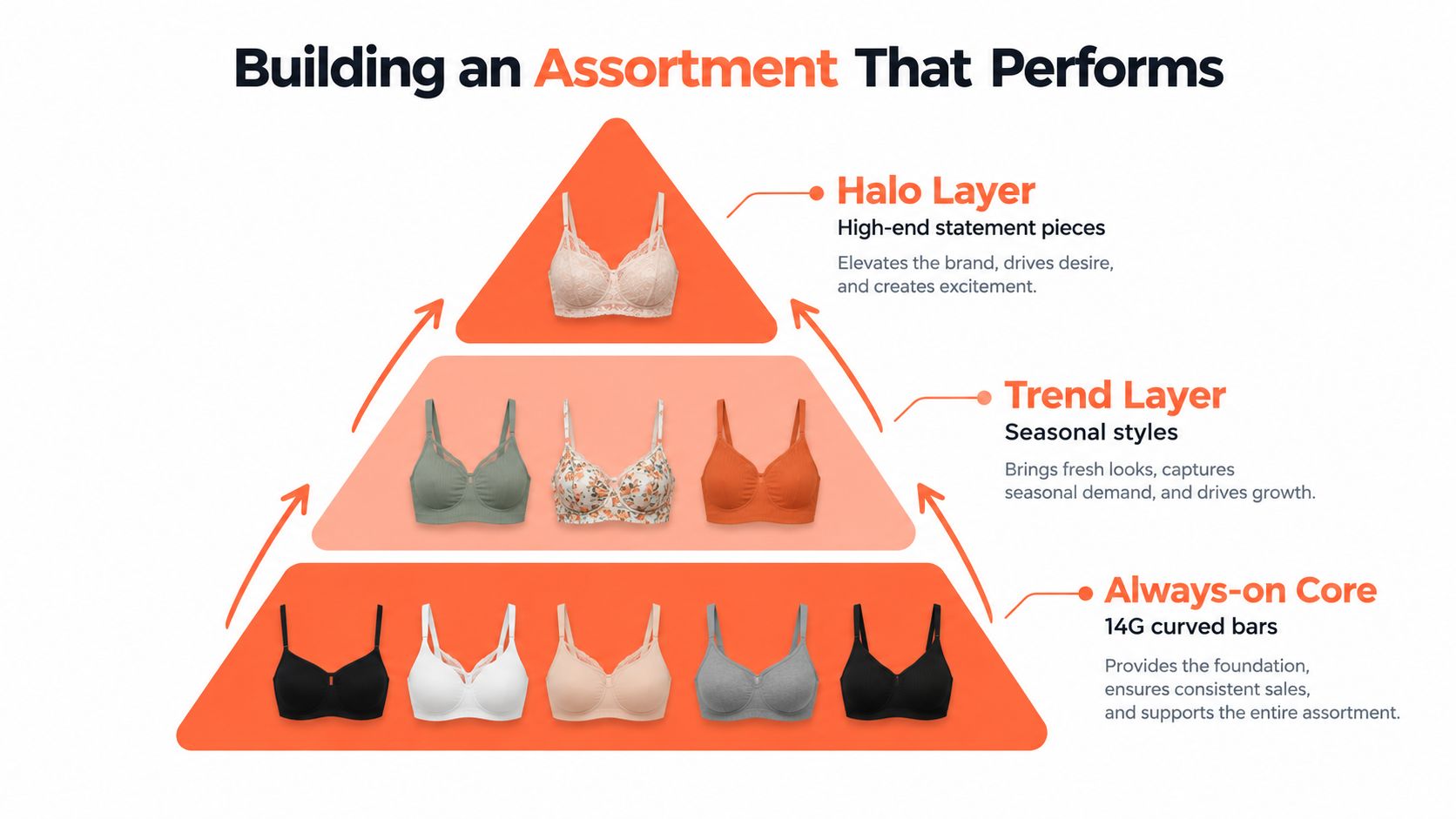
A strong assortment has three layers. The first is the always-on core, the second is the trend layer, and the third is the halo layer. This structure works across Shopify, Etsy, Amazon, physical stores, pop-ups, and social commerce because each layer serves a different buying reason.
The core should center on 14G curved bars in verified titanium and documented 316L stainless steel, supported by simple tops in plain steel, gem, and opal treatments. These pieces answer the practical search query and give customers a dependable replacement option. They're the products that should receive the clearest specifications, strongest photography, and most reliable replenishment.
Let trends earn their depth
Dangles, charms, novelty shapes, and seasonal motifs belong in the trend layer. Sun-and-moon designs can support warm-weather merchandising, while hearts, roses, and collegiate motifs can serve occasion-led campaigns. Keep these buys shallow on flexible platforms, then reorder only the designs that earn attention and sales.
The halo layer should make the buying experience feel complete. Premium statement pieces, insertion aids, aftercare-related accessories, or useful storage products can support a higher-value basket when their purpose and suitability are clearly described. Don't use accessories to compensate for weak jewelry specifications.
Map the layer to the channel
Use the core for search-led product pages and marketplace listings. Use trend pieces for short-form video, live selling, Reels, and TikTok Shop content. Use carefully assembled bundles for Etsy shoppers and in-store customers who respond to gifting and presentation.
A staged release calendar keeps the catalog active without forcing deep inventory. Refresh the core content regularly, introduce trend tests in small batches, and reserve larger replenishment orders for designs that have already proved their appeal. One catalog example, the Bohemian Vintage Geometric Dot Pattern Ring for Women in Stainless Steel with 18K Gold Plating and Natural Stone Accent, is listed as a women's ring with a polka-dot pattern, bohemian and vintage style, a 10g weight, and three variants across option fields. It illustrates why fashion items should be evaluated separately from core navel-jewelry specifications.
Your First Order Checklist and Next Steps
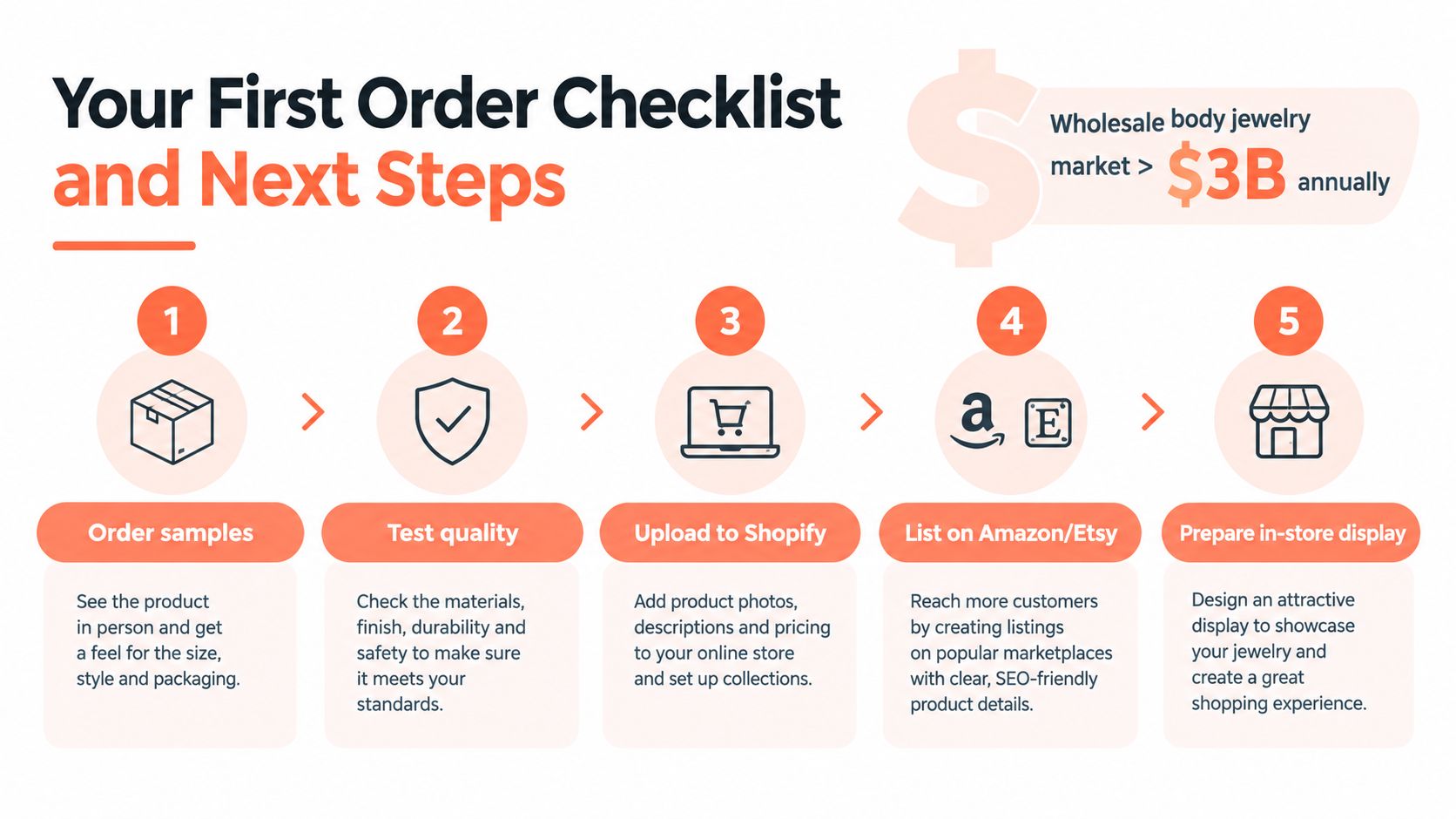
Place a controlled sample order before committing to deeper inventory. Demand for piercing jewelry is established, as Fortune Business Insights reports, so your first order should prove which materials, fits, and designs your customers will buy. A smaller retailer wins by learning faster, not by matching every supplier's catalog.
Source samples from more than one vendor. Include titanium, 316L stainless steel, and one plated fashion style if that tier fits your business. Approve a supplier only after the physical pieces match the stated gauge, wearable length, threading, material, finish, and closure construction. Catalog photography is not evidence.
Use a practical inspection sequence
Photograph each sample flat and worn by a suitable model. Compare its color and scale with the supplier's images, then inspect threading under magnification when needed. Record the stated and measured gauge, stated and measured wearable length, material documents, and visible finish defects.
Use a shared reorder sheet, not scattered notes. Give each SKU separate fields for supplier-stated gauge, your measured gauge, stated wearable length, measured length, lot number, inspection date, and defect notes. If a reorder arrives with a different gauge or length, the discrepancy becomes visible before the pieces reach customers.
Before issuing a purchase order, answer these questions:
- Fit: Does the bar suit the customer profile and healed-piercing use case?
- Construction: Is the threading smooth, secure, and consistent across samples?
- Material: Can the supplier identify the alloy and provide supporting documents?
- Finish: Is the polish even, without rough edges, flaking, or unexplained discoloration?
- Reorder control: Can the vendor reproduce the same specifications in the next shipment?
Place a small reorder across the strongest core designs. Track sell-through, returns, customer questions, and defect reasons. Cut pieces that attract attention but fail to convert. Replenish products customers buy without a long explanation.
Your first buying cycle should build a supplier and assortment you can trust. Once the core passes inspection and earns repeat demand, use flexible MOQ options to test unproven fashion SKUs without putting the margin at risk.
JewelryBuyDirect offers a B2B catalog of body jewelry and fashion accessories, with no minimum order quantity and options including stainless steel, titanium steel, alloy, copper, and gold-plated styles. Visit JewelryBuyDirect to compare wholesale belly button rings before larger buys.