
Acrylic Beads for Jewelry Making: A Wholesale Buyer's Guide
You're comparing a mixed 500g acrylic bead lot at about US$2.80 with a premium assortment that costs several times more, and the catalog photos aren't helping. Both may look bright on screen. One arrives with clean holes and consistent color, while the other has mold seams, cloudy surfaces, or scratches that turn finished jewelry into a return problem.
That's the core buying decision with acrylic beads for jewelry making. Acrylic isn't just the affordable alternative to glass. It's a strategic material for large designs, trend-driven assortments, children's jewelry, and fashion accessories where low weight, color variety, and controlled costs matter. It also has clear limits. Acrylic delivers less sparkle than glass, scratches more easily, and poor finishing can make an entire line look disposable.
The right approach is to match the bead's material, finish, shape, and factory quality to the retail use case. A low-cost lot works when the design needs volume and fast turnover. A premium lot earns its price when the bead will sit in the center of a customer's field of view.
Why Acrylic Beads Deserve a Second Look
A buyer staring at a US$2.80 mixed acrylic lot and a premium assortment should resist the instinct to choose the lowest ticket. The cheaper lot may be ideal for colorful stretch bracelets or craft-oriented products, but it can become expensive if too many beads need sorting, polishing, or removal. Wholesale listings show acrylic beads commonly sold in low-cost bulk packs, including mixed lots around US$2.80, transparent square beads at roughly US$3.95 to US$4.11 per 500g, and mixed-color round beads at US$5.98 (wholesale acrylic bead listings).
The useful question is not “Which lot is cheapest?” It's “Which lot gives me the most sellable beads for this design?” Acrylic beads typically weigh about 0.4g per bead, compared with about 1.5g for glass (acrylic and glass bead comparison). That difference matters when a necklace uses many large beads, when earrings hang from delicate findings, or when a retailer ships bulky statement pieces. Lower weight can reduce the physical burden on the customer and make a design easier to package and transport.
The economics behind a profitable lot
Acrylic also gives small brands more flexibility. A maker can test a seasonal color, build a short run, and reorder without tying as much cash into a heavy glass assortment. That flexibility supports faster stock turnover, especially for colors linked to a short fashion cycle. It also helps retailers build a broader visual range without making every design depend on premium materials.
The material has a useful history in fashion accessories. Lucite, an acrylic resin created by DuPont in 1937, became a major costume-jewelry material after World War II. Its clarity, light weight, and moldability helped it spread through the 1940s and 1950s, and it remained popular into the 1970s (Lucite history and acrylic jewelry). Acrylic beads became more prevalent from the 1960s onward, then broadly dominated fashion jewelry during the 1970s and 1980s because manufacturers could produce them affordably, imitate glass or stone, and keep them lightweight and shatter-resistant (plastic bead dating guide).
| Lot Tier | Price per 500g | Avg. Cost per Bead | Typical MOQ |
|---|---|---|---|
| Entry mixed lot | About US$2.80 | Depends on bead count and size | Small bulk pack |
| Standard transparent lot | About US$3.95 to US$4.11 | Depends on bead count and size | Small bulk pack |
| Better mixed-color lot | About US$5.98 | Depends on bead count and size | Small bulk pack |
| Premium assortment | Supplier-specific | Depends on bead count and size | Supplier-specific |
Practical rule: Use low-cost acrylic for designs that sell through color and volume. Pay more when surface defects will be visible on every finished piece.
What Acrylic Beads Are Actually Made Of
Most jewelry acrylic beads are made from PMMA, or polymethyl methacrylate, a synthetic plastic valued for its low weight, color range, and clarity (jewelry bead material guide). At the material level, PMMA has a refractive index of about 1.49, a density around 1.18 to 1.19 g/cm³, and hardness in the roughly 2.0 to 3.0 Mohs range (PMMA bead properties). Those properties explain the familiar tradeoff. Acrylic can look glass-like without carrying glass weight, but it's softer and more vulnerable to scratches.
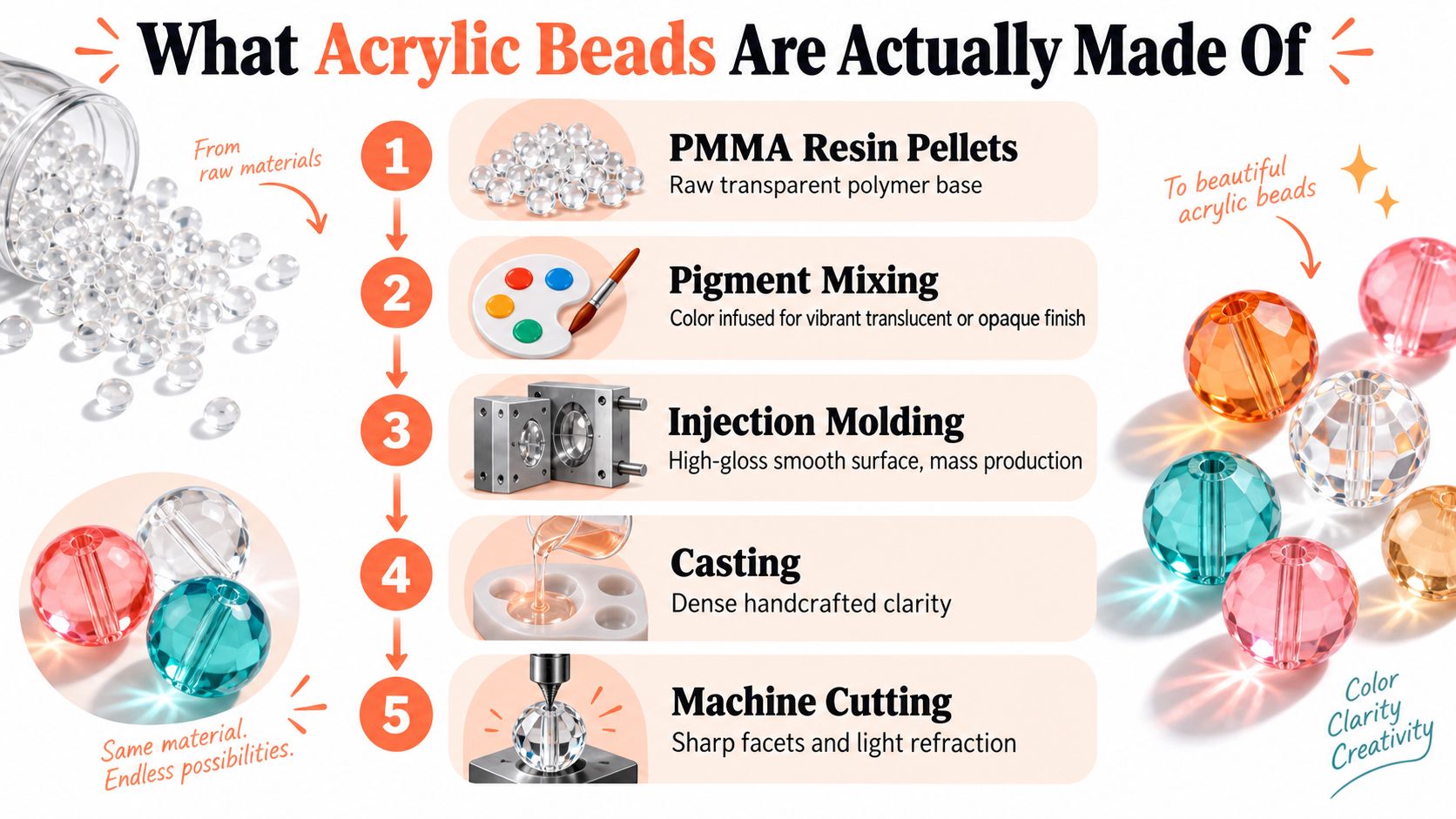
Manufacturers start with resin pellets. They melt the polymer, blend in pigment or effect materials, form the material into bead blanks, create holes, and then polish, coat, or cut the surface. Injection molding generally supports repeatable shapes and efficient production. Casting can produce dense, visually rich material, while machine cutting creates facets that direct light across the bead.
Where factory choices appear in the finished bead
Pigment dispersion is a major quality issue. If color isn't distributed evenly through the melt, beads from the same bag can vary in opacity or saturation. That variation may be acceptable for a deliberately mixed craft assortment, but it looks careless in a coordinated wholesale necklace.
Injection-molded beads usually make sense for molded rounds, uniform bicones, and high-volume color programs. The factory can repeat the same cavity shape efficiently, but the bead may show an equatorial seam that requires tumbling or polishing. Cast acrylic tends to suit deeper translucent effects and specialty appearances, although the added handling and finishing can raise the price. Machine-cut beads offer sharper facets, but buyers should inspect the cut edges and hole transitions closely.
The material itself also sets boundaries. A technical guide reports about 92% light transmittance, UV stability, and hardness in the Shore D 80 to 85 range, while also describing relatively brittle impact behavior with notched Izod impact strength of roughly 0.4 ft-lb/in (technical PMMA bead guide). In practical terms, acrylic can deliver strong clarity and bright color, but rough drilling, excessive tension, and careless packing can create cracks or chips.
Finishes Shapes and Hole Types That Fit Each Style
Finish selection should begin with the customer's intended use, not the supplier's most attractive sample card. An opaque round has a different commercial job from a frosted lentil, even if both occupy the same color family. Buyers who match finish and shape to the product line usually avoid slow-moving assortments built around attractive but impractical pieces.
Finish decisions by product line
Opaque acrylic is the safest volume choice for everyday stretch bracelets, children's accessories, and graphic color blocking. It hides internal imperfections better than clear material and makes bold colors easy to merchandise. Translucent beads work for summer necklaces and layered strands where light passing through the bead adds depth.
Frosted finishes suit bohemian earrings and relaxed, tactile designs. Their softer surface can disguise minor reflections, but it still needs to be even across the lot. Pearl-coated beads support bridal economy lines and occasion accessories, provided the coating is consistent and the holes haven't damaged the finish.
Metallic-luster beads can add polish to fashion pieces, but coating adhesion deserves inspection. Glitter-encased beads fit children's craft kits, playful keychains, and festival accessories. Painted beads offer the most graphic freedom, yet the paint becomes the product's weak point if it chips or rubs during assembly.
Shape and hole selection
Molded rounds and bicones dominate high-volume programs because they're easy to sort, string, and replenish. Hand-cut shapes can support a premium look, but buyers should demand cleaner edges and accept that the production cost will be higher. A flower, star, or irregular geometric shape earns its place when it creates a recognizable design feature, not merely because it fills a catalog page.
Hole design changes assembly speed:
- Single holes around 1mm suit ordinary stringing and common jewelry wire.
- Double parallel holes work for macramé, multi-strand construction, and structured bracelet designs.
- Transverse holes suit floating illusion pieces and designs where the bead needs to sit across the strand rather than along it.
For findings, wire, clasps, and other components that complete the design, compare your bead order with this guide to jewelry findings and components.
| Finish / Hole Type | Best For | Price Band per 500g |
|---|---|---|
| Opaque round, single hole | Stretch bracelets and color-led basics | Entry to standard |
| Translucent round, single hole | Layered necklaces and summer accessories | Standard |
| Frosted lentil, single hole | Bohemian earrings | Standard to premium |
| Pearl-coated round, single hole | Bridal economy collections | Standard to premium |
| Glitter-encased, single hole | Children's kits and playful accessories | Entry to standard |
| Metallic luster, single hole | Fashion statement pieces | Premium |
| Double parallel hole | Macramé and multi-strand designs | Standard to premium |
| Transverse hole | Floating illusion designs | Premium |
Acrylic Versus Glass and Resin in Real Designs
Acrylic wins the sizing and comfort argument before it wins the sparkle argument. For a 10mm round, acrylic averages about 0.4g per bead, while pressed glass averages about 1.5g (acrylic and glass bead comparison). Resin can sit between those materials, with weight varying according to filler load. That makes material choice a design decision, not just a sourcing decision.
A long bib necklace made with many large acrylic beads can remain wearable for hours. Chandelier earrings, festival accessories, and oversized bangles also benefit from the lower load. Glass creates more visual brilliance, but its weight becomes noticeable quickly in large-format designs. Acrylic is also shatter-resistant, which helps reduce breakage risk in handling, although it can still chip or crack when abused.
Three materials, three jobs
Glass earns its place in faceted designs, transparent lampwork-style looks, and products where refractive brilliance is the selling point. Resin is more useful when the design requires sculpted custom shapes or a cast form that acrylic can't reproduce economically. Acrylic is strongest when the line needs broad color coverage, large silhouettes, and manageable wear weight.
| Attribute | Acrylic | Glass | Resin |
|---|---|---|---|
| Typical weight in the stated 10mm comparison | About 0.4g per bead | About 1.5g per bead | Varies by filler load |
| Scratch resistance | Lower, roughly 2.0 to 3.0 Mohs | Typically higher than acrylic | Depends on formulation |
| UV stability | PMMA offers UV stability (technical guide) | Generally stable, depending on coatings | Depends on resin and coating |
| Price per 500g | Commonly low-cost bulk pricing (wholesale listings) | Supplier and finish dependent | Supplier and formulation dependent |
| Typical failure mode | Scratches, seam defects, brittle cracking, coating wear | Weight, chipping, or breakage | Surface wear, yellowing, or inconsistent curing |
| Best design role | Volume, color range, large statement pieces | Faceted brilliance and glass-like sparkle | Sculpted custom forms |
Choose acrylic for volume and color range, glass for refractive brilliance, and resin for sculpted custom shapes.
Quality Checkpoints Before You Place a Wholesale Order
Never approve a wholesale acrylic assortment from a product photo alone. Request a physical sample lot and inspect it under daylight, with the same wire, cord, and findings you'll use in production. A bead that looks acceptable loose in a bag can fail once it becomes the focal point of a necklace.
Start with the mold seam. Run a fingernail around the equator and inspect the line under angled light. A raised seam may be removable through tumbling or polishing, but a deep ridge, offset cavity, or flattened edge signals weak mold control.
Four tests I'd run before approval
- Inspect seam visibility. Sort beads into acceptable and reject piles. If the seam needs extensive hand finishing, include that labor in your landed cost.
- Check hole integrity. Look for clean cylindrical drilling without flashing or cracks. Pass the intended stringing wire through several beads and compare hole diameter with calipers.
- Compare color across the bag. Pull samples from the top, middle, and bottom. Dye-lot drift is especially obvious in translucent, pearl, and metallic finishes.
- Review finish uniformity. Rotate each bead under direct light. Reject dull spots, micro-scratches, bubbles, cloudy areas, and uneven coating.
Stress testing tells you more than appearance
Use a controlled bead drop test on a sample, then inspect the impact point for chips or cracks. Follow with a thread-pull test using the actual cord or wire. A rough hole that cuts the thread may not appear defective until tension is applied.
For coated beads, use an acetone swab only on a sacrificial sample and follow the supplier's safety guidance. Softening, color transfer, or coating removal indicates a surface treatment that may not survive assembly or ordinary wear.
Reject a lot with chipped edges, brittle cracking under finger pressure, inconsistent hole diameters across strands, or widespread raised seams. For broader supplier checks and purchase planning, use this resource on how to buy wholesale jewelry.
Design and Assembly Tips That Make Acrylic Shine
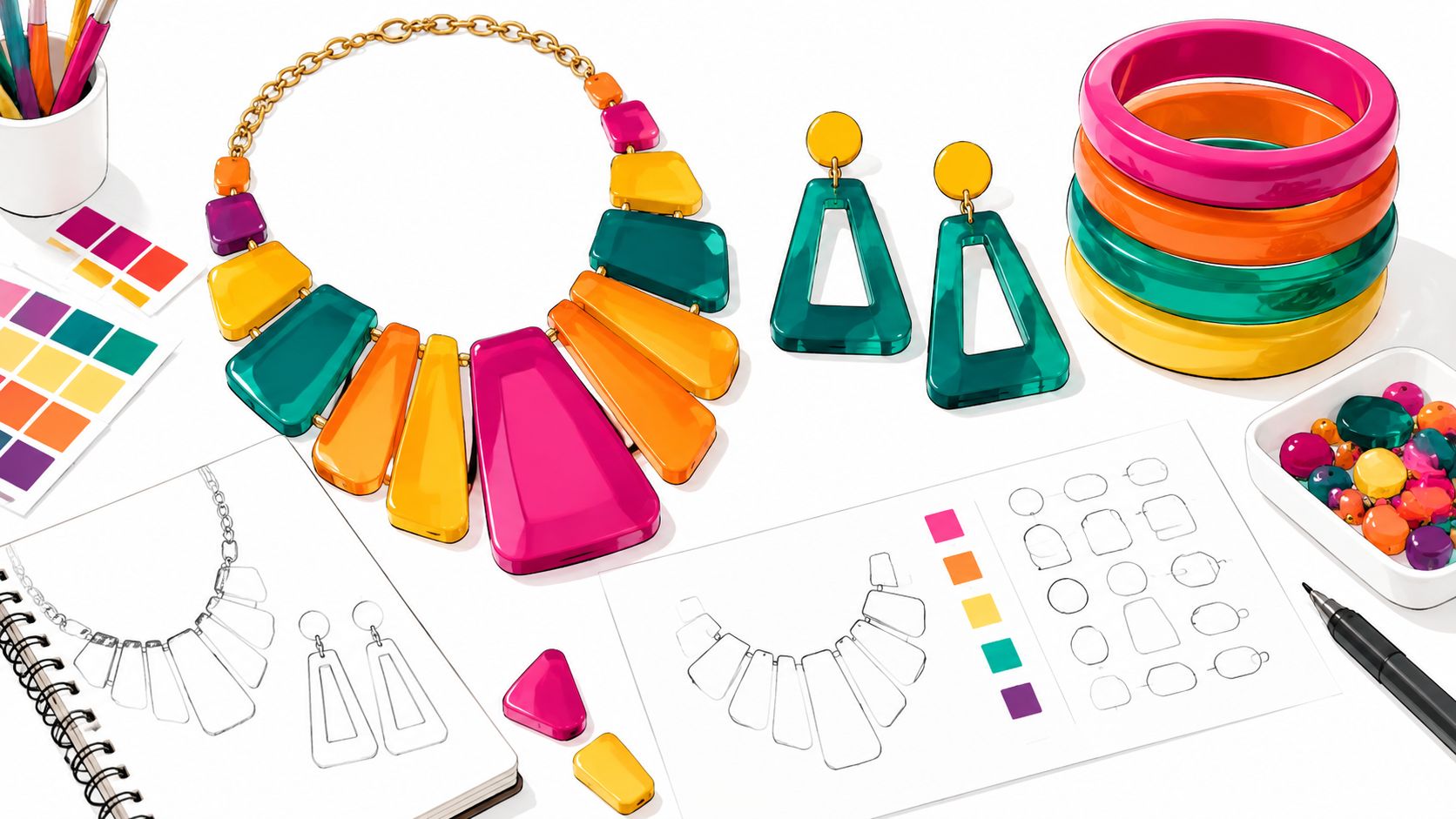
Acrylic looks strongest when the design celebrates scale. Use it for chunky bib necklaces, oversized earrings, bangle stacks, and bold pendant arrangements where a large silhouette matters more than fine refractive detail. The low weight, about 0.4g per bead in the stated comparison, lets you build visual volume without making the customer carry the burden of glass (material comparison).
Opaque colors should read as deliberate graphic blocks. Pair saturated red, cobalt, lime, or black acrylic with neutral cord, restrained metal findings, or a single contrasting bead. Adding too many competing colors often makes an inexpensive assortment look random rather than designed.
Assembly choices protect the bead
Use flexible beading wire instead of rigid thread when the design places repeated stress around drilled holes. Select crimp beads sized 0.5mm larger than the acrylic hole diameter so the connection seats cleanly without forcing hardware into the bead. Avoid glues containing acetone because they can craze acrylic surfaces.
Layering finishes gives low-cost beads more visual depth. A strand combining frosted, pearl, and translucent rounds can look intentionally composed when the colors share a clear palette. Bead caps, knot covers, and polished end findings also help separate the retail product from the raw bulk lot.
- For long necklaces: Use larger acrylic forms and flexible wire to keep the piece light and comfortable.
- For earrings: Reserve oversized shapes for designs with balanced findings and secure attachment points.
- For bracelets: Choose smooth-hole rounds and keep sharp-edged shapes away from elastic unless the holes have passed inspection.
- For children's craft kits: Favor opaque, rounded forms and avoid finishes that shed glitter or paint during handling.
The worst acrylic design is a miniature imitation of fine glass jewelry. The strongest design uses acrylic's own advantages, bold color, generous scale, and comfortable wear.
Sourcing Pricing and Wholesale Strategy for Retailers
A sourcing program should separate material category, finish complexity, and factory consistency. Opaque rounds are straightforward to produce. Pearl, metallic, UV-reactive, and specialty shapes demand more finishing control, so the price should rise with the process, not only with the supplier's branding.
For supplier discovery, screen factories through Alibaba's Trade Assurance and Made-in-China, then request inspection documentation such as DMC inspection reports where available. Don't approve a catalog based on one sample. Request samples at 500g, 2kg, and 10kg tiers so you can compare price breaks, color consistency, packing quality, and defect rates across the quantities you might order.
Price benchmarks by category
The following benchmarks come from the stated sourcing framework, not a universal tariff sheet. Treat them as buying targets to test against samples and factory terms.
| Category | Price per 500g (USD) | Typical MOQ | Lead Time |
|---|---|---|---|
| Opaque rounds | US$1.20 to US$2.80 | Supplier-specific | Supplier-specific |
| Pearlescent beads | US$3.50 to US$6 | Supplier-specific | Supplier-specific |
| UV-reactive and metallic-coated | US$7 to US$12 | Supplier-specific | Supplier-specific |
| Specialty shapes, including Lucite flowers | US$14+ | Supplier-specific | Supplier-specific |
Terms, documentation, and replenishment
Compare FOB and EXW quotations on the same order. FOB pricing generally places more export and freight responsibility with the supplier, while EXW requires the buyer to coordinate more of the movement from the factory. The cheaper headline quote isn't necessarily cheaper after pickup, export handling, freight, inspection, and customs costs.
For origins still affected by the stated 6.8% Section 301 tariff, include that tariff in landed-cost calculations rather than treating it as a surprise at entry. Confirm the product classification and current applicability with your customs broker before placing an order.
Split shipments across two qualified suppliers when a color program is commercially important. That approach adds coordination, but it reduces the chance that one production delay creates a complete stockout. Keep reorder decisions tied to sell-through data and use a quarterly review cadence, rather than replenishing because a color feels popular.
Retailers that need cleaner product information can use effective wholesale line sheets to present finishes, pack sizes, color codes, and reorder details consistently. For broader component planning, review bulk jewelry-making supplies.
Care Durability and the Margin-Saving Mindset
The cheapest acrylic lot doesn't automatically produce the best margin. Consider the supplied example: a US$1.80 lot with a 12% scratch-failure rate can cost more per sellable unit than a US$3.20 lot with a 2% failure rate. Those failure rates and prices are the stated comparison, and the business lesson is straightforward. A lower invoice only helps when the factory delivers enough usable beads to support your finished-product count.
Acrylic's common problems are visible and preventable. Micro-scratches can develop when beads rub against one another during transport or sorting. UV exposure can cause yellowing over a long window display period, and tension around drilled holes can create stress cracking when the bead or assembly is poorly matched to the design.
Turn care instructions into fewer returns
Give customers simple, specific guidance:
- Use a microfiber cloth. Avoid abrasive polishing materials that can mark softer acrylic surfaces.
- Skip ultrasonic cleaners. Mechanical vibration and unsuitable cleaning solutions can damage finishes or worsen existing cracks.
- Store away from direct sunlight. This reduces prolonged exposure that may affect appearance.
- Remove jewelry before swimming. Chlorine can attack PMMA and damage the surface or finish.
Each instruction connects to a recognizable retail complaint. Scratches become “the necklace arrived dull.” Coating damage becomes “the metallic finish rubbed off.” Hole cracking becomes “the bracelet broke.” Clear care guidance won't rescue a defective lot, but it can prevent avoidable misuse after a good product leaves your shop.
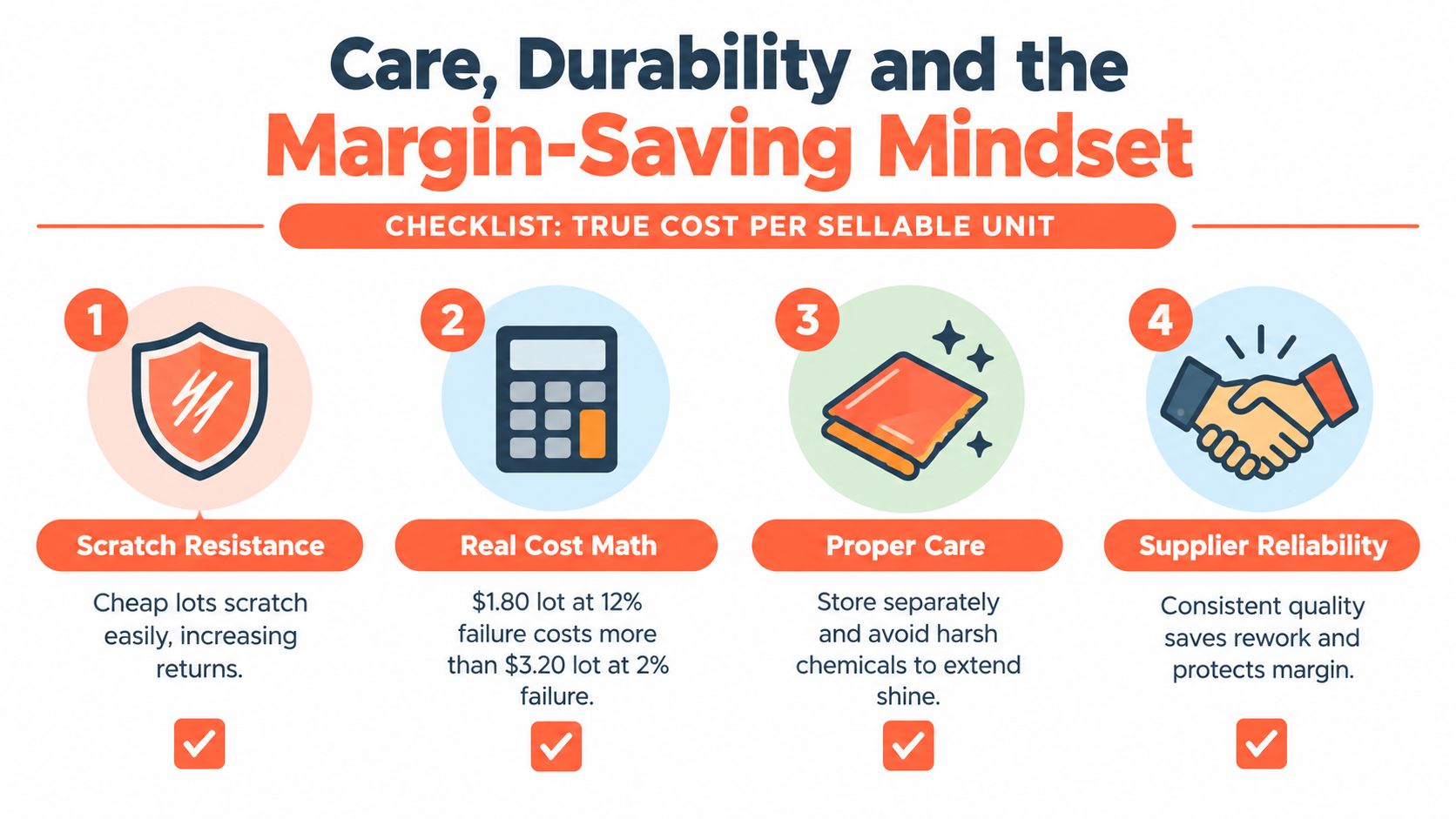
Quality inspection is margin insurance. Sorting, sampling, and testing cost less than remaking finished pieces or refunding a customer.
Build a defect allowance into your purchase decision, but don't normalize a supplier's poor workmanship as the natural cost of acrylic. A clean seam, centered hole, stable color, and even finish make a low-cost material look intentional. That's what turns acrylic from a bargain-bin component into a reliable wholesale category.
JewelryBuyDirect offers wholesale jewelry and jewelry-making components across a broad B2B catalog, with no minimum order quantity and factory-direct sourcing options for retailers and makers. Visit JewelryBuyDirect to compare components, test smaller assortments, and build acrylic-led fashion accessories without overcommitting to inventory.