
Sourcing Jewelry Supplies Tools for B2B Growth
The popular advice is to buy a cheap beginner kit, start making pieces, and upgrade only after sales arrive. That approach works for a hobby project. It fails when customers expect consistent dimensions, clean finishing, dependable replenishment, and on-time delivery. For a growing jewelry brand, jewelry supplies tools are production assets, not incidental craft purchases.
The commercial question isn't “Which pliers should I buy?” It's “Which tool and supplier setup protects margin as volume, product variety, and quality expectations increase?” That shift matters in a category that includes both small-batch making and professional precious-metals processing. The global jewelry making and precious metals processing equipment market was estimated at USD 1.5 billion in 2024 and is projected to reach USD 2.74 billion by 2034, with a projected 6.3% CAGR, according to market coverage of jewelers' tools and equipment.
The Hidden Cost of Beginner Toolkits in Commercial Production
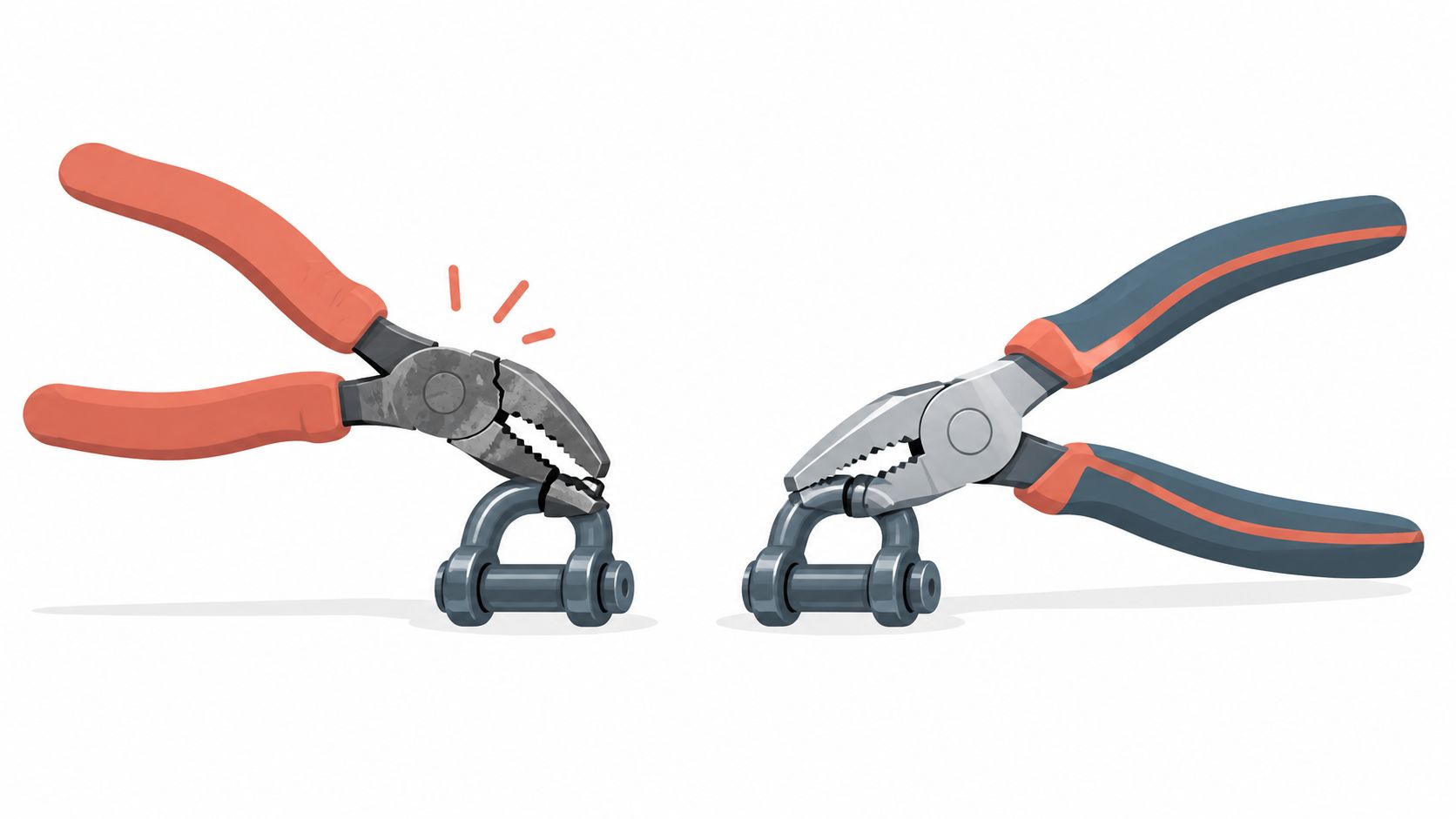
Cheap tools rarely stay cheap once production begins. A loose jaw can mark a finished component. A blunt cutter can deform wire instead of making a clean cut. An inaccurate measuring tool can create a batch of mismatched parts that must be reworked or discarded. Those losses may not appear on the purchase order, but they show up in labor, materials, customer service, and delayed fulfillment.
Most jewelry-making content still stops at beginner hand tools and offers little guidance on when a maker should add safety equipment, soldering tools, or powered bench equipment. The International Gem Society's tool-selection guidance makes the operational point clearly: adding torch work or an advanced setup changes both the workflow and the tool stack.
The upgrade point is operational, not emotional
A maker should upgrade when the tool becomes a constraint. That may happen when repeated orders require identical bends, when a seller adds soldered construction, when stone setting demands controlled pressure, or when multiple people share a bench. At that point, buying another generic kit only spreads inconsistency across more operators.
Start with reliable pliers, flush cutters, saws, files, rulers, and measuring tools for core assembly. Then add equipment according to the production method. A soldering station, torch setup, flex shaft, kiln, or polishing system isn't automatically necessary for every collection, but each becomes justified when the product architecture depends on it.
For a focused look at one essential hand-tool category, review this guide to jewelry needle-nose pliers. The point isn't to collect every variation. It's to match jaw shape, reach, finish, and grip to the work your team repeats.
Procurement rule: If a tool affects alignment, surface finish, heat control, or worker safety, evaluate it by its effect on the finished product, not by its shelf price.
The cheapest toolkit can become the most expensive option for a growing seller because it increases rework, breakage, and unsafe handling. B2B buyers should document those failure points before approving a replacement budget. A dependable bench setup protects throughput and craftsmanship at the same time.
Categorizing Professional Jewelry Making Equipment
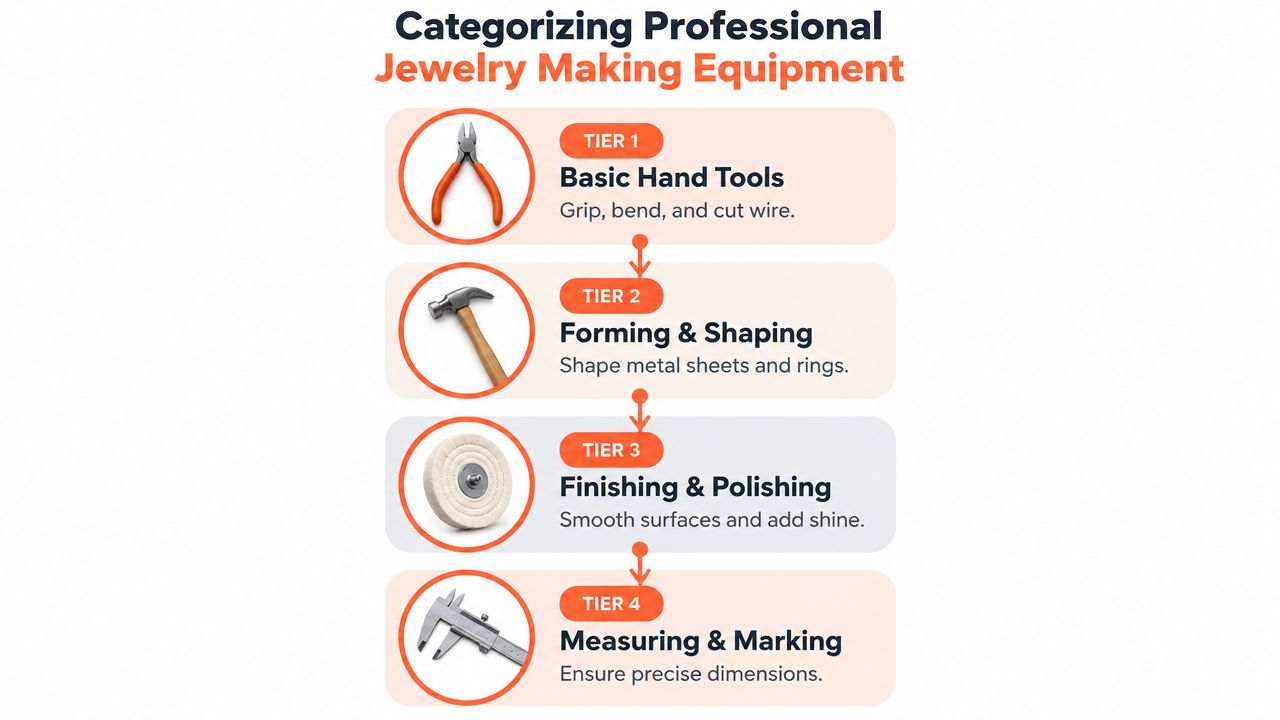
A professional tool stack follows the production lifecycle. Basic hand tools handle manipulation and cutting. Forming equipment changes shape. Finishing systems refine surfaces. Measuring and marking tools control repeatability. Consumables and safety equipment support every stage, even though they often receive less attention in product-list content.
Build the stack around production stages
Basic hand tools include chain-nose and needle-nose pliers, round-nose pliers, flush cutters, jeweler's saws, files, and tweezers. These tools are broadly useful for earrings, links, wirework, findings, and repair. Commercial buyers should inspect jaw alignment, cutting precision, handle comfort, corrosion resistance, and replacement availability.
Forming and shaping tools include chasing and forming hammers, mandrels, blocks, anvils, ring tools, and specialty pliers. These are technique-dependent, but they become essential when a collection uses shaped sheet, consistent ring forms, or repeatable wire profiles. A hammer with the wrong face or an unstable bench block can introduce unwanted marks that later consume finishing time.
Specialized bench equipment includes soldering stations, torches, kiln equipment, flex shafts, rotary tools, polishing motors, and dust-control systems. Don't buy these just because a professional bench appears incomplete. Buy them when the construction method, order volume, or finish standard requires controlled power, heat, or repeatability.
Consumables include saw blades, solder, abrasives, polishing compounds, burs, discs, and protective materials. Their reorder logic differs from capital equipment. Consumables follow usage, while equipment follows capacity, condition, and process requirements.
Finishing is a sequence, not a single polish
Jewelry finishing illustrates why professional procurement requires process knowledge. Coarse sanding and grinding remove surface defects and excess metal. Progressively finer abrasives refine the surface, and buffing compounds create the final polish, as explained in this guide to jewelry polishing tools and abrasive stages.
Using the wrong grit sequence can leave deeper scratches that later stages can't fully remove. The operator then spends more time correcting the surface, with a higher risk of rounding edges, settings, and prongs. For commercial batches, standardize abrasive grades, keep them separated by stage, and record which compound belongs to each metal and finish.
The same logic applies to measuring and marking. Calipers, dividers, ring gauges, templates, and scribes don't add visual appeal, but they prevent avoidable variation. A buyer who understands these categories can specify tools by function instead of purchasing a broad assortment with no relationship to the actual product range.
Use this visual reference to reinforce the hierarchy, then map every SKU in your workshop to a production stage:
B2B Buying Criteria for Wholesale Jewelry Tools
A B2B buyer shouldn't approve a supplier because the product page looks polished or the unit price is low. Evaluate the supplier's ability to deliver consistent specifications, compliant materials, predictable replenishment, and traceable logistics. The buying decision must survive the second order, not just the sample order.
Independent sourcing platforms emphasize that supplier matching should account for MOQs and compliance, while trade-data-driven discovery is becoming more common, as outlined in jewelry supplier sourcing guidance. That reflects the procurement problem. Retailers need dependable supply, not another unverified product list.
Use a qualification sequence
Begin with a written specification. Define material, dimensions, finish, tolerance, packaging, labeling, and intended use. If the tool contacts jewelry surfaces, specify whether the contact area must be smooth, non-marring, or replaceable.
Request samples from the exact production line intended for repeat orders. Test jaw alignment, cutter performance, handle movement, corrosion protection, and performance under the actual materials your makers use. A sample from one supplier location shouldn't automatically qualify a different factory or product family.
Then verify quality documentation and compliance evidence. SGS-certified manufacturing partners can provide a stronger quality-control reference than unsupported marketplace claims, but buyers should still confirm what the certification covers, which facility produced the item, and whether documentation applies to the exact SKU.
Compare the purchasing environments
| Evaluation Criteria | Hobbyist Marketplace | Vetted B2B Wholesale Partner |
|---|---|---|
| Product specification | Often brief or inconsistent | Written specifications and repeatable references |
| Quality control | Evidence may be difficult to verify | Documented checks and clearer accountability |
| Compliance | Buyer may need to investigate independently | Supplier can provide relevant documentation |
| MOQ | May vary without clear planning | Discussed as part of supplier matching |
| Replenishment | Stock can change unexpectedly | Catalog, production, and lead-time planning are more structured |
| Logistics | Tracking and customs support may be limited | Shipping process and issue resolution are defined |
Judge landed cost, not unit cost
The relevant figure includes product price, freight, duties, inspection, packaging, defects, replacement handling, and the cost of delayed stock. A supplier with a lower unit price can become more expensive if it creates inconsistent batches or forces emergency replenishment.
Ask practical questions before committing:
- Can you repeat the specification? Confirm whether future orders use the same materials, dimensions, finish, and packaging.
- What happens when a batch fails inspection? Require a documented resolution process.
- How small can replenishment be? Flexible order sizes reduce inventory exposure for testing and seasonal collections.
- What can you track? Request order status, shipment tracking, carton information, and clear customs documentation.
- Who owns the escalation? A named account contact is more useful than a generic support inbox.
Inventory Management and Cost-Saving Strategies
Inventory discipline starts by separating consumption items from capacity assets. Saw blades, burs, abrasives, solder, and polishing compounds disappear through use and require replenishment signals. Pliers, hammers, calipers, flex shafts, and polishing equipment remain on the balance sheet and should be purchased according to process demand, condition, and operator requirements.
Don't stock every specialty tool before the related product line proves itself. Hold dependable core tools, then add technique-specific equipment when orders, prototypes, or repair requirements justify it. This keeps cash available for findings, finished accessories, packaging, and the materials that directly support current sales.
Create a replenishment system that reflects usage
Track consumption by production batch, not by guesswork. If one collection uses a particular abrasive or blade repeatedly, record withdrawals and set a reorder point based on observed usage, supplier lead time, and the consequence of running out. Keep unopened consumables separated from opened stock so purchasing data reflects actual availability.
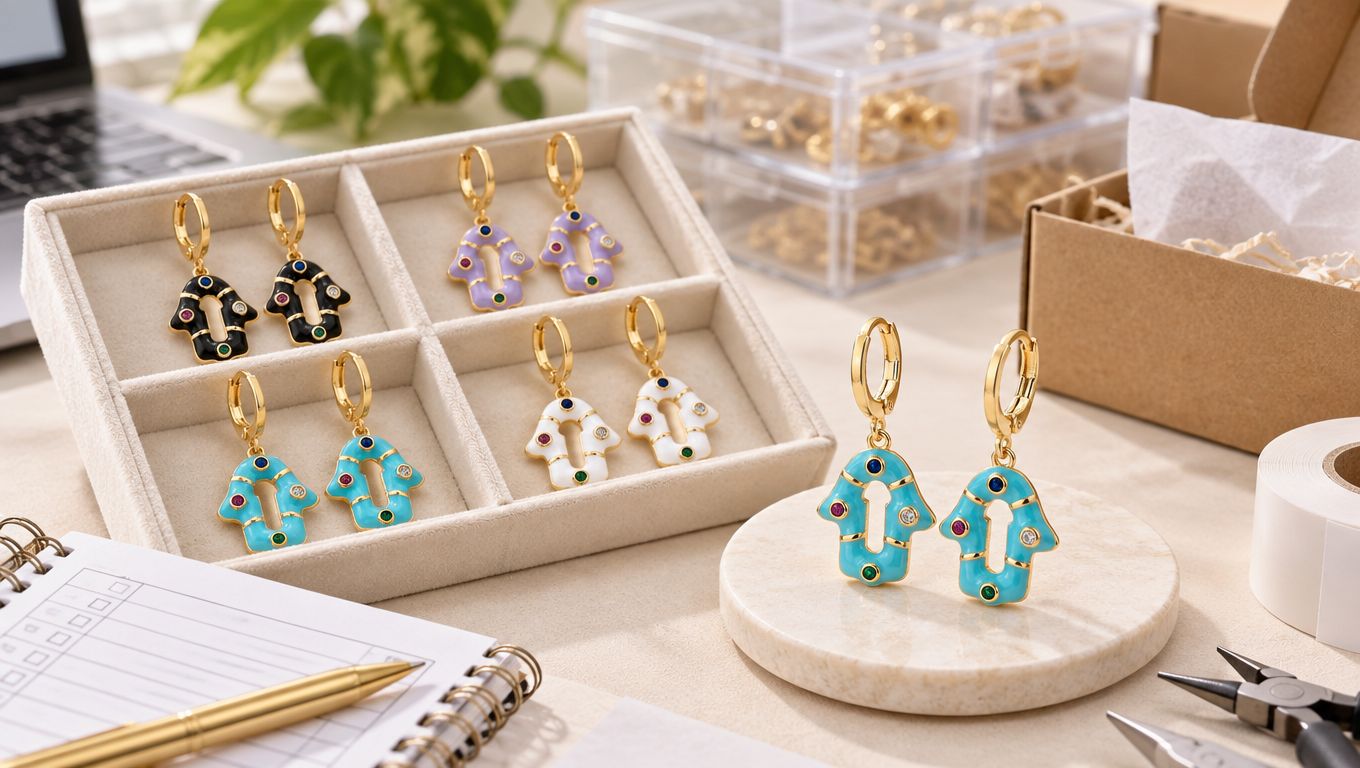
A no-MOQ model can help a small seller test a component or accessory without committing cash to a broad assortment. The same discipline applies to finished goods. For example, Bohemian Geometric Earrings for Women with Copper Base Plated in 18K Gold and Enamel-Set Zirconia are listed as women's earrings in a Bohemian, Minimalist style, with a 20g weight and three variants across option1, option2, and option3.
A practical jewelry inventory management system should connect tool consumption, components, finished items, purchase orders, and returns. For broader ecommerce controls, the Nexist ecommerce inventory management guide is a useful resource for organizing stock visibility and replenishment logic.
Protect margin through purchasing flexibility
Ask suppliers about first-order terms, shipping thresholds, payment timing, and return handling before you build the purchasing plan. A discount only helps if it doesn't push you into slow-moving inventory. Free freight can be useful when the order already matches a genuine replenishment need, but it shouldn't justify buying obsolete tools or untested accessories.
Review SKU performance by product family and production method. Retain the tools that support repeatable core work, consolidate duplicate consumables where specifications allow, and keep a small approved-supplier list for urgent restocks. The objective isn't the largest workshop. It's a responsive one.
Maintenance Protocols and Workshop Safety Standards
A precision tool is only an asset while it remains accurate, safe, and available. Maintenance should sit inside the production routine, not depend on a maker noticing a problem after a cutter slips or a flex shaft vibrates.
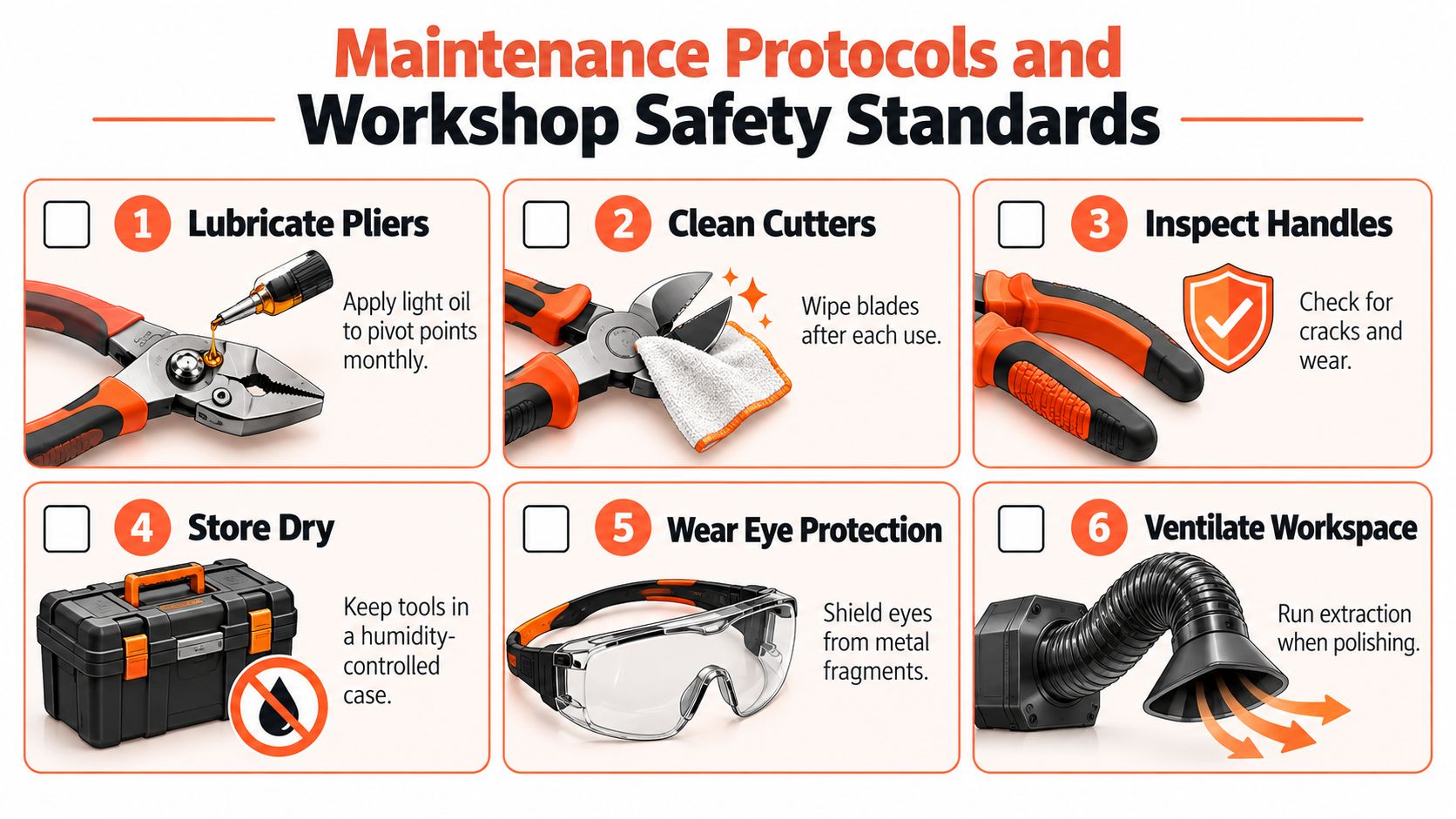
Inspect tools at the start of each shift. Remove metal dust from joints and handles, check edges, test moving parts, and isolate anything with cracks, excessive play, or damaged insulation. Clean tools after use, especially when flux, polishing compound, or abrasive residue can remain on working surfaces.
Assign maintenance by tool type
- Pliers and cutters: Keep pivot points clean and apply light lubrication when movement becomes stiff. Wipe edges after use and never use cutters beyond their rated material.
- Measuring tools: Store calipers, gauges, and rulers where they won't be struck or contaminated. Check them against a known reference when dimensional consistency matters.
- Rotary equipment: Inspect bits, discs, collets, cables, and guards before operation. Replace worn accessories rather than compensating with excessive pressure.
- Abrasives and compounds: Keep products dry, labeled, and separated by grit or polishing stage. Cross-contamination can undermine the finish even when the operator follows the correct sequence.
Make safety visible at the bench
Torch work, kiln operation, polishing, and chemical treatments require controls appropriate to the process. Provide eye protection, heat-resistant surfaces, ventilation or extraction, suitable storage, and clear operating procedures. Workers need to know where protective equipment is kept and when each item is mandatory.
Don't treat safety eyewear or ventilation as optional upgrades. Metal fragments, dust, heat, fumes, and rotating equipment can injure makers and interrupt production. A written inspection log, assigned maintenance owner, and quarantine area for damaged tools turn safety from personal judgment into a repeatable shop standard.
Shop-floor standard: A tool that fails inspection doesn't return to the bench because an order is urgent. It goes into quarantine, gets repaired or replaced, and is recorded.
Streamlining Operations with Unified B2B Platforms
Fragmented sourcing drains margin through repeated specifications, payment terms, quality discussions, shipment records, and supplier failures. As a jewelry brand grows, procurement staff can spend more time reconciling catalogs than approving samples, developing collections, or fulfilling orders.
Consolidation works when one platform covers a substantial part of purchasing without weakening inspection standards. Keep sample approval and specification checks in-house, then use a unified catalog to reorder tools, components, findings, and finished fashion accessories through a controlled workflow.
Consolidation should improve control
A B2B platform earns a place in the procurement process when it provides:
- A broad catalog: One account can cover necklaces, bracelets, rings, earrings, body jewelry, and jewelry-making components.
- Traceable quality references: Supplier and manufacturing details support consistent buying decisions across repeat orders.
- Clear logistics: Shipment tracking and defined issue procedures reduce uncertainty after payment.
- Operational support: Responsive account teams can resolve specification, order, and replenishment questions.
- Flexible ordering: Smaller, controlled purchases let buyers test assortments without committing to excessive stock.
JewelryBuyDirect, or JBD, demonstrates this consolidation model in practice. Its catalog covers 120,000+ SKUs across necklaces, bracelets, rings, earrings, body jewelry, and jewelry-making components. The platform presents factory-direct pricing and works with SGS-certified manufacturing partners, but those claims do not replace buyer-side sample inspection, material checks, or compliance review.
Use one catalog without losing discipline
A unified catalog does not justify approving every listing from one vendor. Create an approved product record for each tool or component, recording material, finish, dimensions, supplier reference, sample status, inspection notes, and reorder history. Before production approval, compare every replacement listing with the previously accepted version.
Apply the same control to fashion accessories. Wholesale suppliers commonly carry sunglasses, costume jewelry, hair accessories, hats, belts, and related categories, as shown in this fashion accessories supplier directory. Retailers can also use vetted directories and trade-show-style platforms to identify global accessory manufacturers through verified accessories sourcing channels.
The procurement platform should reduce vendor administration while preserving specification control. If it merely places inconsistent suppliers under one larger catalog, it has relocated fragmentation rather than solving it.
Scaling Your Jewelry Business with Reliable Sourcing
Creative direction rarely limits growth first. Unreliable supply does. A brand can produce strong designs with skilled makers, yet lose margin when tools vary between orders, consumables arrive late, or accessory suppliers cannot hold the required finish. Treat jewelry supplies tools as production assets, not disposable workshop purchases.
The market is expanding, which means more brands will compete for dependable suppliers and consistent components. As noted earlier, analysts project a 6.3% CAGR for jewelry-making and precious-metals processing equipment through 2034. For an individual seller, that growth increases the need to qualify suppliers before order volume rises. Use the jewelers' tools and equipment market projections for market context, not as a substitute for buyer-side inspection.
Compare the two scaling paths
A fragmented marketplace may provide fast discovery and low-cost listings. It also leaves the buyer responsible for checking each supplier, matching specifications, coordinating shipments, reviewing compliance evidence, and managing batch variation. That approach suits early testing. It becomes expensive once a brand needs repeatable output, predictable replenishment, and controlled landed margins.
A vetted wholesale relationship creates a stronger operating base. Qualify the supplier, approve production samples, document specifications, monitor replenishment, and retain purchasing records for tools, components, and finished accessories. Inspection still matters. Standardized records make it faster and easier to identify a deviation before it reaches customers.
Use this practical supply chain guide to structure broader purchasing controls, then apply the same discipline to jewelry supplies tools:
- Audit the bench: Flag tools that cause rework, dimensional variation, surface damage, or safety concerns.
- Separate core from specialized equipment: Keep universal tools available and purchase technique-specific equipment against a defined production requirement.
- Qualify suppliers: Check samples, material specifications, compliance documents, MOQ, lead time, packaging, and resolution procedures.
- Control replenishment: Track consumables by usage and reorder before shortages interrupt production.
- Consolidate selectively: Use a bulk jewelry-making supplies resource when catalog breadth and flexible purchasing reduce supplier administration.
- Review landed margin: Include defects, freight, customs, labor, returns, and delayed fulfillment in every comparison.
A growing brand does not need the largest inventory. It needs an approved, maintained, and replenishable one. Build that system around verified quality, documented compliance, and cash-flow controls, so trend-driven production can scale without sacrificing craftsmanship.
JewelryBuyDirect offers a centralized B2B catalog for jewelry-making components, finished jewelry, and fashion accessories, with factory-direct sourcing and SGS-certified manufacturing partners. Visit JewelryBuyDirect to assess assortments against your quality, replenishment, and margin requirements.