
Stainless Steel Bangles: Sourcing Guide for Retailers
Stainless steel is a strong jewelry category, not a flawless one. Corrosion resistance starts with an alloy containing at least 10.5% chromium, and a finished bangle sold for prolonged skin contact in the EU must generally release less than 0.5 micrograms of nickel per square centimeter per week under the applicable test framework.
That distinction is where profitable sourcing begins. The boutique owner who buys on the words “surgical steel,” “hypoallergenic,” or “waterproof” without asking for the grade, finish, and test report isn't buying certainty. They're buying a claim that may become a return, a chargeback, or an uncomfortable customer-service exchange.
I've seen buyers get excited about a low unit cost, then discover that the production batch doesn't match the sample, the gold color is a thin electroplate, or the supplier can't explain what “skin-safe” means. Stainless steel bangles can deliver a reliable mix of affordability, visual appeal, and everyday resistance, but only when the buyer treats them as a specified product rather than a generic commodity.
Why Stainless Steel Bangles Are Not the Safe Default You Think
A small boutique owner once ordered a batch of bangles labeled “hypoallergenic surgical steel.” The pieces looked clean in the sample photos, the price fit the shop's target margin, and the supplier promised everyday wear. After the launch, three customers returned bangles. One reported a skin reaction. Another complained about color change around the edges. The third said the finish looked worn far sooner than expected.
The supplier's response was predictable. The bangles were “stainless,” the factory said, so the problem must have come from the customers. That answer wasn't useful. The listing had never identified the exact grade, nickel-release test method, plating system, or finished-surface documentation.
Buyer's rule: If a supplier can't define the material beyond “surgical steel,” treat the description as incomplete.
Stainless steel isn't a single jewelry material. Grades differ, surfaces differ, and plated pieces behave differently from uncoated ones. A polished 316L bangle, a brushed 304 bangle, and a gold-colored bangle with a separate coating may all appear in the same catalog category while carrying very different return risks.
The category still deserves serious attention. Stainless steel gives retailers a practical alternative to softer or more reactive base metals, especially for customers who want a modern silver tone without precious-metal pricing. It also supports open, adjustable, geometric, stackable, engraved, and stone-set designs without forcing every order into a luxury price position.
What the failed batch teaches
The cheapest supplier often isn't the cheapest source. A low purchase price becomes expensive when a retailer has to replace pieces, refund shipping, answer allergy complaints, or remove a product page after a marketplace dispute. The true buying decision includes:
- The alloy grade, not just the word stainless.
- The finished surface, including polish, brushing, blasting, or plating.
- The nickel-release evidence, where prolonged skin contact makes it relevant.
- The production consistency, checked against an approved sample.
- The wording on the listing, which must match what the supplier can document.
That is the frame I use for stainless steel bangles. They're a strong category, but they aren't a permission slip to stop checking specifications.
The Material Science Behind the Marketing
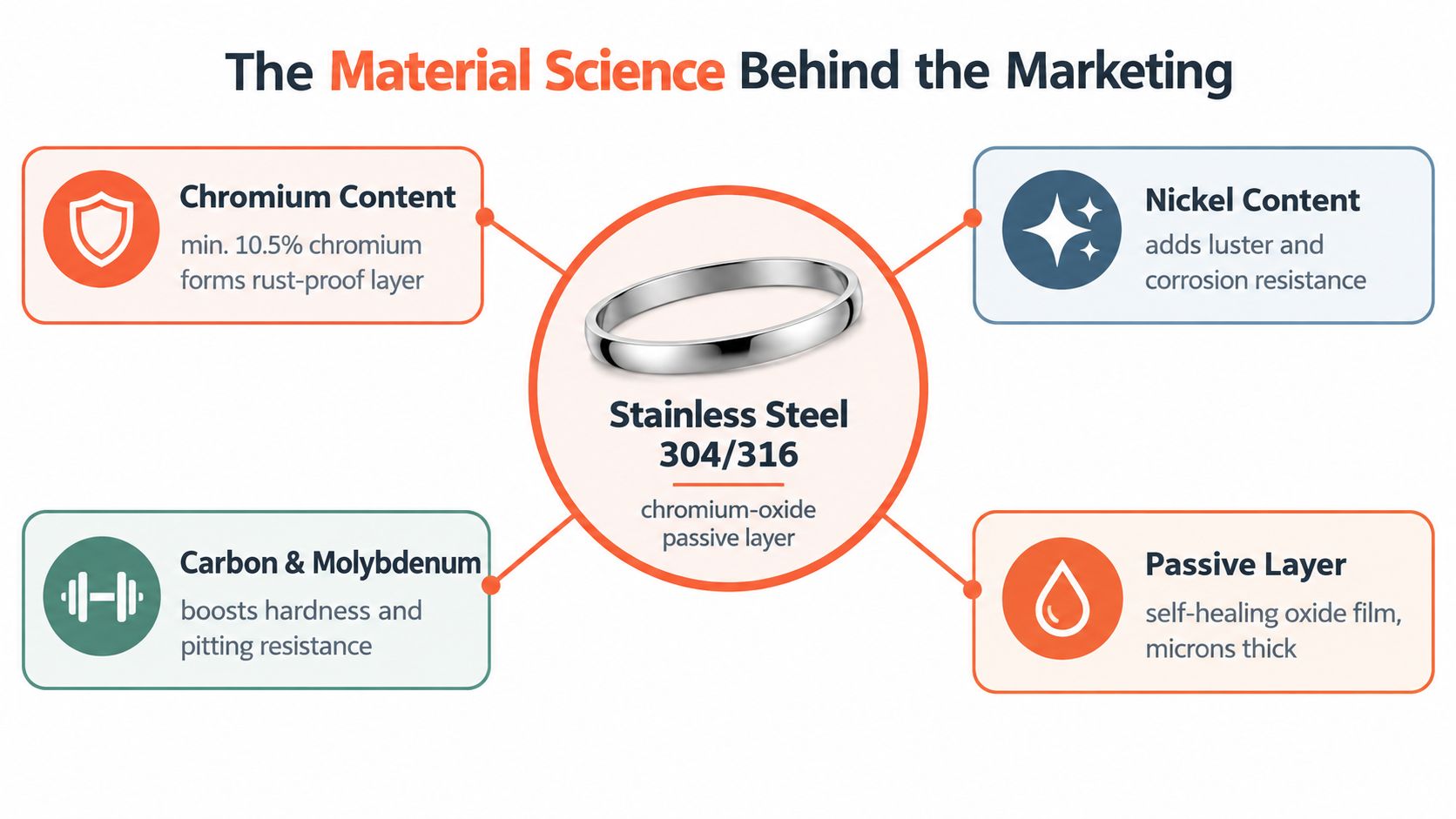
Stainless steel earns its name from chemistry, not from a decorative film. On 13 August 1913, British metallurgist Harry Brearley produced an alloy widely recognized as the first true stainless steel, containing approximately 12.8% chromium and 0.24% carbon. Earlier work by P. Monnartz and W. Borchers established that corrosion resistance increased substantially once steel contained at least 10.5% chromium. The historical development is documented in Wired's account of the first stainless steel.
When chromium in the alloy meets oxygen, it forms a thin chromium-oxide passive layer on the surface. That layer renews itself when the surface is exposed to oxygen, which helps reduce visible rust and surface corrosion. Brearley tested the original alloy against nitric acid, lemon juice, and vinegar, demonstrating the chemical-resistance principle that later made stainless steel useful in wearable accessories.
Translate the chemistry into buying language
The passive layer doesn't make a bangle immune to every environment. Sweat, saltwater, humidity, sunscreen residue, trapped moisture, acidity, and chlorine can challenge the surface, especially when the grade or finish is poorly selected. A bangle can remain attractive under ordinary use while still experiencing surface change or releasing small amounts of nickel if corrosion conditions develop.
That's why the alloy name matters more than a product title. “Stainless” describes a family of corrosion-resistant alloys, not one guaranteed formula. A coating can create a color or visual effect, but it isn't the same thing as the chromium-rich surface chemistry within the steel itself.
For a deeper explanation of the grade most often discussed in jewelry, see this guide to 316L stainless steel jewelry. Use it to support product training, but keep your own supplier file more specific than a marketing label.
What can weaken the protection
Chlorinated pool water and harsh cleaning chemicals deserve a warning. Abrasive cleaning can also damage a brushed or coated surface, even when the underlying steel remains sound. For solid steel, mild soap, warm water, a soft brush, thorough rinsing, and microfiber drying are sensible care instructions. For PVD or other colored surfaces, skip polishing because abrasion removes the color layer.
The useful mental model is simple. Chromium gives the steel a passive defense. The exact grade, the surface condition, and the customer's environment determine how well that defense performs.
Reading the Grades and Finishes Buyers Encounter in Factory Catalogs
Factory catalogs commonly list 304, 316, and 316L. Those grades are more useful than “premium steel,” but they are not a complete buying decision. They affect corrosion behavior, composition, cost, and the type of wear your product can credibly support.
304 suits fashion-led assortments where design, finish, and accessible pricing drive the sale. 316 and 316L support a stronger corrosion-resistance position for bangles intended for frequent or prolonged wear. The “L” identifies a low-carbon variant. A grade label still does not prove skin-contact compliance or guarantee consistent finishing from one factory to another.
Nickel requires precise product documentation. A commonly cited composition for 316L includes approximately 10–14% nickel, as discussed in this stainless steel jewelry quality reference. That figure does not decide whether the bangle is suitable for sale. Ask how much nickel the finished article releases, which test method was used, and whether the result supports the market where you sell.
Use the finish as a merchandising decision
A mirror polish photographs sharply, yet it exposes fingerprints, hairline scratches, and handling marks. Choose it for clean, minimalist designs only when the approved sample arrives without polishing haze.
A brushed or satin finish conceals minor marks better and gives daily-wear bangles a quieter appearance. The grain must run consistently across the surface. Mixed directions and uneven patches show clearly under retail lighting, so reject them rather than hoping photography will hide the defect.
Hammered surfaces add texture and can disguise light wear, but inspect the depth and regularity of every mark. Engraving can add value without changing the base material, although shallow lines may lose definition beneath a heavy coating. Stone-set designs create another quality risk. Check setting security, symmetry, and adhesive residue instead of judging only the steel.
| Grade | Typical use | Nickel content, verify with supplier specification | Wholesale price tier |
|---|---|---|---|
| 304 | Accessible fashion bangles and broad style assortments | Range varies by supplier. Confirm the specification. | Entry to mid |
| 316 | Higher-resistance positioning and frequent-wear designs | Range varies by supplier. Confirm the specification. | Mid |
| 316L | Premium stainless jewelry positioning and prolonged-wear candidates | Approximately 10–14% in a commonly cited composition, see the quality reference linked above | Mid to upper |
Use the table to screen options, not to replace documentation. Put the grade on the invoice, retain the approved sample, and test the finished article when the bangle is intended for prolonged skin contact. A catalog label is a starting point. Your supplier file is what protects the product claim when a customer challenges it.
Plated Bangles and the Color Story
Most shoppers don't walk into a store asking for chromium content. They ask for gold, black, rose, or silver. Color determines how a bangle fits a collection, but the color layer also determines how accurately you can describe wear.
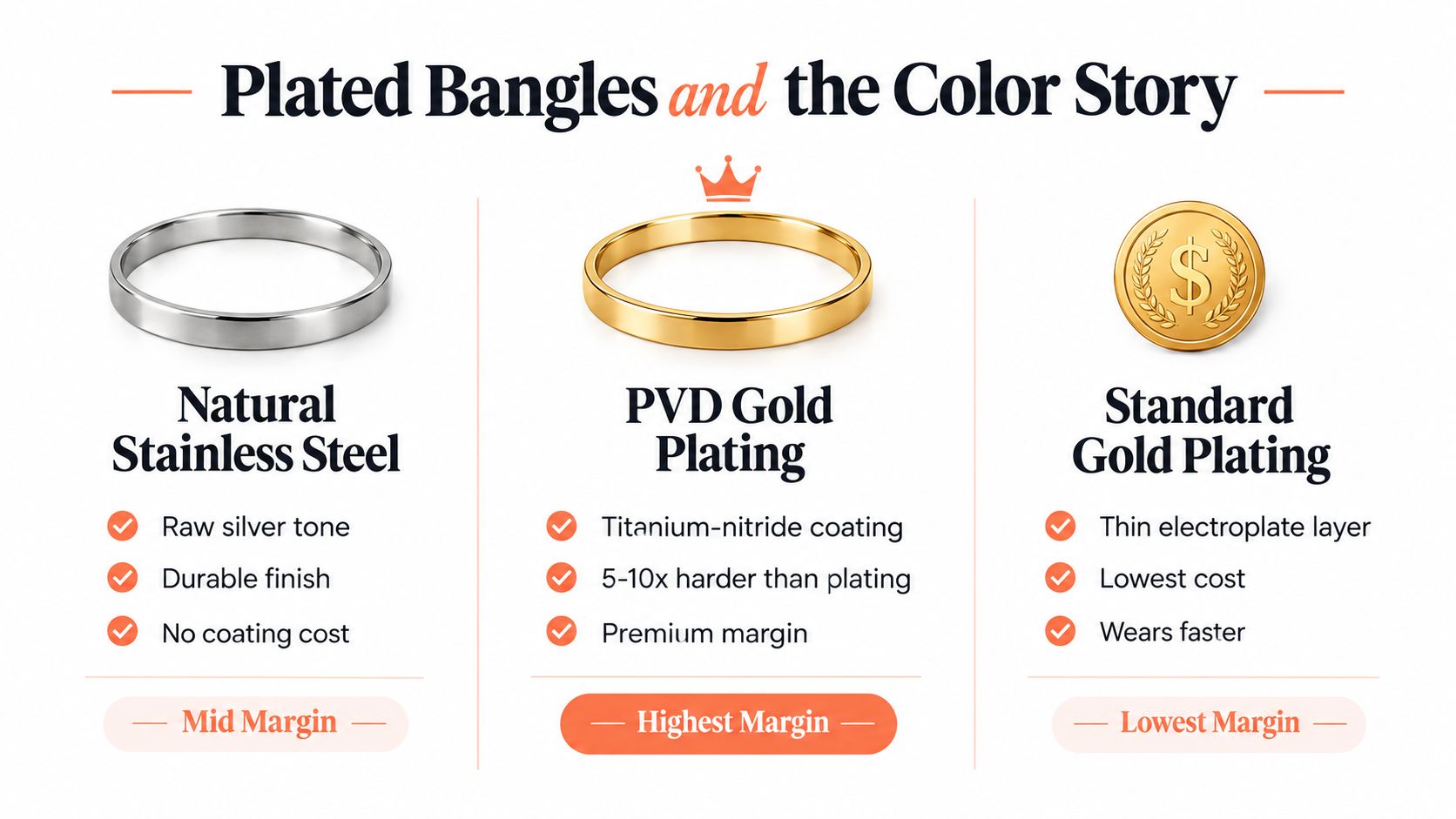
Natural stainless steel has the cleanest durability story because there isn't a separate color coating to abrade. It can still pick up marks, lose visual clarity under residue, or react to harsh conditions, but the surface remains the same alloy rather than exposing a different base metal beneath a thin decorative layer.
PVD, or physical vapor deposition, is a harder coating system than ordinary electroplating and is widely used for colored stainless steel jewelry. IP, or ion plating, is often used as a related commercial term, though buyers should ask the factory exactly what process and coating structure it means. Neither term justifies “never fades.” The coating is still a layer, and edges, contact points, clasp areas, and high-friction zones deserve close inspection.
Choose color by use, not by sample-table beauty
Standard electroplating usually wins on upfront cost. It can look excellent when new, but a thin layer is more vulnerable to abrasion, sweat, chemicals, and contact with other jewelry. It makes sense for trend pieces with a short merchandising cycle, not for a product page promising permanent color.
PVD or IP generally supports a stronger premium argument, but the buyer still needs coating specifications, adhesion evidence, and a production sample. A gold PVD bangle can command a better retail position because the color and surface usually feel more substantial, yet the correct care advice remains mild cleaning and no abrasive polishing.
Natural steel tends to produce a mid-margin product with the lowest claims risk. PVD or IP can create a higher-margin item when the design and color are right. Standard gold plating can fill an entry price point, but don't let a low factory quote hide the cost of color-related returns.
Merchandising advice: Sell the color as a finish, not as a permanent transformation of the metal.
Compare the production sample under the same lighting used for catalog photography. Check the inside of the bangle, edges, openings, adjustment points, and any area that rubs against skin. A color that matches on the face but shifts at the edge will create complaints quickly.
For terminology and process details, use this explanation of PVD coating on jewelry. Keep the customer-facing copy shorter and more honest than the factory vocabulary.
Wholesale Pricing, MOQ Strategy, and Sampling
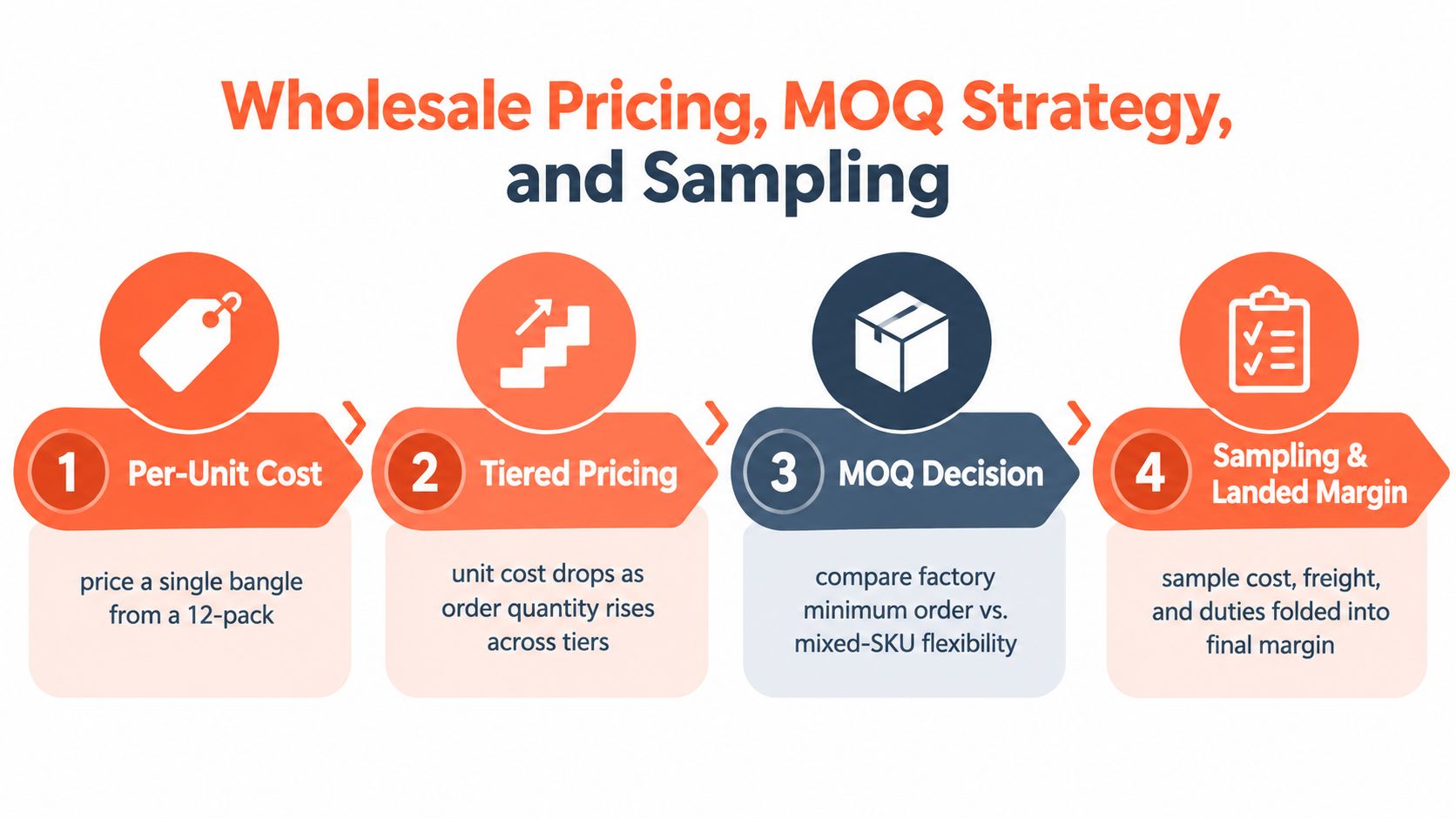
A wholesale quote is only useful when you can convert it into a landed product decision. Start with the per-unit cost from the supplier's pack structure, such as a 12-bangle pack, then add freight, duties where applicable, packaging, payment fees, and the expected cost of damaged or unsellable pieces. The unit price on the invoice is not your margin.
Build the order in layers
Ask for quantity tiers rather than one price. The factory may offer a lower unit cost at higher volumes, while a platform may give you mixed-SKU flexibility with a smaller commitment. Compare both structures against your actual assortment needs. A low per-unit number is useless if half the designs sit in storage.
A useful Monday-morning routine looks like this:
- Price the individual bangle. Divide the pack price by the number of pieces and record the finish, grade, packaging, and stated dimensions.
- Request the next quantity tiers. Ask what changes when you add units, mix styles, or reorder the same design.
- Separate factory MOQ from platform MOQ. A factory may require a larger run, while a flexible wholesale channel may allow mixed products or no minimum order quantity.
- Calculate landed cost. Include freight and all predictable charges before setting a retail price.
- Order samples before photography. Photograph the piece you will sell, not a supplier image that may show a better finish.
A small first order beats a confident large order
Suppose your first test budget is $300. Don't place it all behind one fashionable style. Split the order across three distinct bangle designs, such as a polished open style, a brushed stackable style, and a colored geometric style. Photograph each, wear-test each, inspect the coating and adjustment points, then compare customer response before repeating the order.
The point isn't to predict a bestseller from a catalog thumbnail. The point is to discover which combination of grade, finish, color, fit, and price produces the fewest objections.
Cross-check two suppliers and one marketplace reference before committing. Use this wholesale stainless steel jewelry buying resource as one reference point, then verify the actual specification and landed cost for the product you want.
The Claims That Hurt Retailers Most
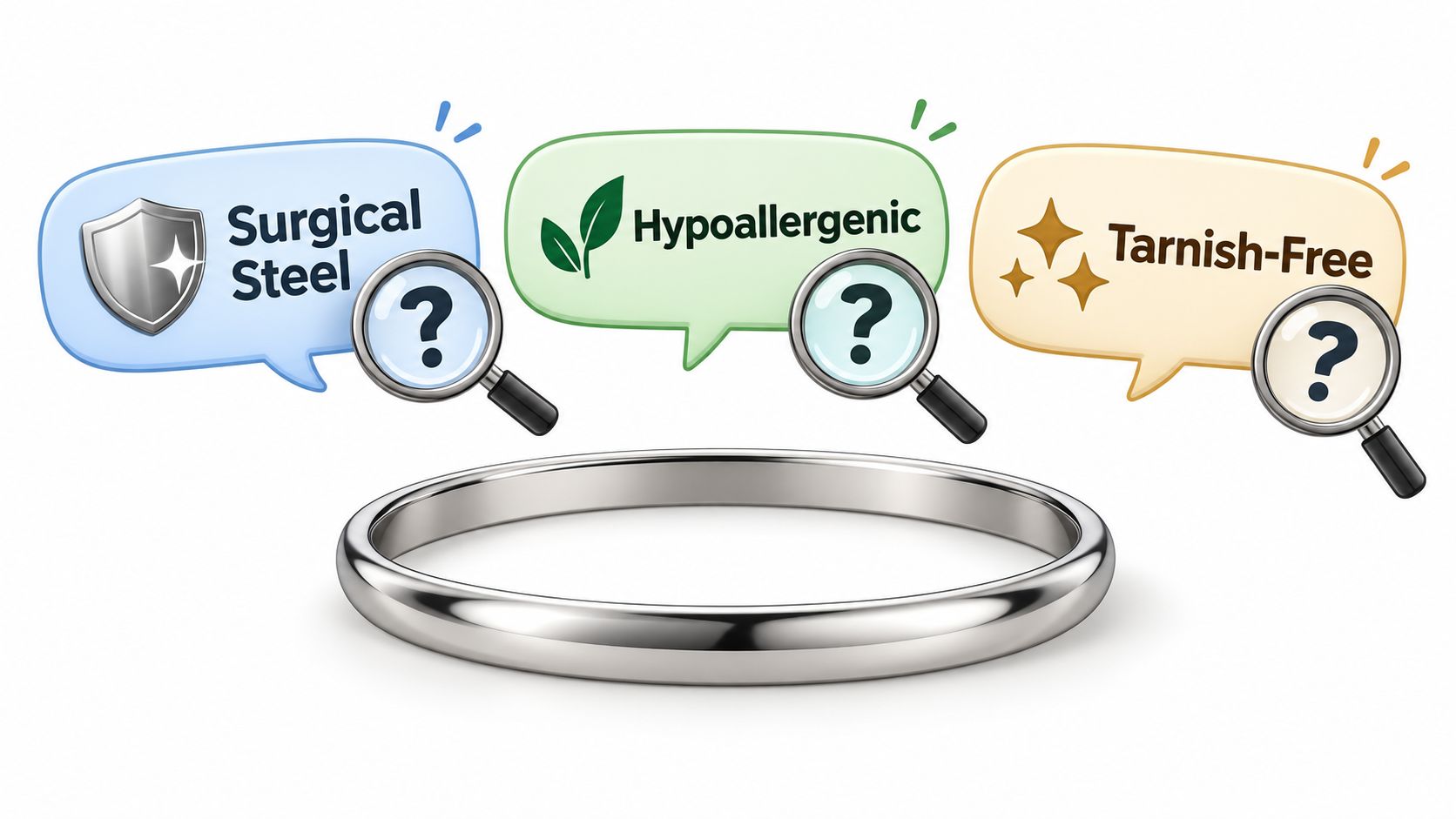
The words that sell stainless steel bangles can also create the returns. “Surgical steel” sounds medical and standardized, but it isn't a legally standardized jewelry designation. Ask what exact alloy grade the supplier means and whether the finished article has test documentation.
“Hypoallergenic” is even more dangerous as a blanket promise. The relevant question is nickel release during prolonged skin contact, not merely whether the alloy contains nickel. Under the EU REACH framework, bracelets and bangles worn directly against the skin generally need to release no more than 0.5 micrograms of nickel per square centimeter per week when tested using the EN 1811 reference method, as explained in this nickel-release compliance position paper. Piercing posts have a stricter 0.2 microgram per square centimeter per week threshold, which isn't normally the category for a conventional bangle.
Replace slogans with defensible wording
Even 316L can contain nickel and has been associated with allergic dermatitis in some cases. A compliant result reduces a defined risk, but it doesn't guarantee that every highly sensitive customer will tolerate the piece. Write that distinction into internal product training and customer-service replies.
| Risky claim | What it implies to a shopper | Safer product language |
|---|---|---|
| “Surgical steel” | Medical-grade certainty | State the exact grade and finish |
| “Hypoallergenic” | No skin reaction | Identify nickel-release documentation and avoid absolute promises |
| “Tarnish-free” | Permanent appearance | Describe corrosion resistance under ordinary care |
| “Waterproof” | Safe in every liquid and activity | Give practical care limits, especially around chlorine and chemicals |
| “Never fades” | Color cannot change | Name the plating system and describe the color as a finish |
A retailer should also explain that sweat, saltwater, sunscreen, trapped moisture, and coating damage can affect real-world performance. Recommend rinsing and drying after swimming or heavy perspiration, and tell customers not to polish colored surfaces.
The Federal Trade Commission Jewelry Guides require marketers to represent a jewelry product's type, kind, grade, quality, quantity, metallic content, size, weight, durability, serviceability, origin, price, value, manufacture, and distribution truthfully. That makes precise copy good risk control, not merely cautious writing.
Compliance, Documentation, and Product Pages That Hold Up
A defensible product file doesn't need to be complicated. It needs to connect the listing to the item that arrives in the carton.
Keep the exact alloy grade, the supplier's material declaration, the finish description, and the country of origin together. If the bangle is colored, record whether it uses PVD, IP, electroplating, or another system. Ask for coating durability evidence where the supplier makes a durability claim, and retain the production sample used for approval.
For EU-facing products, request an EN 1811 nickel-release test report for the finished article or a clearly matching product family. The applicable benchmark for prolonged direct skin contact is generally 0.5 micrograms per square centimeter per week, while piercing components use 0.2 micrograms per square centimeter per week. Don't treat a grade label as a test result.
Write the page around evidence
A clean product page should state:
- Material: Exact stainless steel grade, if documented.
- Finish: Natural polished, brushed, matte, hammered, engraved, or plated.
- Color treatment: PVD, IP, electroplated, or uncoated.
- Care: Rinse and dry after heavy perspiration or exposure to saltwater, and avoid harsh chemicals.
- Fit: Open, adjustable, hinged, or fixed construction, with dimensions supplied accurately.
- Skin-contact information: Available test method and documentation, without a universal allergy promise.
- Origin and quality details: Written consistently with supplier records.
The FTC guidance on truthful jewelry product representations applies to more than precious-metal pieces. It matters whenever a listing makes claims about material, durability, quality, or construction.
Photography is part of the specification too. The required 383:204 display ratio is approximately 1.877:1, so export at 766 × 408 pixels or 1,149 × 612 pixels. Frame the entire bangle with safe margins. If CSS uses object-fit: cover, the browser preserves the image proportions but crops excess content, which can remove the clasp, opening, packaging, or adjustment detail. Responsive image guidance from web.dev explains why object-position controls which portion remains visible after cropping.
Sourcing Checklist and What to Do on Your Next Order
Hand this checklist to anyone placing an order for stainless steel bangles:
- Confirm the alloy. Record 304, 316, 316L, or the exact supplier specification. Reject “premium steel” as a complete answer.
- Check the finished surface. Inspect polish, brushing, hammered texture, engraving, stone settings, edges, and adjustment points.
- Identify every color layer. Natural steel, PVD, IP, and electroplating shouldn't share the same care or longevity claim.
- Request nickel-release evidence. For EU prolonged skin contact, look for EN 1811 testing against the applicable threshold.
- Compare sample and production. Keep an approved sample and require the supplier to confirm that the production alloy and finish haven't changed.
- Inspect after wear. Test sweat, moisture, clasp friction, and cleaning before publishing “daily wear” language.
- Audit the listing. Remove unsupported promises such as “zero reaction,” “never fades,” and “waterproof.”
- Prepare the image correctly. Use the 383:204 ratio, export the full bangle inside safe margins, and check the live crop.
If you're planning a wider accessory assortment, review how to check best crafts with Tagada for ideas beyond one product category. Then pull your current bangle listings and flag every item that relies on “surgical steel” or “hypoallergenic” without documentation. Place a small comparison order from a second supplier this week, inspect both batches side by side, and let the evidence decide what earns a reorder.
JewelryBuyDirect offers wholesale stainless steel bangles and other jewelry styles with no minimum order quantity, factory-direct sourcing, and product options suited to boutiques, online sellers, and small test assortments. Visit JewelryBuyDirect to compare grades, finishes, and colors before your next order, then verify the documentation and sample quality before publishing the claims.