
Toe Ring Wholesale Guide for Retailers
You've stocked a tray of attractive toe rings, placed them beside the sandals, and expected an easy add-on sale. Instead, customers return rings that slide off, lose their finish, or feel uncomfortable after a few hours. The problem usually isn't demand. It's sourcing.
Toe ring wholesale sits at the intersection of fashion, body jewelry, fit, and direct skin contact. A supplier can offer a low unit price while leaving you with inconsistent sizing, weak plating, or incomplete compliance documentation. The right buying strategy protects your margins by treating toe rings as trend-sensitive products that need accurate fit, durable materials, and flexible replenishment.
Why Toe Rings Keep Getting Returned
The familiar retail failure starts innocently. A buyer chooses a mixed batch because the designs photograph well and the supplier promises quick dispatch. The display looks full, but customer feedback soon reveals three problems: the ring doesn't stay in place, the finish changes after exposure to moisture, and the style feels different from what shoppers expected online.
Toe rings are harder to source than they appear because they sit on a part of the body exposed to sweat, friction, water, footwear pressure, and temperature changes. A small mistake in alloy selection or fit becomes noticeable quickly. A retailer who judges the product only under showroom lighting misses the conditions that shape the customer's experience.
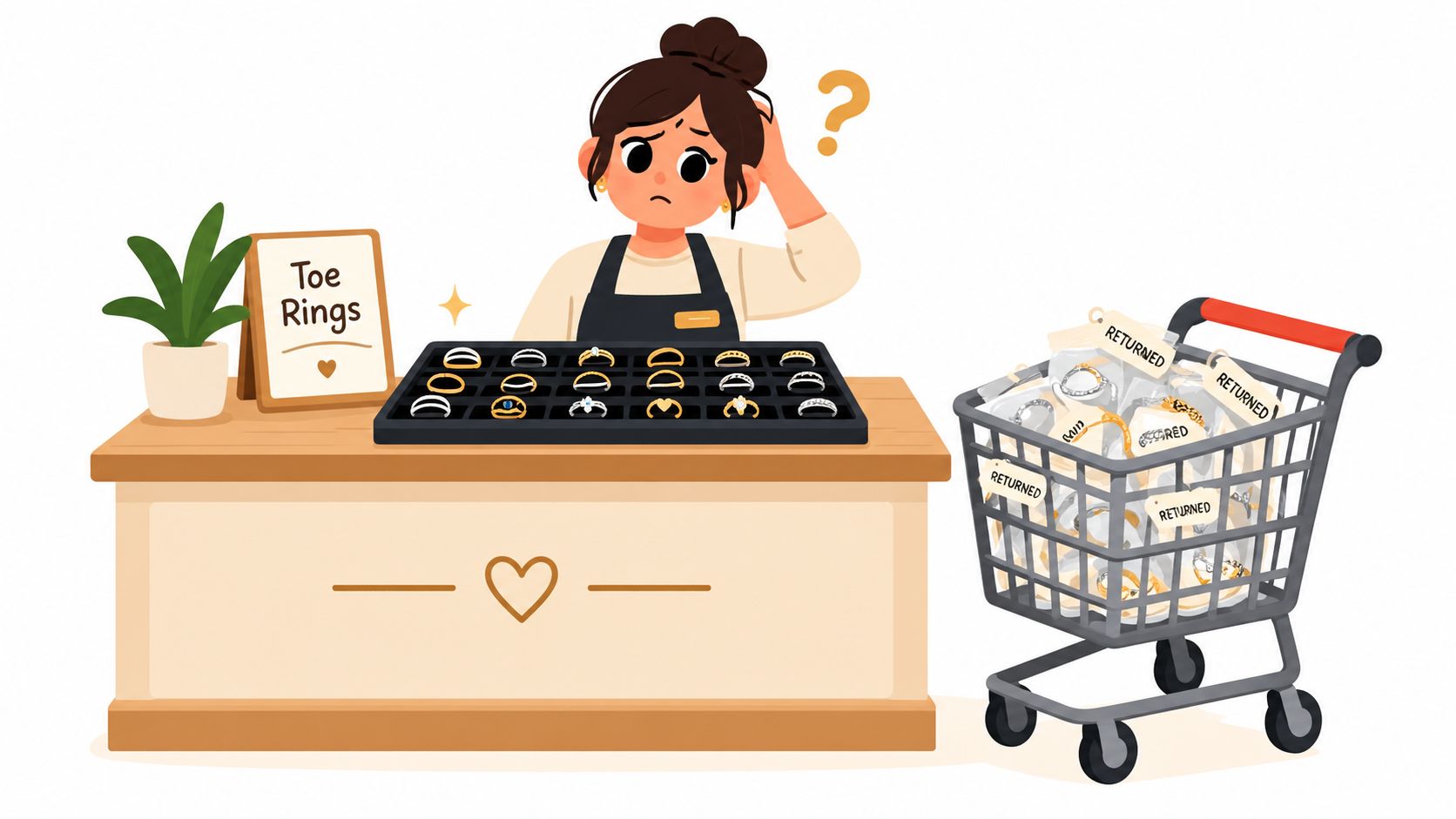
Three sourcing failures
Poor fit causes the most avoidable dissatisfaction. Toes vary in circumference, joint width, and swelling throughout the day. A ring that feels secure while a customer is standing in a cool store may become tight later, while an overly loose style can twist or fall away.
Weak surface performance creates another problem. Plating can wear where the ring rubs against adjacent toes or footwear, while unsuitable alloys may react badly with perspiration. The customer experiences this as tarnishing, discoloration, discomfort, or a product that no longer resembles the listing.
Static buying decisions create dead stock. Toe rings have a documented fashion history that includes copper-alloy examples found in ancient Egyptian remains dating to roughly 3000–2000 BCE, followed by a mainstream U.S. fashion reintroduction in 1973 by Marjorie Borell through a New York boutique and Bloomingdale's, as described in the documented history of toe rings. The category then experienced a major popularity spike in the late 1990s and around 1999–2001, showing that demand moves in waves rather than behaving like a permanent basics category.
Buying rule: Treat toe rings as trend-led accessories. Order broad styles in controlled quantities, then replenish the winners instead of making one deep seasonal bet.
For online stores, fit guidance can reduce uncertainty before checkout. Retailers exploring AI size recommendations and virtual try-on can use those tools as part of a wider approach that includes accurate measurements, clear product photography, and honest fit notes.
Choosing Materials That Last
Material selection determines whether a toe ring feels like an affordable fashion purchase or a disappointing disposable item. The decision should follow your customer, price position, and expected wear conditions, not the supplier's preferred inventory.
The practical material comparison
925 sterling silver gives shoppers a recognizable precious-metal option and a more premium feel. It can suit jewelry boutiques and customers who value metal composition, but it also brings tarnish management and greater exposure to raw-material price movement. A retailer needs clear care guidance and reliable composition documentation before committing to a broad silver assortment.
Stainless steel with IP plating is the stronger default for many value-focused ranges. Alibaba's 2026 material configuration guide reports that gold and silver prices rose sharply in 2025 and identifies stainless steel with IP plating as a growing option because it avoids much of that precious-metal volatility while maintaining a finished appearance. For toe rings, that consistency matters because the product faces moisture and friction during normal wear.
Base alloys with plating can work for highly price-sensitive, short-cycle fashion, but they require strict testing. The coating is the customer's main barrier from the underlying alloy, so surface wear can change both appearance and skin-contact performance. Use these pieces only when the supplier can provide dependable material information and when the retail positioning clearly matches the expected lifespan.
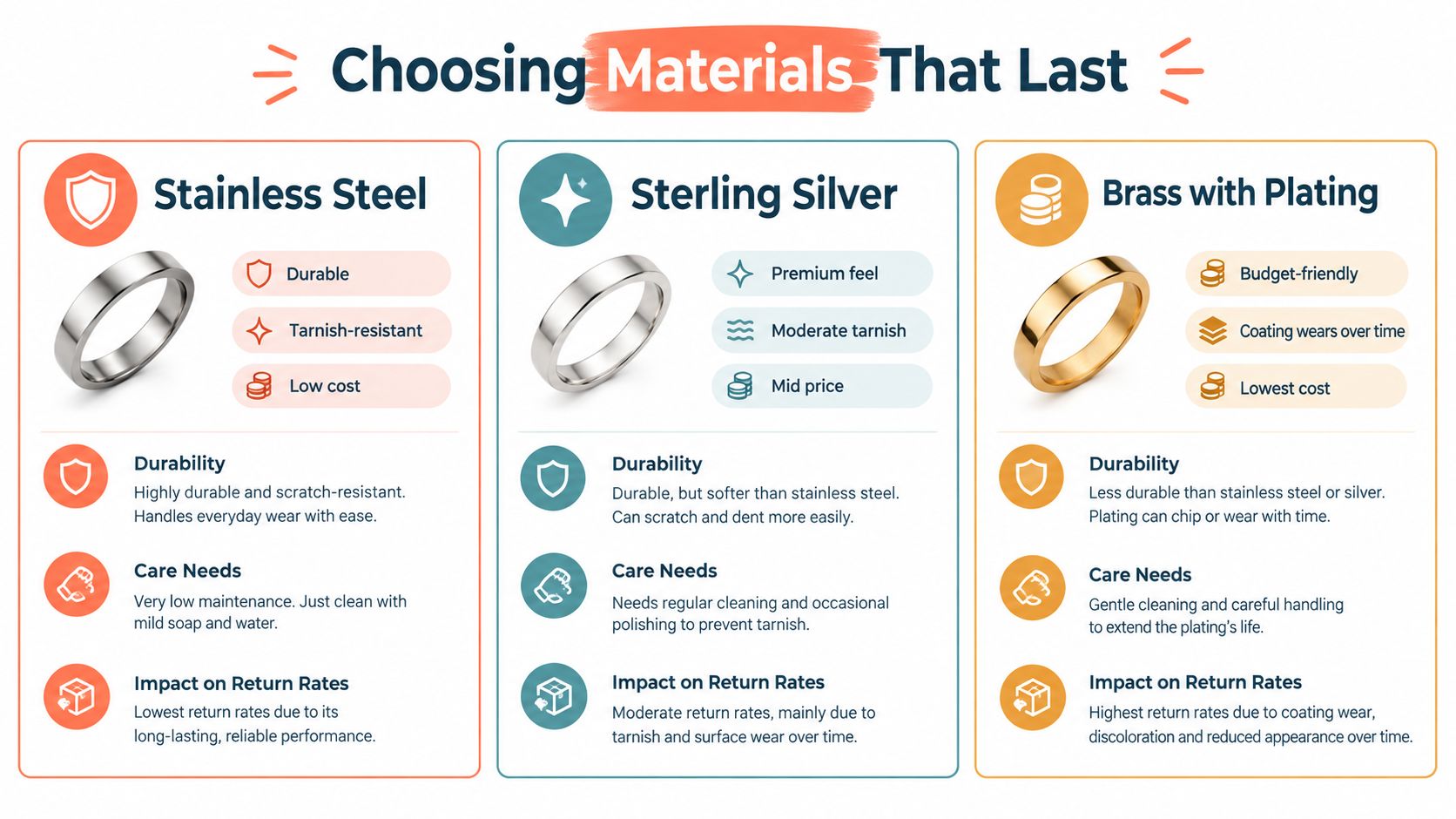
Match the metal to the assortment
Choose IP-plated stainless steel for everyday fashion assortments, seasonal testing, and retailers that need consistent landed costs. Choose 925 silver when your customer already shops by metal quality and accepts care requirements. Reserve plated base alloys for tightly controlled trend capsules, not for the foundation of your collection.
Before ordering, ask the supplier what sits beneath the plating, how the finish is applied, and what testing supports the stated composition. A useful primer on composition and care is this guide to what stainless steel jewelry is.
The best material is the one that matches the promise on your product page. Don't describe a low-cost plated alloy as a long-wear premium piece. That mismatch creates returns even when the ring looked attractive at wholesale inspection.
Getting the Sizing Right
Toe rings use the same numeric ring scale as finger rings, but customers don't experience toe fit in exactly the same way. The ring must sit snugly at the toe's resting point without pinching, while still passing over a wider joint or knuckle area.
Common demand clusters around US sizes 3–5 for women and 5–7 for men, according to toe ring sizing guidance. Many suppliers also stock half sizes, and you should treat them as practical inventory rather than an unnecessary complication.
Build the size range around movement
Start with the core whole sizes, then add half sizes where the design has limited adjustability or a narrower band. An adjustable open-ended style can cover more variation, but it still needs a safe range. If the opening is too loose, the customer will keep repositioning the ring. If it's too tight, pressure becomes obvious as the toe swells.
Your product page should show:
- Numeric size: State the US size clearly and don't rely on “small,” “medium,” or “large.”
- Fit position: Explain whether the ring is intended for the base, middle, or upper part of the toe.
- Measurement method: Tell shoppers to measure at the resting point and account for the widest joint the ring must pass.
- Wear guidance: Describe a snug fit as secure but comfortable, never tight or painful.
In a physical shop, keep a sample sizing ring or fitting gauge beside the display. Online, photograph the ring on a foot and include a visual scale reference. You can reduce overbuying by reviewing which sizes generate exchanges, then adjusting the next purchase instead of expanding every size evenly.
A balanced size assortment beats a large assortment with no fit explanation. Clear guidance is part of the product, not an afterthought.
Finding the Right Wholesale Supplier
Supplier choice should reflect how you plan to test and replenish the category. Large B2B marketplaces can expose you to many factories and designs, while specialized wholesale platforms may simplify product selection, order handling, and repeat purchasing.
A marketplace guide reports wholesale toe ring prices typically ranging from about $3 to $39, with minimum order quantities as low as 1 unit and many first-order minimums between $100 and $200, according to Faire's toe ring buying guide. That makes the category suitable for controlled testing, provided you inspect samples before scaling.
| Channel Type | Typical MOQ | Price Range | Best For |
|---|---|---|---|
| Large B2B marketplace | As low as 1 unit, supplier dependent | About $3–$39 | Comparing factories, designs, and quoted materials |
| Specialized wholesale jewelry platform | No MOQ may be available, supplier dependent | Varies by product and quantity | Small test orders, repeat buying, and curated assortments |
| Direct factory relationship | Negotiated | Negotiated | Larger repeat programs with defined specifications |
Buyer behavior also spans several retail formats. The same marketplace guide identifies gift shops as the largest buyers on its platform, with typical orders of about 3 units per brand, while women's clothing stores average about 6 units and jewelry stores about 2 to 3 units. The implication is useful: toe ring wholesale isn't restricted to specialist jewelry stores. It can work as an impulse item, a seasonal add-on, or a body-jewelry extension.
Compare suppliers on evidence
Alibaba can be useful for factory discovery and specification negotiation, but you'll need to verify samples, testing, plating, packaging, and shipping terms yourself. Specialized platforms such as JewelryBuyDirect can be more practical when you want product-level ordering and repeat replenishment. Use this guide to buying wholesale jewelry to structure your supplier questions.
Request a sample pack, confirm the actual metal, test closure or adjustability, inspect edges, and ask for documentation before placing a meaningful order. A low price is irrelevant if inconsistent quality forces markdowns or replacements.
Pricing for Profit
A toe ring's wholesale price is only one part of its economics. Calculate landed cost before deciding whether a design deserves shelf space.
Use this formula:
Landed cost per unit = product cost + allocated shipping + customs or duties + packaging + platform fees
Then compare the result with your intended wholesale and retail prices. Independent jewelry pricing guidance describes keystone pricing, or doubling cost, as a minimum for most retail, while 2.5–3x can be more appropriate for fashion jewelry when the market supports it. The same guidance stresses that shipping, customs, packaging, and platform fees belong in the calculation, as shown in this resource on how to scale channels profitably.
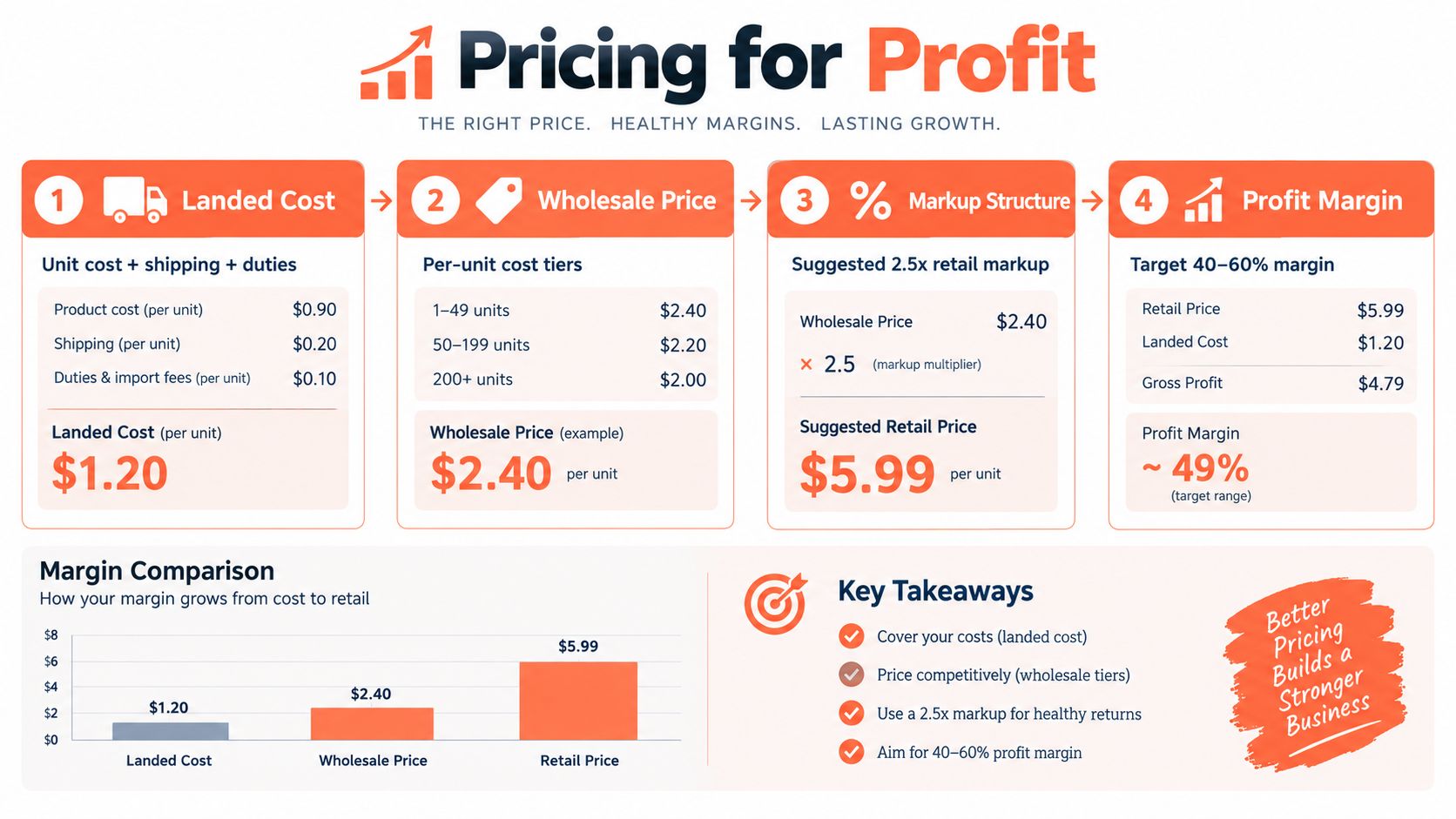
Make the order earn its space
Suppose a supplier quotes a low unit price, but shipping is expensive because the order is small. The resulting landed cost may make the design less profitable than a slightly higher-priced item from a supplier with better logistics. Always compare vendors using the same basis.
The U.S. clothing and clothing-accessories wholesaling sector contains 34,214 businesses in 2026, with projected industry revenue of $119.4 billion in 2026, while revenue declined at a 3.2% CAGR over the prior five years, according to IBISWorld's industry data. That mature environment leaves little room for careless cost assumptions.
Use a simple order worksheet:
- Record the supplier's per-unit quote.
- Allocate freight and import costs across the units received.
- Add packaging and selling fees.
- Set a wholesale price that protects your operating costs.
- Set a retail price that fits comparable accessories without hiding the material limitations.
A wholesale profit margin calculator can help standardize this process across suppliers and product lines. Don't let a visually attractive ring pass your buying test until the complete landed-cost calculation still works after likely markdowns and replacements.
Compliance and Quality Checks
Compliance is a customer-safety issue and a retailer-protection issue. Toe rings sit against skin in a sweaty, friction-prone environment, so plating failure or unsuitable alloy content can increase irritation complaints and rejection rates.
Base-metal labels aren't enough. You need evidence about metal release and restricted substances for the markets where you sell. EU-style rules commonly referenced in wholesale sourcing set nickel release at no more than 0.5 μg/cm²/week for items intended for prolonged skin contact, with a tighter 0.2 μg/cm²/week limit for pierced parts, and cap lead content at 0.05% by weight, as outlined in Amazon's compliance reference.
Ask for proof before you buy
Send suppliers a written request covering:
- Material composition: Ask for the base metal and plating specification, not just “silver color” or “hypoallergenic.”
- Test documentation: Request relevant reports for nickel release and lead content, and confirm which product batch they cover.
- Plating integrity: Inspect edges, inner surfaces, adjustment points, and areas likely to rub against footwear.
- Construction: Check for sharp edges, weak joins, rough seams, and adjustable sections that open too easily.
- Packaging: Require individual protection that prevents scratching, tangling, and surface contamination in transit.
If documentation is incomplete, don't treat the gap as a minor administrative issue. Hold the order, request clarification, or choose another supplier. A supplier that can't identify the alloy or support a compliance claim is asking you to accept the risk on its behalf.
Quality standard: Never sell a direct-skin product on a material promise you can't document.
Merchandising Toe Rings Effectively
A good toe ring needs context. Customers often understand the style only after seeing it worn, so display the product near the items that create the buying occasion.
Gift shops should use small, easy-to-browse trays near sandals, travel accessories, or checkout areas. Women's clothing stores can cross-merchandise toe rings with sandals, flip-flops, summer apparel, and vacation-focused outfits. Jewelry retailers should group them with anklets, body jewelry, and other small accessories while keeping size information visible.
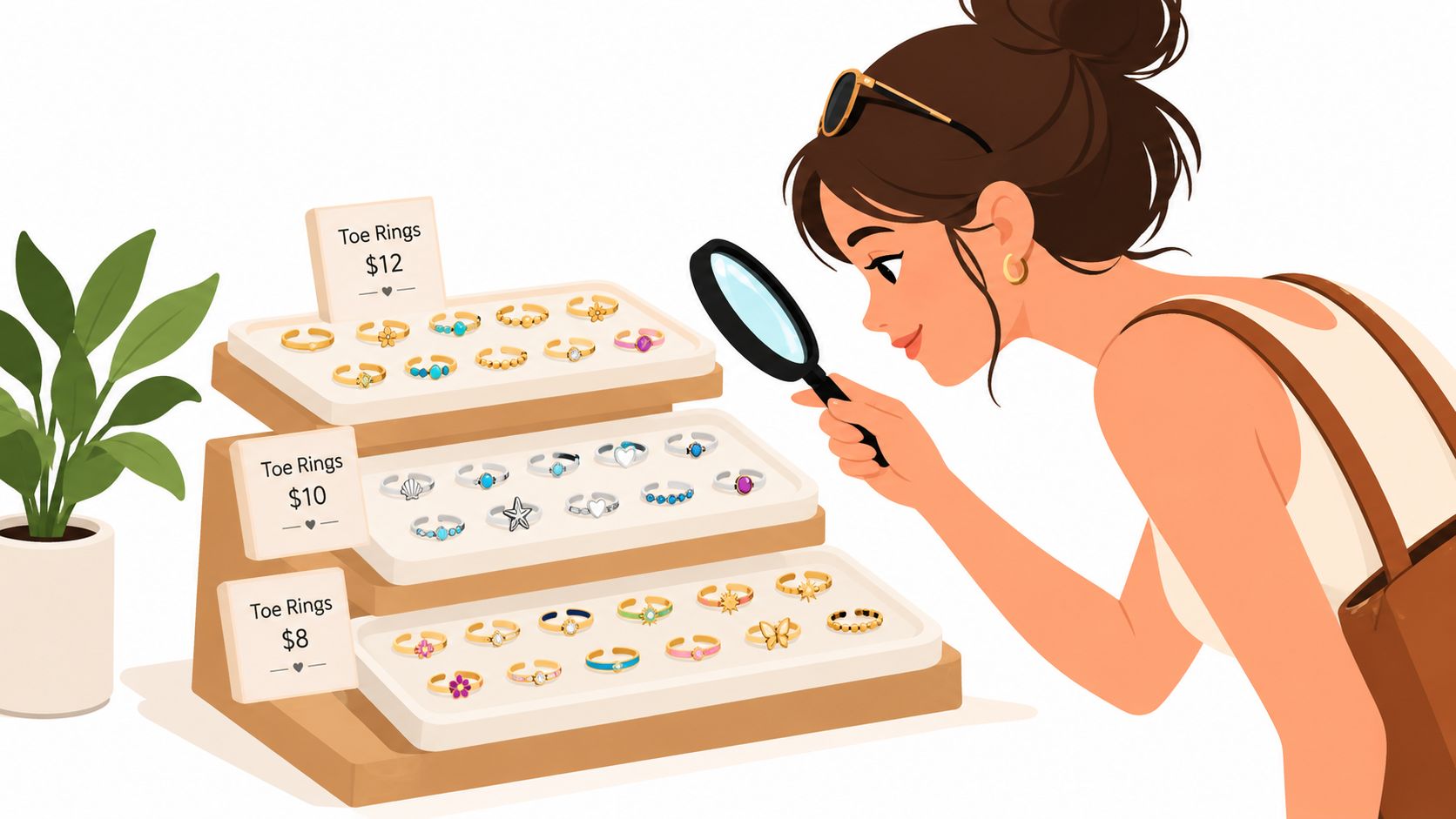
Remove the three reasons customers hesitate
Show scale. Use lifestyle photographs of the ring on a foot, not only isolated product shots. Include a close-up that reveals the finish and a second image that shows how the ring sits.
Explain fit at the display. Put the numeric size, adjustment details, and a short snug-fit instruction on the card. Online listings should use the same information so shoppers receive a consistent message across channels.
Make the package giftable. Individual packaging protects the surface and makes a small accessory feel considered. For a polished presentation, compare compact Pillow Boxes for packing Jewellery with your current packaging format.
Ask customers to review comfort, fit, and finish after purchase. Reviews that mention actual wear conditions help future shoppers choose more confidently than generic praise. Keep the strongest designs in high-traffic locations, but rotate the assortment as seasonal styling changes rather than leaving every ring in one permanent fixture.
Building Your Toe Ring Wholesale Strategy
A profitable program starts with a controlled test, not a crowded display. Decide your customer and price position first, then choose materials that support that promise. For most retailers, stainless steel with IP plating provides a dependable starting point, while sterling silver belongs in a clearly premium segment and plated base alloys require tighter quality control.
Use this first-order checklist
- Define the range. Select a focused mix of adjustable and fixed styles, with enough visual variety to test customer preferences without overcommitting.
- Set the size plan. Use the core numeric ring scale, include half sizes where the design demands them, and publish fit instructions.
- Request samples. Inspect edges, joints, plating, adjustment tension, packaging, and comfort before approving the full order.
- Verify documentation. Ask for composition and relevant metal-release evidence, especially for direct-skin products.
- Calculate landed cost. Include freight, duties, packaging, and selling fees before setting your retail price.
- Plan the display. Position rings beside the products that create the purchase occasion, then support the display with worn photography and clear sizing.
- Replenish selectively. Track sell-through, exchanges, complaints, and finish issues. Reorder proven designs and discontinue weak performers.
The wholesale market is broad enough to support several entry routes. Shopify cites a projected global fashion accessory market CAGR of 12.3% from 2023 to 2028, a projected U.S. accessory market of $104.7 billion in 2026, and China's leading revenue position at $98.3 billion, as reported in its wholesale accessory market overview. Those figures support a globally connected sourcing approach, but they don't replace product-level inspection.
Keep the strategy simple: test small, document materials, stock the right sizes, price from landed cost, and replenish based on evidence. That discipline turns toe ring wholesale from a risky novelty purchase into a manageable accessory category.
JewelryBuyDirect offers wholesale toe rings and broader fashion jewelry options with no minimum order quantity, so you can test materials, sizes, and styles before expanding the range. Visit JewelryBuyDirect to compare toe ring options and build a controlled first order for your store.