
925 Sterling Silver Charms: A Retailer's 2026 Buying Guide
You've found a charm collection that looks excellent on screen, then the first shipment arrives and the bail feels weak, the finish rubs at the edges, and the “925” claim exists only on a removable tag. That mistake is expensive. Customers notice quickly, returns consume the margin, and a display full of slow-moving designs ties up cash.
For a retailer or reseller, 925 sterling silver charms deserve a buying process, not blind enthusiasm. You need verified metal content, dependable attachment hardware, sensible finishes, and an assortment built around reasons to buy again. The right sourcing habits let you offer a credible quality story without carrying gold-level inventory risk.
Why 925 Sterling Silver Charms Deserve a Spot in Your Assortment
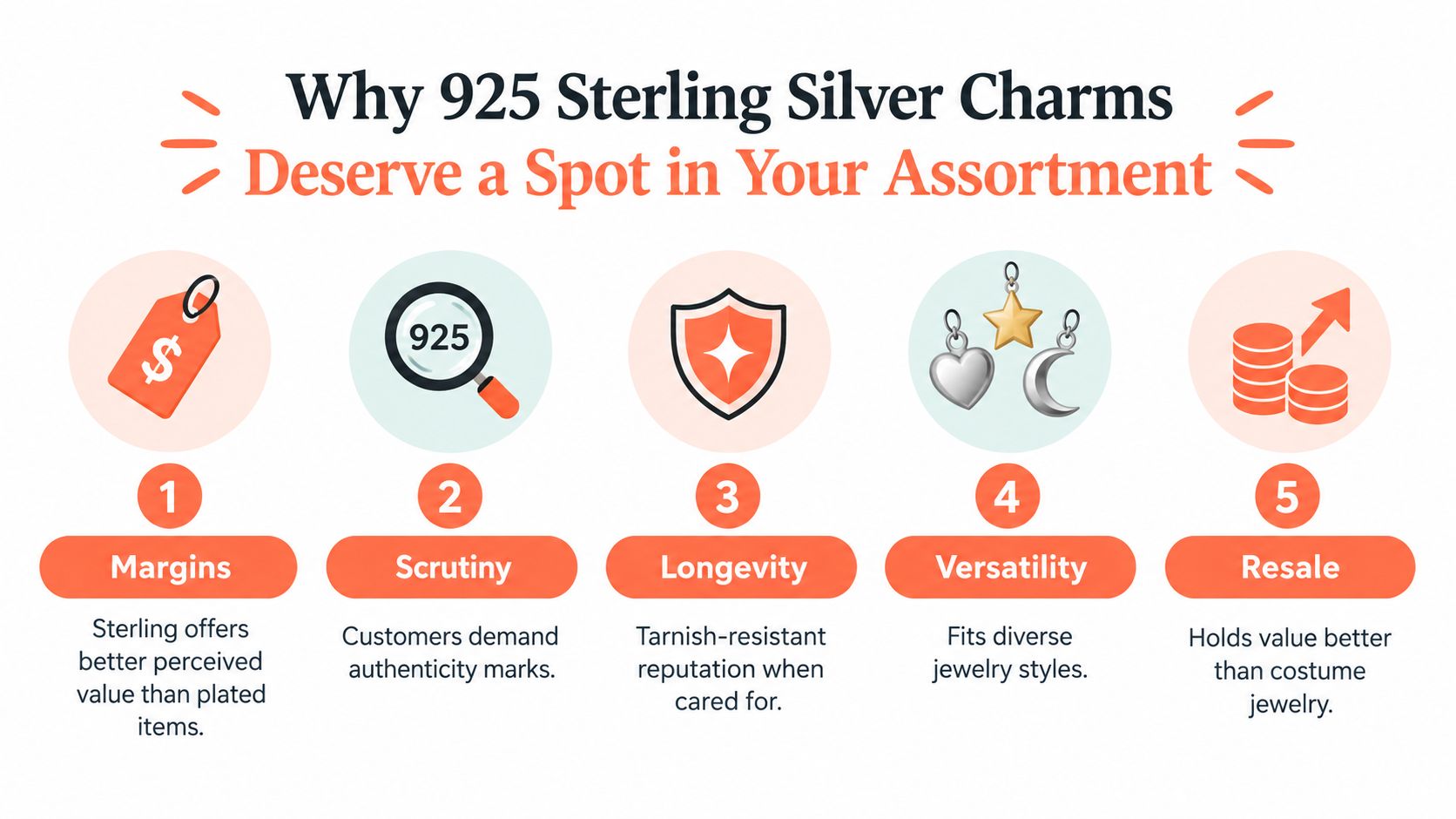
A boutique owner deciding whether to give sterling a second spinner display should judge the category against six commercial checkpoints. First, charms encourage repeat purchasing because customers can add a new symbol to an existing bracelet or necklace. That creates a more durable selling relationship than a one-off fashion accessory.
Second, sterling gives shoppers a stronger perceived-value story at price points below gold. The recognized 925 mark tells customers that the item isn't merely silver-colored, provided the mark is supported by reliable documentation and testing. Third, charms fit personalization naturally. Initials, zodiac symbols, birthstones, hearts, and meaningful icons let a buyer build a piece that feels personal rather than generic.
Fourth, small charms are practical to ship and display. Their compact format supports lightweight packaging, curated online collections, and themed counter presentations. Fifth, the audience is broad. Teens building a first bracelet, gift buyers choosing a symbolic token, and adult customers refreshing an established collection can all shop within the same category.
Sixth, sterling offers resale credibility that costume jewelry usually can't match. The 925 shorthand means 92.5% silver and 7.5% other metals, a standard used across jewelry categories, including charms. That recognized purity language helps a small retailer compete on material quality and transparency instead of trying to win only on price. The sterling silver jewelry market was valued at USD 24.28 billion in 2025 and is estimated at USD 25.77 billion in 2026, with a projection of USD 39.24 billion by 2035 at a 5.0% CAGR, according to NextMSC's sterling silver jewelry market report, which specifically includes charms in its product mix.
Buyer's rule: Stock sterling when you can explain the metal, prove the construction, and give customers a reason to add another charm later.
Treat the six checkpoints as a filter. Repeat purchase potential supports the assortment, perceived value supports conversion, personalization expands relevance, compact shipping protects operations, broad demographics improve sell-through, and recognized purity strengthens trust. The sections that follow turn those advantages into supplier questions, quality checks, care instructions, style decisions, and merchandising moves.
What 925 Actually Means and Why the Alloy Matters
925 is a fineness mark, not a design name. It means that 925 parts out of 1,000 are silver, or 92.5% pure silver, while the remaining 7.5% consists of other metals, typically copper. The alloy definition is confirmed by the Canadian Conservation Institute's explanation of silver tarnish.
Pure silver is too soft for a charm that gets handled, clipped, stacked, and rubbed against neighboring pieces. Copper gives the material workable hardness while retaining the appearance and value associated with sterling. That balance matters more than chasing the highest possible purity. A charm made from very soft fine silver may bend at a thin loop or lose crisp detail before a well-made 925 charm does.
The word sterling describes the accepted alloy standard, while 925 expresses its silver content numerically. Buyers encounter both terms because the standard travels across markets. A stamp helps, but it isn't proof by itself. A supplier can mark an item incorrectly, so the stamp must match documentation, construction, and sample testing.
Use this guide to what 925 sterling silver means when training staff or preparing product descriptions. Keep “sterling silver” separate from “silver-plated.” Plated jewelry may look attractive, but its value depends on the base metal, plating thickness, and condition of the surface. It shouldn't be presented as the same material.
Silver Purity Compared
| Grade | Purity | Common Alloy | Charm Suitability |
|---|---|---|---|
| Fine silver | 99.9% silver | Minimal alloy content | Too soft for many everyday charm applications |
| Sterling silver | 92.5% silver | Usually copper | Practical balance of purity, hardness, and detail |
| Silver-plated | Surface layer only | Brass, copper, zinc, or another base | Suitable only when clearly labeled and priced as plated |
Nickel isn't the default definition of sterling silver. It may appear in uncertain alloy compositions, solder, or hardware, so ask suppliers for a written material declaration when skin sensitivity matters. Copper can also bother some wearers, and an item described as hypoallergenic isn't automatically safe for every customer. 925 is the balance point. The alloy mix, solder, attachment hardware, and finishing process determine whether that balance becomes a quality product or a shortcut.
Hallmarks and Quality Checks That Separate Real Sterling From Plated Lookalikes
A supplier once showed me a tray of charms stamped with a familiar mark. The stamps looked convincing until I compared the pieces with a known sterling sample. Several felt unusually light, and the marks sat on tags that could be removed without touching the charm. That tray failed before it reached a sales floor.
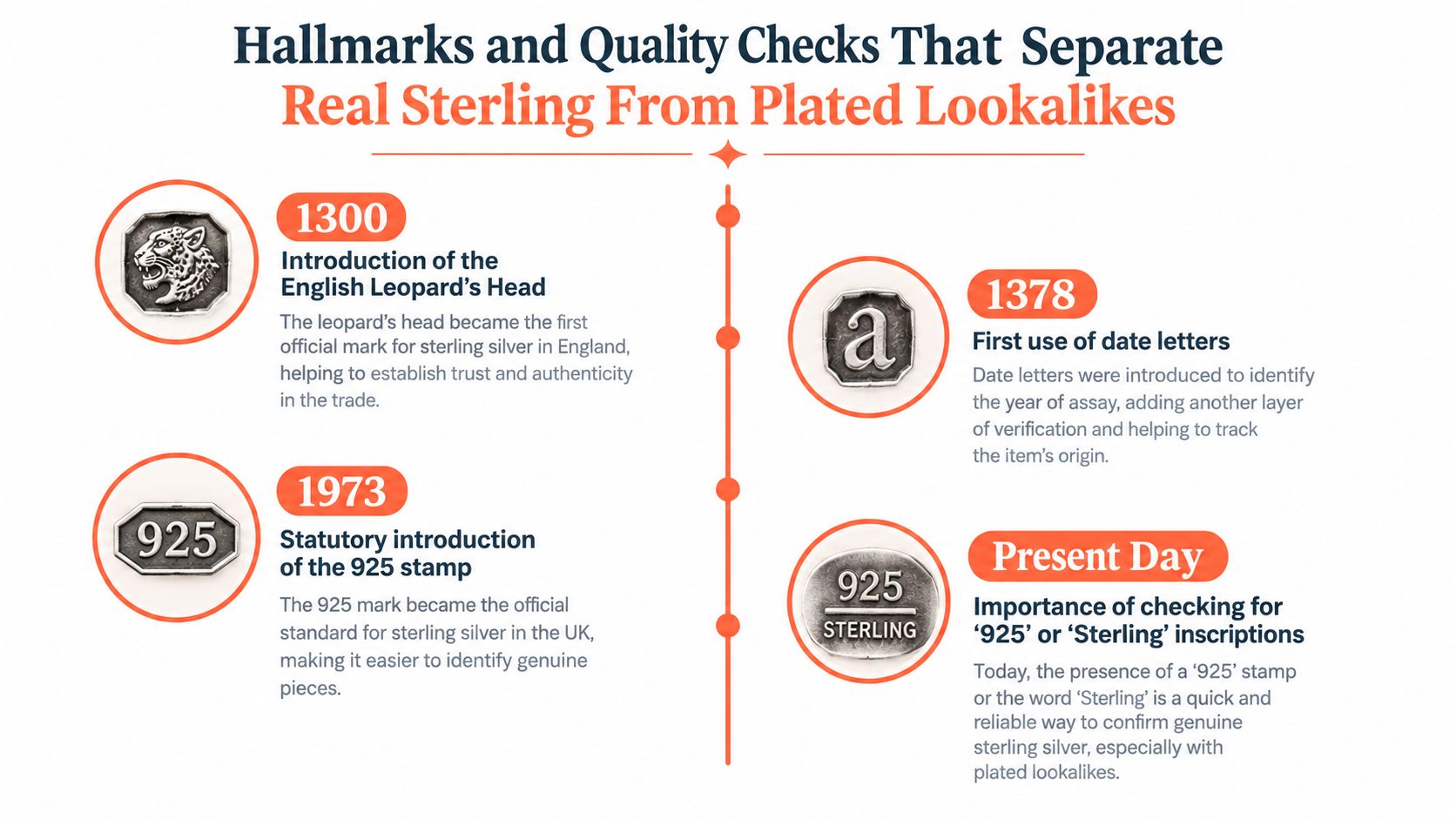
Hallmarking has authority because the system has been built over centuries. England had standardized silver purity to 92.5% by the late 1100s under Henry II, and the British hallmarking system dates to 1300. The United States passed the National Stamping Act in 1906, requiring “sterling” to mean at least 92.5% silver. The 1972 International Convention on Hallmarks later helped harmonize precious-metal markings across countries, as outlined in this history of the 925 sterling silver mark.
Those dates explain why 925 is trusted, but they don't excuse skipping present-day checks.
What to inspect before accepting stock
Look for 925, S925, STER, or STERLING stamped directly on a sensible part of the item, such as the back of a pendant or the attachment area. A mark on a removable paper tag is a claim, not evidence. Ask for supplier invoices, mill certificates, and assay documentation when the order value justifies it.
Use several simple checks on samples:
- Magnet check: The main silver body should be non-magnetic. A clasp or spring may contain steel, so don't judge the whole charm from a hardware point alone.
- Ice comparison: Silver transfers heat efficiently. Place an ice cube on the sample and compare it with a known non-silver object. A faster melt supports the claim, but it isn't a substitute for laboratory analysis.
- Weight comparison: Keep one genuine sterling charm as a reference. An item that feels conspicuously light for its size deserves investigation.
- Surface inspection: Genuine tarnish generally darkens the surface rather than flaking away. Peeling, patchy color, or green exposure suggests worn plating or a base-metal core.
- Documentation review: Request the declared composition, plating details, origin information, and test results before placing a large order.
The mark alone can't protect you from a counterfeit. A supplier can stamp a base-metal charm, while a genuine piece may lack room for a mark. For a new factory or substantial purchase, send representative samples for professional analysis rather than relying on a counter test.
Documentation protects margin: A clear assay report and traceable origin record help you defend the product description when a customer disputes authenticity.
This short video can help staff recognize common authenticity questions during receiving and customer service.
Country-of-origin stamps can add useful context, but don't treat an origin label as a guarantee. Italian production may carry premium weight in some charm categories, yet the material still needs verification. The reseller takeaway is straightforward: inspect the actual charm, test samples, keep the paperwork, and reject vague answers before the stock reaches your warehouse.
Plating, Finishes, and Base Metal Trade-offs Worth Knowing
A charm that looks gold or bright white in a product photo can have a very different construction underneath. Specify the base metal, surface treatment, and expected wear in the catalog, staff notes, packaging, and price. Customers should not mistake a solid 925 charm with a finish for a silver-plated brass charm.
Rhodium over 925 suits a bright white-silver collection. The coating can slow visible discoloration and keeps polished pieces looking clean in e-commerce photography. Friction still wears it away at edges and attachment points, so describe it as a surface finish, not permanent protection.
Vermeil is gold over sterling, with a required gold thickness of 2.5 microns under the FTC's vermeil definition. Definitions can vary by market, so confirm the applicable rule before making that claim in another country. Vermeil gives gold-tone collections a precious-metal base, while rubbing, sweat, and repeated contact gradually affect the surface. Standard gold plating over silver usually wears fastest on charm edges, bail openings, and raised motifs, where handling creates constant friction.
Construction should determine the retail position
| Construction | Tarnish Resistance | Allergy Risk | Best Retail Position |
|---|---|---|---|
| Solid 925, polished | Natural sterling behavior | Depends on alloy and hardware | Core silver collection |
| Rhodium over 925 | Improved surface brightness | Depends on base alloy and solder | Bright, modern white-silver line |
| Vermeil over 925 | Gold-tone surface protection varies with wear | Depends on alloy and plating components | Premium gold-tone capsule |
| Silver-plated brass | Surface appearance can change as plating wears | Base metal and solder require review | Clearly labeled entry fashion line |
| Silver-plated copper | Plating can expose copper at friction points | Copper or mixed components may bother some wearers | Low-price novelty styles |
| Silver-plated zinc alloy | Surface finish depends heavily on coating | Composition can be uncertain | Only with clear specifications |
Brass, copper, and zinc cores create different durability and disclosure concerns. Review nickel-bearing bases and hardware carefully for customers with sensitive skin. Avoid a blanket “hypoallergenic” promise unless the supplier identifies the complete composition, including clasps, jump rings, solder, and posts.
Finish choice should match the sales channel. High polish photographs sharply against a clean background and works well on product pages. Brushed matte surfaces hide small handling marks in physical displays. Oxidized silver brings out recessed details in vintage-inspired designs, while rose-gold finishes support warmer capsule collections.
My retail sweet spot is solid 925 with rhodium for bright silver lines, vermeil for gold-tone assortments, and untreated or oxidized silver for vintage-led designs. Use plated base-metal styles only when the lower price is clear and the description names the construction plainly.
Caring for Sterling Silver Charms the Way Your Buyers Will Ask About
Most care problems start where the customer doesn't look. Tarnish often concentrates around bails, jump rings, and clasp openings, where moisture, skin oils, and debris collect. A charm face may still look bright while the attachment point has already darkened.
That matters more on charm-heavy bracelets and necklaces than on plain chains. Moving pieces rub against one another, and the connectors are harder to reach with a cloth. Give your staff a simple inspection routine before putting a charm in a gift pouch.
Inspect the attachment points first
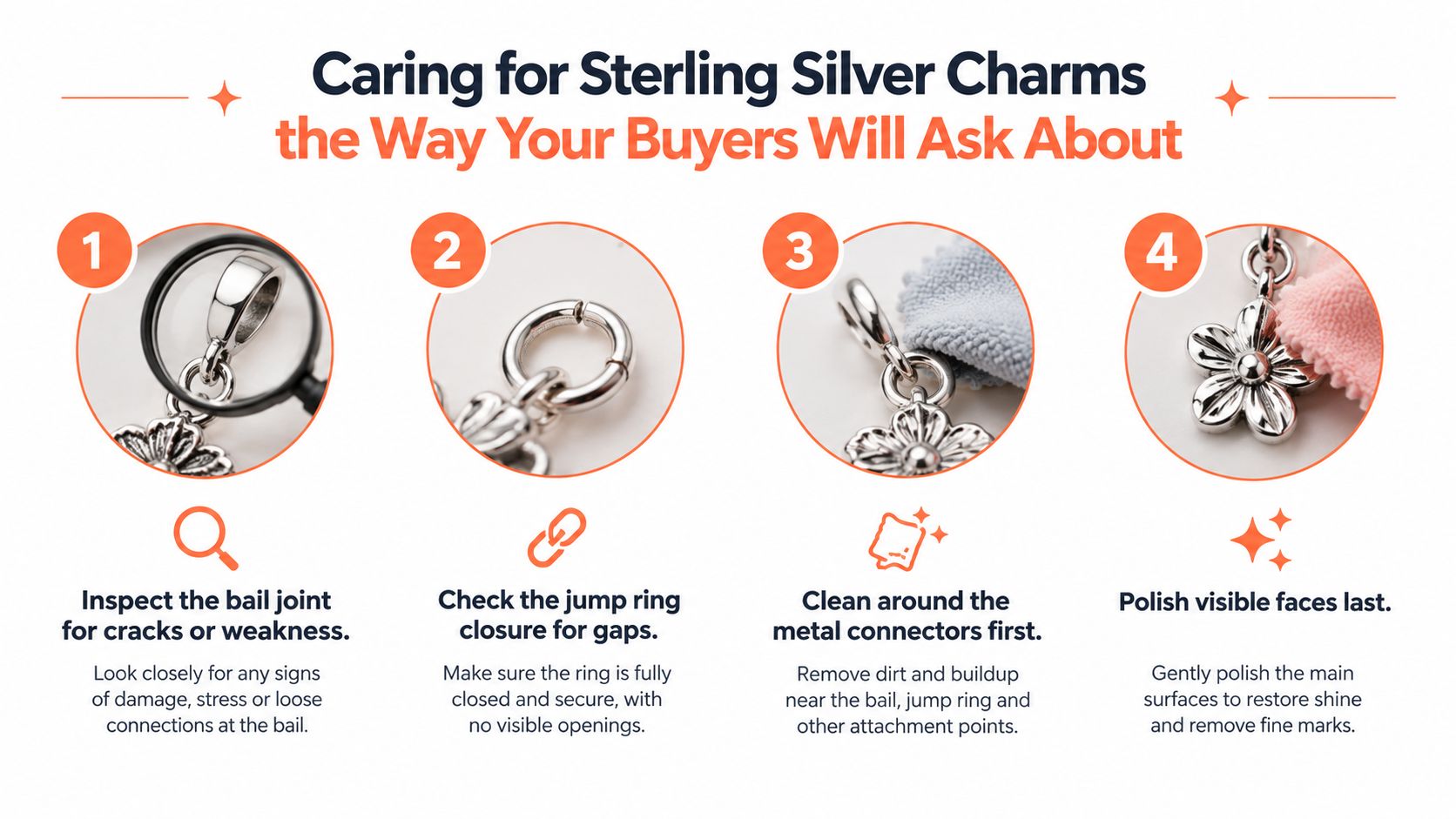
- Check the bail joint. Look for cracks, distortion, or a seam that opens under light pressure.
- Examine the jump ring. The closure should meet cleanly. A visible gap can let the charm escape.
- Clean the connector. Work a polishing cloth around the ring, bail, and clasp opening before polishing the visible face.
- Finish the front. Use light strokes on the decorative surface only after the hidden areas are clean.
For routine care, use a silver polishing cloth for quick touch-ups and mild soap with water for gentle cleaning. Dry the charm completely, especially inside the bail. Avoid liquid dips on oxidized designs and vermeil inlays because aggressive cleaning can remove intentional darkening or affect the decorative surface. Retailers can point customers to this practical guide to cleaning silver jewelry when they need a longer explanation.
Put care into the packaging
Use anti-tarnish strips inside charm packaging. Store individual SKUs in separate poly bags when you hold more than 10 pieces, and add silica gel for seasonal inventory storage. Keep pieces dry, separated, and away from rubber materials that can contribute to discoloration.
Give staff a short demonstration they can repeat:
“Keep the charm dry, wipe it with this cloth after wearing, and pay special attention to the ring and bail. If the design is oxidized or gold-finished, use mild soap instead of a liquid silver dip.”
A compact care card can read:
925 Sterling Silver Care
Wipe gently after wear. Keep dry and store separately. Clean connectors before polished surfaces. Avoid liquid dips on oxidized or vermeil details. Bring the charm back to us if the bail or jump ring looks loose.
That card reduces preventable complaints and turns basic maintenance into part of the product experience.
Charm Style Categories That Move on Shelves and Feeds
A charm wall works when shoppers can find meaning quickly. Don't arrange every design by supplier code or metal weight. Build visible groups that answer the customer's first question, whether that question is “What represents me?” or “What can I give her?”
Build the assortment around meaning
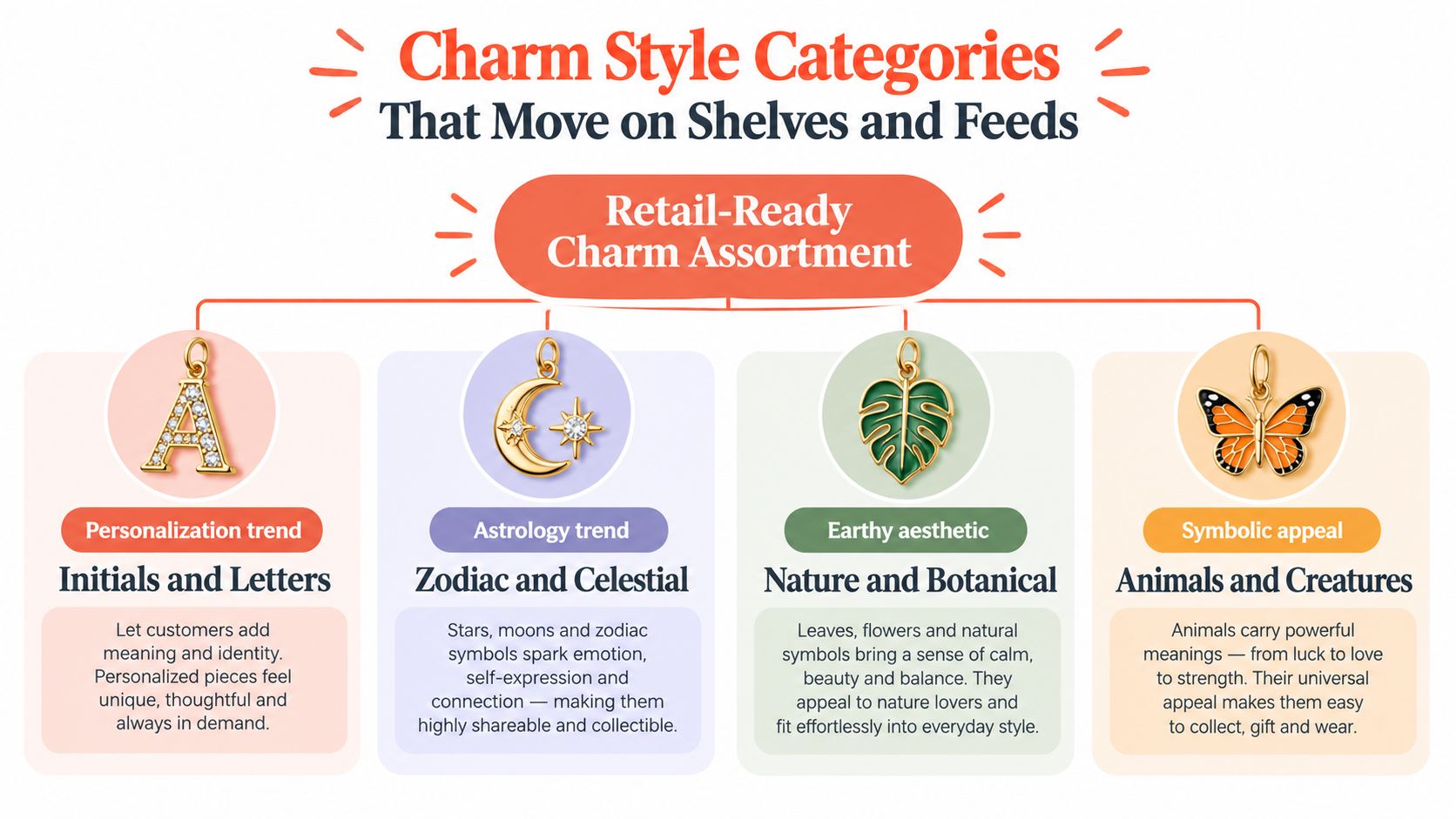
Initials and letters are the safest personalization group. Keep the alphabet represented in the core range, then use layout, finish, and font changes to create variety without multiplying every product type.
Zodiac and celestial charms support astrology-led shopping and gift discovery. Stars, moons, constellations, and zodiac symbols work as standalone pieces and as stackable additions.
Nature and botanical motifs give the collection an earthy direction. Leaves, flowers, mushrooms, suns, and insects appeal to shoppers who want symbolism without an overtly personalized letter.
Animals and pets combine emotional meaning with easy gifting. Dogs, cats, birds, butterflies, and symbolic creatures can sit in a year-round section, while unusual animals provide novelty.
Add occasion-led groups without overbuying
Travel and landmark charms work best when they connect to a destination, memory, or trip. Faith and spiritual designs need careful local selection because demand varies by community. Birthstones and hearts are strong gifting tools, especially around romantic and family occasions. Hobbies and professions create excellent niche signals, from music and cooking to teaching, nursing, and sport.
Novelty drops should stay controlled. Use them to test a visual idea, not to replace your dependable core. A whimsical charm can create attention on a social feed, but initials, hearts, celestial pieces, animals, and giftable symbols usually give the assortment a stronger foundation.
Use three price tiers
Build an entry tier with small, simple symbols and uncomplicated finishes. Use a core tier for detailed 925 designs, stones, moving elements, or stronger silhouettes. Reserve the premium tier for intricate construction, vermeil, distinctive mechanisms, or pieces that can anchor a themed display.
Plan gifting windows around graduation, Valentine's Day, and Mother's Day, but don't let seasonal demand dictate the entire range. A good shelf has evergreen personalization beside occasion-led capsules. On social channels, show combinations rather than isolated pieces. A customer who sees an initial paired with a zodiac symbol and a heart can understand the collecting behavior immediately.
Merchandising principle: Sell the first charm as a statement, then present the second and third as natural additions.
Smart Sourcing and Merchandising Moves for Charms
A boutique, online reseller, and scaling direct-to-consumer brand face different cash-flow risks, customer-acquisition patterns, and exposure to unsold variations. Match the buying process to the channel before placing an order.
Independent boutiques should begin with a compact hero assortment and inspect every design in person. Request mill certificates or third-party assay reports, confirm where the 925 mark appears, and test the attachment hardware before expanding the display. Set an MOQ that supports a real test without filling the tray with slow-moving designs. A supplier that refuses samples or gives vague alloy documentation is not protecting your margin.
Online resellers need product data that keeps returns under control. Require clean photography, accurate dimensions, searchable attributes, and packaging that can survive transit. For broader marketplace sourcing research, use this guide to wholesale suppliers for Amazon from Next Point Digital as a discovery resource. Verify the material independently before publishing sterling-silver claims.
A scaling DTC brand needs repeatable production. Approve one sample, record the accepted finish, dimensions, clasp or loop construction, and stone setting, then require replenishment orders to match that reference. Build hero SKUs around proven symbols and initials, and add modular pieces that raise basket value without making customers buy an entirely new set.
Match the channel to the sourcing tactic
| Channel | Vetting Strategy | MOQ Lever | Margin Lever |
|---|---|---|---|
| Independent boutique | Physical samples, assay documents, hardware inspection | Small test assortment | Curated displays and gift packaging |
| Online reseller | Product data, image consistency, fulfillment checks | Test variations before deeper buys | Bundles, search-led listings, and shipping efficiency |
| Scaling DTC brand | Approved reference sample and repeatability checks | Tiered replenishment commitments | Hero SKUs, capsules, warranty process, and stock planning |
Merchandising should turn selection into a buying decision. A charm-bar wall lets customers build meaning in real time, while themed capsule drops give them a reason to revisit the store or website. Bundle pricing can support a bracelet-plus-charm purchase or a three-piece story without discounting every unit.
Protect margin beyond the unit cost. Packaging upgrades can support gifting, and clear warranty handling can stop a preventable dispute from becoming a refund. Set replenishment cycles for proven designs, while limiting finished stock that may become dead capital. For a broader assortment and sourcing reference, review this guide to wholesale charms for jewelry.
JewelryBuyDirect offers a B2B catalog with 925 sterling silver charms and other jewelry and accessory products, with no minimum order quantity and factory-direct sourcing through SGS-certified manufacturing partners. Review the assortment and wholesale options at JewelryBuyDirect, then order samples and test construction against the checks above.
Use those results to build a hero-led collection before committing to deeper stock. That sequence protects cash, exposes weak hardware early, and gives each channel a clearer path from trial order to dependable replenishment.