
Bulk Sterling Silver Beads Sourcing Guide for B2B Buyers
The most popular advice about bulk sterling silver beads is also the advice that costs small retailers the most: buy the lowest unit price you can find. That approach ignores the expenses that appear after checkout, including inconsistent fineness, distorted bead holes, customs problems, damaged stock, and customer returns.
A professional buyer doesn't ask only, “How much does each bead cost?” They ask whether the bead can be resold legally, assembled efficiently, stored without avoidable tarnish, and reordered with the same dimensions and finish. Margin protection starts with total risk, not the supplier's headline quote.
The Hidden Costs of Cheap Bulk Sterling Silver Beads
A low quote becomes expensive when the product fails in production. A bead with an undersized or rough hole can slow stringing, damage cord, or force a maker to discard otherwise usable components. Inconsistent diameters create visible variation across a finished bracelet or necklace, which turns a quality issue into a return or discount.
The 925 stamp doesn't solve those problems. It indicates an intended fineness standard, but it doesn't establish hole quality, surface consistency, dimensions, plating, or manufacturing controls. Independent documentation and a sample inspection remain necessary, especially before committing to a large assortment. The Silver Society explains the 925 standard and why markings should be understood as part of a broader identification process in its guide to identifying silver.
Price-per-piece is an incomplete calculation
Treat the quoted price as one line in a larger cost model. Add freight, duties, payment costs, inspection time, storage materials, damaged units, rework, and the cost of carrying slow-moving designs. Then account for the commercial damage caused by inconsistent goods, including poor reviews and lost repeat orders.
- Fineness risk: A supplier who can't provide credible batch-level evidence leaves you exposed when a customer or marketplace challenges the sterling claim.
- Production risk: Rough edges, uneven polishing, and inconsistent holes increase assembly time and waste.
- Compliance risk: Missing origin or hallmark documentation can create relabeling work, customs delays, or resale restrictions.
- Return risk: A technically inexpensive bead is no bargain if customers reject the finished jewelry.
Sourcing rule: The cheapest technically compliant bead isn't always the lowest-risk bead. Buy the component that protects your finished-product margin.
Small retailers should sample several production lots, not just one attractive pre-shipment sample. Check hole diameter with the actual cord or wire used in production, weigh representative pieces, inspect edges under magnification, and record the supplier's stated specifications in the purchase order. That discipline costs less than discovering a recurring defect after the goods are already in your customers' hands.
Decoding the 925 Standard and Alloy Realities
925 means at least 925 parts per thousand silver, or 92.5% pure silver. The remaining 7.5% is typically copper or another strengthening alloy. That composition separates sterling silver from fine silver, which is generally 99.9% silver, and from lower-purity alloys. The history behind the standard is substantial, with British hallmarking beginning in 1300, but historical recognition doesn't replace modern production checks.
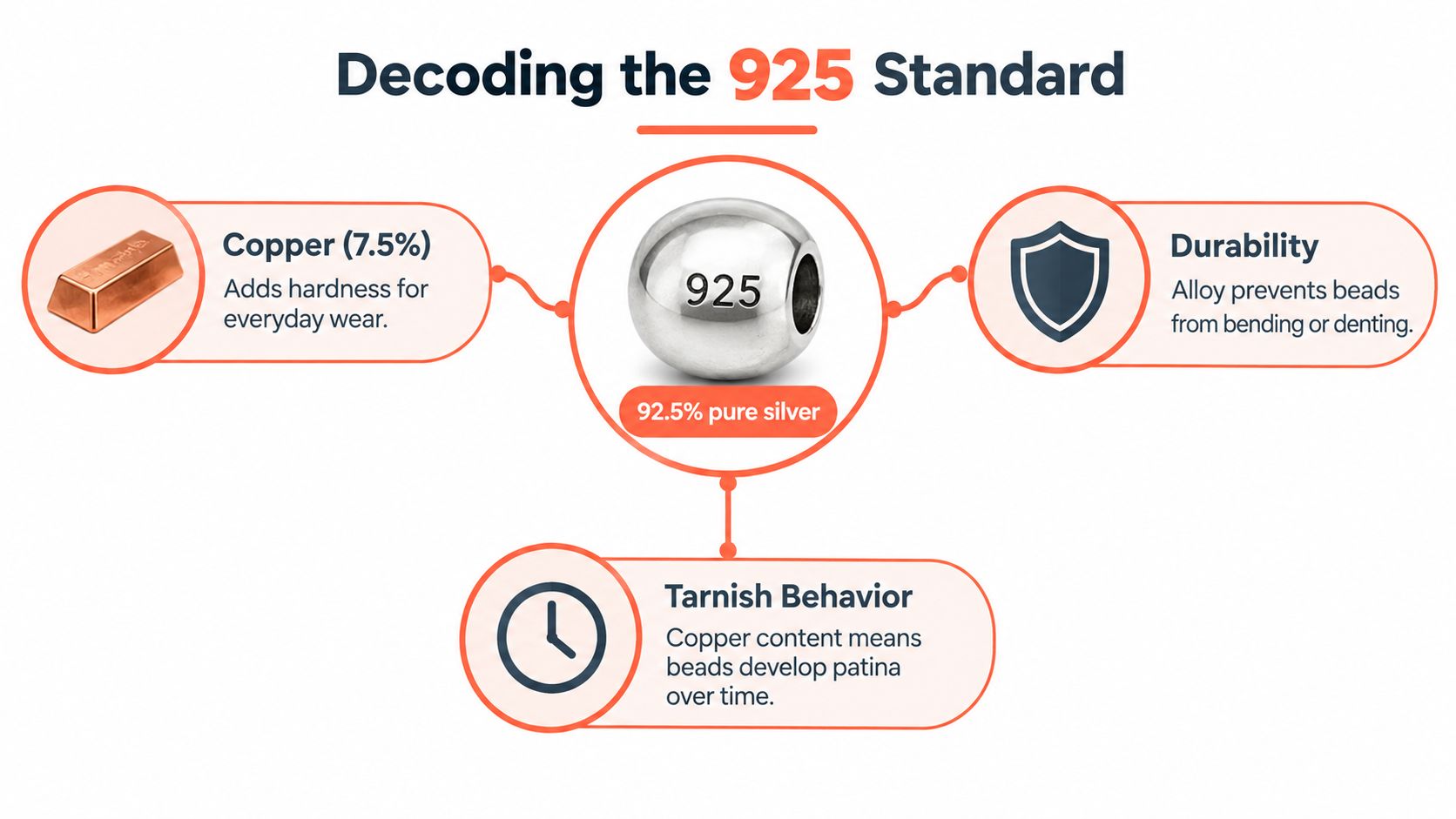
Copper gives sterling silver more strength and workability than fine silver, but alloy behavior still varies with composition, heat treatment, and cold work. Those variables affect whether a small-hole spacer bead stays stable during stringing or begins to deform under repeated handling.
Hardness matters at the bead hole
Technical benchmark data for annealed sterling silver reports approximately 207 MPa tensile strength, 124 MPa yield strength, and 41% elongation. Annealed sterling-silver wire measures about 283 MPa tensile strength, while half-hard and full-hard wire reach approximately 386 MPa and 496 MPa, respectively, according to the technical overview of sterling silver.
Don't treat those figures as a universal specification for every bead. Use them as a reason to ask the supplier for the material condition, temper, or hardness state. A stamp can identify intended fineness, but it doesn't tell you whether a bead is soft, work-hardened, dimensionally consistent, or resistant to hole enlargement.
Request the following before approval:
- Material evidence: Ask for a 925 assay report or equivalent batch documentation.
- Condition details: Ask whether the components are annealed, work-hardened, or supplied in another stated temper.
- Dimensional controls: Confirm bead diameter, length, hole size, and acceptable variation.
- Sample testing: String the smallest-hole designs with your production wire or cord before ordering.
For a broader distinction between precious-metal standards and investment products, this guide to eligible coins for a silver IRA offers useful context, although investment coins aren't interchangeable with jewelry components. You can also review what 925 sterling silver means before writing product descriptions or supplier specifications.
A short technical video can help your purchasing team align on the difference between purity and performance:
The practical conclusion is simple. Buy 925 composition and a defined manufacturing condition, not a stamp alone.
Domestic Versus Overseas Sourcing Strategies
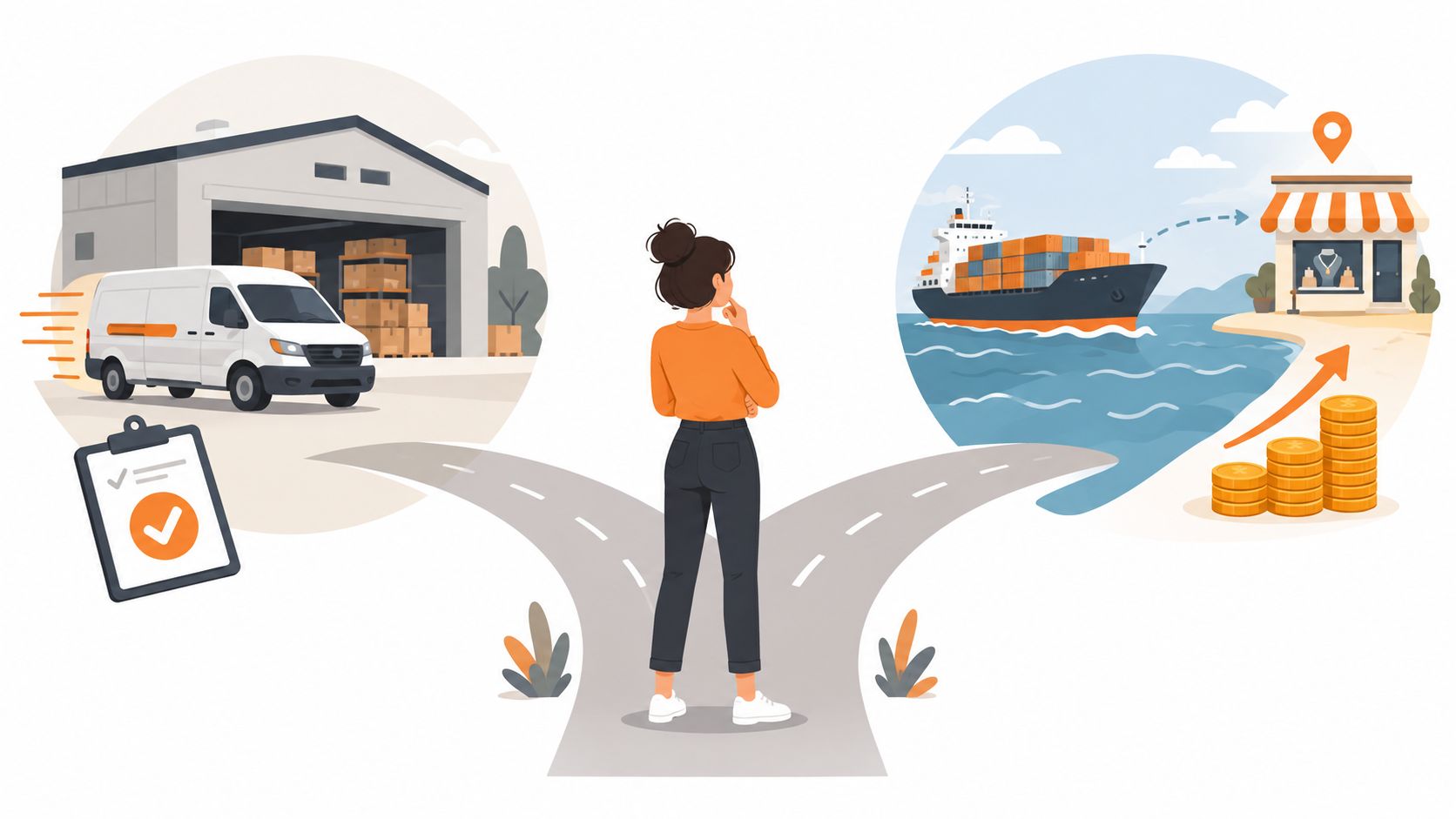
Domestic sourcing usually wins on responsiveness. You can inspect stock more quickly, communicate in the same business hours, resolve a shortage with fewer handoffs, and return unsuitable goods without managing an international claim. That convenience has a price, and the local supplier may offer fewer shapes, finishes, or factory-direct options.
Overseas sourcing can improve the purchase price and expand design depth, particularly for retailers ordering repeatable components across a wider assortment. It also introduces more variables, including freight timing, customs paperwork, language differences, payment exposure, and the difficulty of correcting a production error after dispatch. The right choice depends on the cost of being wrong.
Choose the model that fits your tolerance for disruption
| Buying situation | More practical starting point | Main reason |
|---|---|---|
| Pop-up seller needing rapid replenishment | Domestic inventory | Speed and simpler recovery matter more than the lowest quote |
| Boutique testing unfamiliar designs | Domestic or low-commitment overseas samples | The buyer needs flexibility before scaling |
| Established retailer with repeatable SKUs | Overseas factory-direct sourcing | Process control can justify deeper purchasing |
| Marketplace seller with strict delivery promises | The supplier with the clearest logistics evidence | Late delivery can damage account performance |
| Seasonal assortment with a fixed launch date | Earlier overseas planning or domestic backup stock | A missed launch can erase the expected margin |
Communication quality matters more than the supplier's location. A strong overseas partner should answer specification questions precisely, show consistent samples, explain packaging, and define what happens when goods fail inspection. A domestic vendor should meet the same technical standard, rather than receiving a free pass because shipping is easier.
Retailers comparing regions can use this practical overview of wholesalers in China for jewelry as a starting point, but no article replaces sample approval and a written specification sheet.
Don't make the decision by looking at volume alone. A smaller business may benefit from domestic flexibility, while a growing brand can justify overseas sourcing once it has stable designs, predictable demand, and someone responsible for inspection and documentation. Scale only after the buying process is repeatable.
Vetting Suppliers Through Due Diligence Frameworks
A supplier's catalog tells you what it wants to sell. Due diligence tells you whether it can support the claims your business makes. For silver components, that means checking material evidence, production controls, ownership details, origin information, and remedies when the shipment fails inspection.
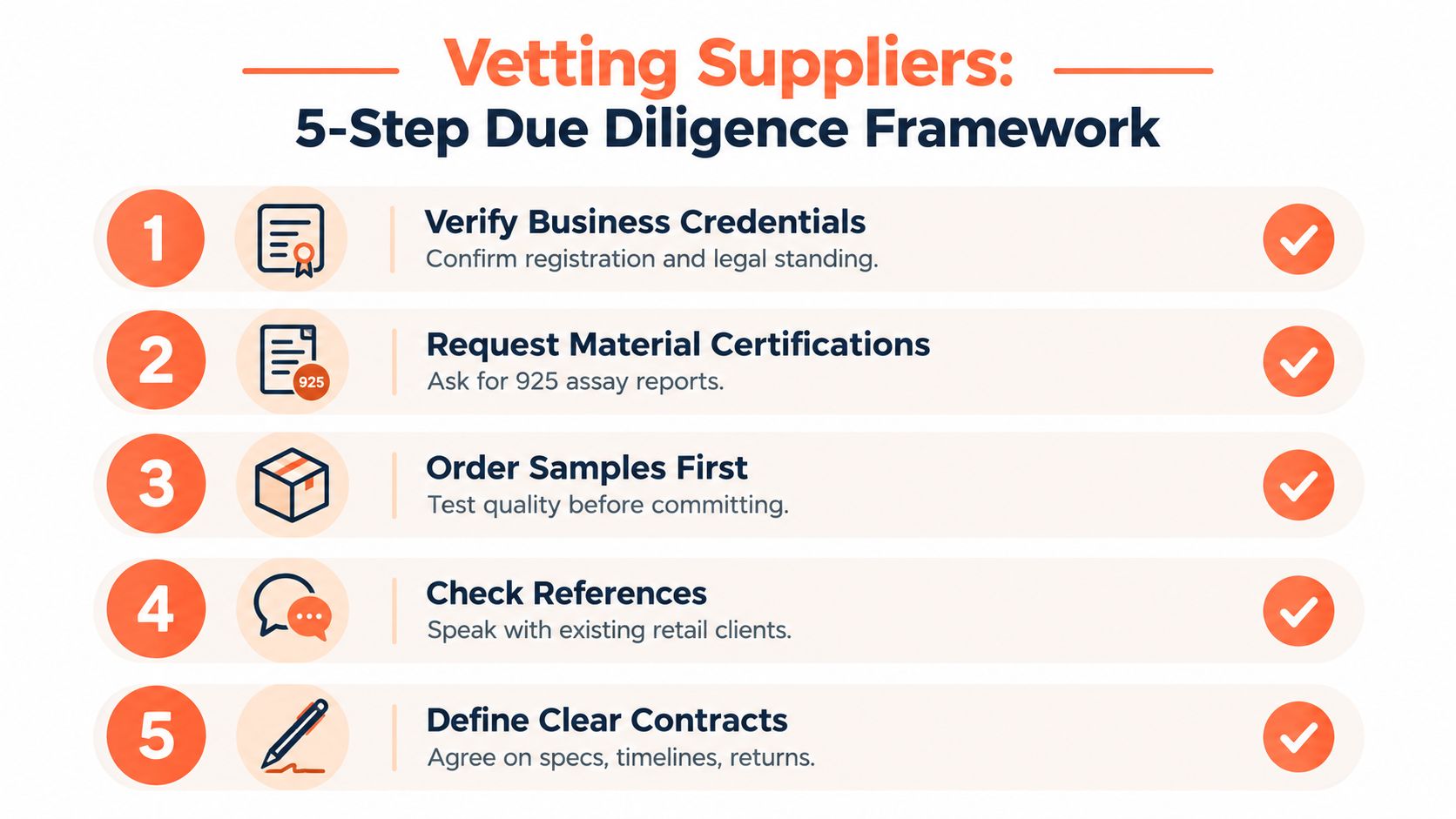
The OECD's globally applicable mineral-supply-chain guidance uses a five-step, risk-based framework covering policy, controls, risk identification, risk assessment, and independent third-party audits. Its mineral supply-chain due-diligence guidance is designed to address human-rights abuses, conflict financing, and financial crime across the minerals supply chain.
Use five checks before you approve a production partner
- Set your sourcing policy. Write down acceptable fineness, origin information, labor expectations, testing requirements, packaging, and return conditions. A supplier can't meet a standard you haven't defined.
- Identify the upstream chain. Ask who manufactures the beads, where production occurs, and whether the supplier can provide chain-of-custody or upstream-actor information. Vague answers deserve escalation, not automatic approval.
- Check material and production evidence. Request batch-level assay reports, sample measurements, process information, and any relevant independent factory audit. Review whether the document identifies the same business that invoices you.
- Assess the risks. Compare the supplier's country, intermediaries, payment route, product claims, and documentation against your written policy. A low quote doesn't offset unexplained gaps.
- Require independent review where risk warrants it. Third-party audits should focus on relevant points in the chain, not just produce a decorative certificate. Put audit cooperation, corrective action, and termination rights into the agreement.
Ask for retail references that can speak about repeat orders, defect handling, and communication under pressure. Then place samples before a production order and define acceptance criteria in writing. Trust is useful after verification, not instead of it.
Navigating Market Volatility and Pricing Dynamics
Silver demand gives bead sourcing a real industrial foundation, but it doesn't guarantee easy retail sell-through. The Silver Institute reported that jewelry fabrication increased 3% in 2024, reaching 208.7 million troy ounces of silver. At approximately 31.1 grams per troy ounce, that equals roughly 6,490 metric tonnes of silver used in jewelry fabrication, and the equivalent fine-silver content would be about 6,003 metric tonnes if all the material followed the sterling standard. The Silver Institute supply and demand data supports the conclusion that component demand sits within a large international jewelry ecosystem.
That scale doesn't mean you should buy broadly across every design. High silver prices can support the value story of genuine sterling components while making finished jewelry harder for price-sensitive customers to justify. A retailer who increases inventory without checking weight, conversion, and retail positioning can end up with valuable metal locked in slow-moving SKUs.
Build an assortment with two price positions
Use a core 925 range for customers who care about authenticity, longevity, and material transparency. Keep those designs commercially focused, with dependable shapes, practical hole sizes, and weights that support a clear finished-product price.
Pair that core with lighter-weight or alternative-metal components for customers who want the look at a lower entry price. Label the materials accurately. Substitution protects conversion only when the product description makes the difference clear.
The market outlook reinforces the need for disciplined buying. The Silver Institute forecast a 6% decline in jewelry demand in 2025, particularly because high local prices affected India, while forecasting recycling to rise 5% and exceed 200 million ounces for the first time since 2012 in its 2025 market forecast. Later reporting in the supplied market data put global silver-jewelry demand down 8% to 189.3 million ounces, while recycling rose 2% to a 12-year high of 197.6 million ounces.
Plan each SKU around bead weight, defect rate, freight, expected retail price, and sell-through risk. Price per piece is meaningless without metal content and finished-product economics.
Ensuring Legal Compliance and Hallmarking Standards
A supplier's 925 claim doesn't guarantee that your finished goods can be sold everywhere. Fineness, marking, assay evidence, and destination-market compliance are separate questions, and small retailers often discover the distinction only after customs or marketplace scrutiny.
In Great Britain, new stock entering the market must carry a UK hallmark or Common Control Mark. Equivalent EU hallmarks stopped being automatically recognized for goods entering Great Britain after January 1, 2021, while EU hallmarks continue to be recognized in Northern Ireland, according to the UK hallmarking requirements. Whether beads sold as components receive different treatment from finished jewelry depends on the jurisdiction and how the goods are packaged and sold.
Establish a compliance file before ordering
Request the supplier's country-of-origin information, batch-level composition evidence, marking details, invoice description, and explanation of who carries hallmark responsibility. Ask your customs broker or relevant authority how components, finished jewelry, and packaged retail units are treated in each destination market.
For U.S. marketing, the Federal Trade Commission defines “sterling silver” and “sterling” as at least 925 parts per 1,000 pure silver, and says products below that threshold shouldn't use those terms. Its jewelry guidance also supports traceability by requiring identification of the manufacturer, dealer, or responsible party through a name or registered trademark associated with the fineness mark. Review the FTC jewelry guides before publishing product claims.
Don't assume a supplier's stamp transfers its legal obligations to you. Get written clarity before the goods ship, especially when selling through a marketplace with its own documentation requirements. The cost of compliance work is predictable. A held shipment, forced relabeling exercise, or delisted product line is not.
Calculating True Landed Cost and Shipping Risks
A useful landed-cost model starts with the supplier invoice but doesn't end there. Calculate the merchandise cost, freight, payment fees, duties or tariffs, broker charges, inspection cost, packaging, expected defect allowance, and the value of your own handling time. Divide the total by the number of sellable beads, not the number originally shipped.
Keep two numbers separate. Cash landed cost tells you what the shipment consumes immediately. Risk-adjusted landed cost adds the expected effect of damage, missing units, customs friction, rework, and slow-moving inventory. A supplier with a lower invoice can still lose on the second measure.
Protect the shipment before dispatch
Confirm the declared value, contents description, destination restrictions, and carrier claims process. USPS states that Priority Mail International merchandise shipments include coverage against loss, damage, or missing contents up to $200 at no additional charge. Priority Mail Express International also includes merchandise coverage up to $200, with additional coverage potentially available depending on the shipment and destination. The USPS international insurance and extra-services guidance also explains that countries impose their own prohibitions and restrictions and that extended tracking history can be purchased through Tracking Plus.
Use those limits as a control point, not as a promise that every order is fully protected. Compare the shipment's declared value with included coverage, then decide whether additional insurance or a different carrier is appropriate. Photograph packaging and count or weigh the received goods quickly enough to meet the carrier's claim conditions.
For a price reference framework, review how much 925 silver costs per gram, then calculate each bead design separately. A heavier bead can justify a higher retail price, but it also ties up more working capital and increases the impact of a pricing mistake.
Merchandising High-Quality Beads for Maximum Profit
Quality only creates margin when customers can understand it. A product page that says “beautiful silver bead” gives shoppers no reason to accept a premium. State the material clearly, identify the 925 fineness, describe the intended use, and show close images of the finish and hole construction.
A boutique selling spacer beads might group them by design purpose, such as bracelet spacing, necklace accents, or charm assembly. An online seller can pair a close-up of the bead with a finished piece that demonstrates scale. Those details reduce uncertainty and help customers buy complementary components instead of treating every bead as an interchangeable commodity.

Turn care information into a service advantage
Untreated sterling silver isn't permanently tarnish-proof. Sulfur-containing gases can react with silver to form silver sulfide, and the copper in sterling can also form copper sulfide. The Canada Conservation Institute recommends storing silver below 50% relative humidity, while corrosion research cited in its silver-tarnish guidance found that tarnish behavior varies with humidity and temperature.
Give customers practical care instructions rather than vague promises. Recommend sealed low-sulfur packaging, desiccant, separation from rubber, wool, cardboard, and sulfur-bearing adhesives, and cool storage away from humid stockrooms. Apply the same discipline to your own bulk inventory so customers receive a consistent finish.
For finished goods, combine sterling beads with gemstones or pearls to create a clear design story and a higher-value purchase. A simple 925 spacer can become part of a coordinated bracelet set, while a textured bead can anchor a charm collection. Sell the design outcome, not just the component count.
JewelryBuyDirect offers bulk jewelry and jewelry-making components with factory-direct pricing, no minimum order quantity, and a broad selection of 925 sterling silver and alternative materials. Visit JewelryBuyDirect to compare bead styles, test an assortment, and build a sourcing plan around landed cost rather than the cheapest quote.