
Gold Plated Bracelet Charms: Sourcing, Quality, and Care
The gold-plated jewelry market was valued at USD 14.22 billion in 2023 and is projected to reach USD 24.36 billion by 2031, with a projected 7.1% CAGR over that period, according to market coverage of gold-plated jewelry. That growth helps explain why gold plated bracelet charms remain central to affordable retail assortments, but market size doesn't answer the question boutique buyers face: how long will the finish survive on a small component that rubs, bends, and moves all day?
After handling large volumes of plated findings and finished jewelry, I've found that the answer depends less on the phrase “gold plated” than on three details hidden behind it: plating thickness, base-metal selection, and contact-point wear. Those details determine whether a charm supports a profitable repeat-purchase model or creates avoidable complaints and replacements.
What Gold Plated Bracelet Charms Actually Are
A gold plated bracelet charm is usually a base-metal or alloy component covered with a thin electroplated layer of gold. The gold changes the surface appearance and can provide a barrier between skin and the underlying metal, but it doesn't turn the entire charm into gold. The value proposition is straightforward: a boutique can offer a warm gold finish, broad design variety, and a lower entry price than solid gold.
The important distinction is thickness. A decorative flash layer around 0.17 microns is intended for low-abrasion items and wears through faster on bracelets, where repeated friction is unavoidable, according to plating specifications from JK Findings. A practical durability threshold for frequently worn bracelet components is about 1.0 micron, while 2.5 microns is commonly treated as a heavy-plating benchmark.
The three categories buyers should separate
- Flash or gold-washed pieces: Very thin decorative deposits, generally below the practical threshold for frequent bracelet wear. They suit occasional-use fashion pieces, not a daily stack.
- Standard plated charms: Pieces around the 0.5 to 1.0 micron range. They can work well in trend-led assortments when customers understand that moisture and friction shorten the finish's life.
- Heavy gold plate: Charms at or above the 2.5 micron benchmark. They cost more to produce, but they offer a stronger basis for premium merchandising and more demanding wear expectations.
Vermeil isn't a nicer name for plating. It uses sterling silver beneath a qualifying gold layer, while a solid gold charm has gold throughout the piece and therefore carries its value in the metal itself. Base-metal plated charms sit at a different price and durability level, and product descriptions need to make that difference obvious.
| Category | Gold Layer | Base Metal | Typical Lifespan | Price Tier |
|---|---|---|---|---|
| Flash or gold washed | Around 0.17 µm | Base metal or alloy | Shorter under abrasion | Entry |
| Standard plated | Around 0.5 to 1.0 µm | Brass, copper, or zinc alloy | Moderate with careful use | Accessible |
| Heavy gold plate | 2.5 µm or more | Brass, copper, or other disclosed alloy | Higher wear resistance | Premium plated |
| Vermeil | At least 2.5 µm | Sterling silver | Higher than standard plating | Premium |
| Solid gold | Gold alloy throughout | Gold alloy | Long-term, with maintenance | Fine jewelry |
For retailers expanding beyond charms into coordinated accessories, construction language matters just as much on adjacent products. A useful comparison is the material and finish detail found in Milanese watch bands for smartwatches, where buyers also need to distinguish surface finish from the underlying metal.
From Ancient Talismans to Personalization Trend
Charm jewelry began as a carrier of meaning, not merely decoration. Ancient examples associated with Assyrians, Babylonians, Persians, and Hittites show that small objects held symbolic roles long before the modern bracelet. Evidence places charm bracelets' roots at least as far back as 600–400 BC, according to the history of charm bracelets.
Manufacturing methods shaped the materials available. Early protective objects were carved, hammered, or cast from local metals. Victorian jewelry brought charms back as a mainstream fashion statement, particularly after 1861, when symbolic lockets and keepsakes became closely connected with personal memory. Gold and silver remained higher-end choices, while plated base-metal charms gave shoppers the appearance of precious metal at a lower cost.
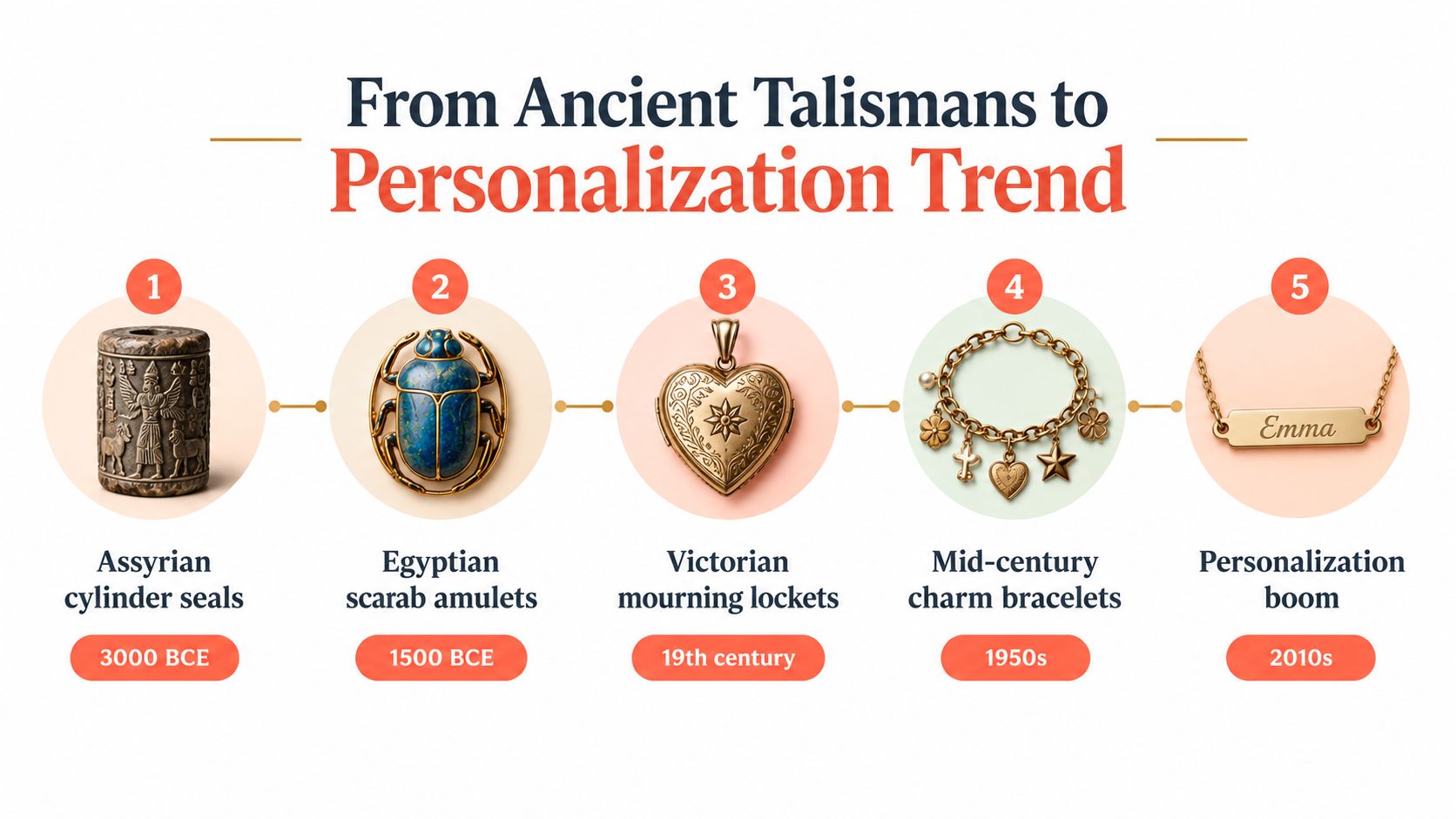
By the mid-20th century, charm bracelets were common in women's jewelry boxes. Their commercial strength was simple: customers could build meaning one charm at a time. A travel symbol, initial, hobby motif, or birthstone-style design turned a standard bracelet into a personal record.
Why plated formats became the practical default
That same buying behavior supports today's personalization market. Customers want broader themes and frequent style changes. Solid gold places more capital in every individual design, while plated charms let retailers test motifs, refresh displays, and carry more variations with the same purchasing budget.
The finish also affects how a retailer should position the product. Plated charms work well for variety, accessible pricing, and seasonal styling. A buyer selecting inventory should match plating thickness and base-metal disclosure to the intended price tier, then treat high-contact designs, such as clasp-adjacent or bracelet-bottom charms, as higher-risk items for visible wear.
For boutiques, the historical lesson is commercial. Charms encourage add-on purchases because customers can keep extending an existing bracelet instead of replacing it. Plated formats support that model by making new themes easier to stock and easier for shoppers to collect. That improves capital efficiency, especially when a retailer is testing unfamiliar motifs or short seasonal runs.
Plating Layers and Base Metals Explained
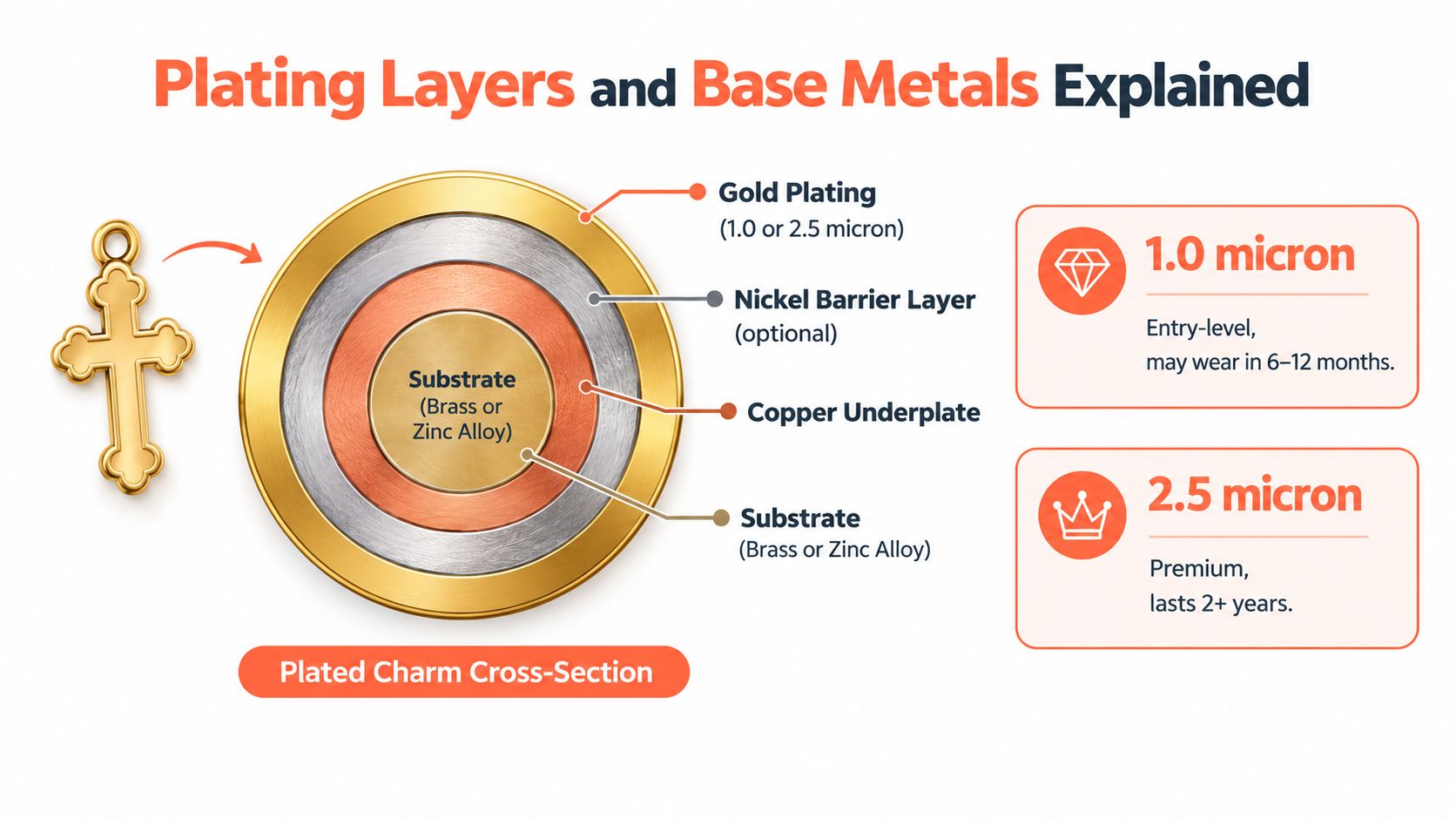
A plated charm is a layered component, not a base metal painted gold. The substrate supplies the shape and strength. A copper layer can improve surface preparation and conductivity. Some factories add a nickel barrier for adhesion or diffusion control, although nickel may concern customers with sensitivities. The final gold layer provides color and surface finish, while e-coating can help separate the plating from moisture and friction. Its plating guidance explains how these layers affect the finished surface.
What each layer means at the sample table
- Substrate: Ask whether the charm uses brass, copper, zinc alloy, stainless steel, or another disclosed material. Shape complexity and weight can indicate the production method, but they do not prove quality.
- Underplate: Copper can create a more even surface, yet exposed copper oxidizes after scratches reach it. The supplier should identify this layer instead of hiding it behind “premium finish” wording.
- Nickel barrier: Nickel may support adhesion, but request material disclosure. For skin-contact products, consider nickel-free construction where available.
- Gold plate: Put the thickness in microns on the quotation or purchase order. “Gold tone” and “gold finish” describe appearance, not deposit thickness.
- Protective topcoat: E-coating can reduce everyday exposure to moisture and rubbing. It supports the plating system, but does not replace adequate gold thickness.
Micron thickness matters most at contact points. A bracelet-bottom charm, jump ring, bail, clasp interface, sharp edge, or recessed engraving may wear differently from a broad flat face because movement concentrates friction and can produce uneven coverage. That difference affects ownership economics. A thinner deposit may suit a low-contact, occasional-wear charm, while a thicker deposit is easier to justify for a piece expected to rub against links, clothing, or neighboring charms.
Inspect samples under magnification. Look for thin color at edges, exposed underplate around holes, roughness in recesses, and plating that stops short of contact surfaces. Ask the supplier whether the stated thickness applies to the finished charm or only to a test panel, and record the base metal and layer stack with the sample approval. That documentation helps match each design to its retail tier and reduces surprises when customers wear it daily.
For visual learners, this plating demonstration video shows why surface preparation and layer bonding influence the final finish. The purchasing question is whether the supplier can document how the gold surface was built, not merely whether the charm looks gold on delivery.
Comparing Common Base Metals for Plated Charms
The base metal affects more than cost. It influences the charm's weight, edge strength, surface preparation, reaction to moisture, and likelihood of exposing a contrasting color when the gold wears away. Brass, copper, and zinc alloy are common choices, but they belong in different assortment roles.
Brass is usually the strongest all-round option for detailed charms. It accepts plating well when properly prepared and holds sharper structural features than softer alternatives. The drawback is inconsistency. Cheap brass alloys can contain unwanted metals, so the supplier's material disclosure matters as much as the name “brass.”
Copper offers excellent conductivity during electroplating and can produce a smooth finish. It also oxidizes aggressively when scratches or thin spots expose the substrate. For that reason, copper works better in a mid-tier product with a protective e-coating than in a piece marketed for rough daily use.
Zinc alloy, often called pot metal, supports economical die-cast shapes and elaborate silhouettes. It's light and cost-efficient, but it can pit, and the surface may show wear quickly at edges and contact points. I use it for seasonal, fashion-forward runs where the design's short trend window matches the product's expected ownership cycle.
| Base Metal | Relative Cost | Hardness | Plating Adhesion | Skin Reaction Risk | Best Tier |
|---|---|---|---|---|---|
| Brass | Moderate | Moderate to high | Generally strong with preparation | Depends on alloy disclosure | Premium plated |
| Copper | Moderate | Moderate | Strong when properly prepared | Depends on purity and barriers | Mid-tier |
| Zinc alloy | Lower | Lower | More variable | Depends on alloy disclosure | Fashion tier |
Retailers shouldn't assign a skin-safety promise from color or price. Nickel, lead, and other alloy components need supplier documentation, especially for charms worn against skin for long periods. A practical overview of the finish and substrate relationship appears in this guide to gold-plated brass jewelry.
The buying decision becomes clearer when the charm's role is explicit. Choose brass for core designs that need better structural confidence, copper for balanced mid-tier pieces with protection, and zinc alloy for low-risk trend testing. Don't pay for a premium base metal if the gold layer is still too thin for the customer's use case.
Quality Indicators Retailers Should Check
A polished sample can conceal weak plating. Retailers should inspect the supporting evidence before they commit to a repeat order, especially when a charm contains several small components and recessed details.
Start with documentation. Ask for the stated gold thickness in microns, a material disclosure sheet, and an SGS or equivalent third-party report where available. The report should relate to the actual product or production specification, not merely a generic factory certificate. If the supplier won't identify the substrate, plating thickness, and relevant test documentation, treat the missing information as a buying risk.
A practical sample-stage inspection
- Read the paperwork first. Confirm the specified thickness, base metal, coating system, and any nickel-free requirement before judging appearance.
- Use a loupe. Under magnification, inspect jump rings, bail interiors, engraving recesses, corners, and clasp surfaces for patchiness or exposed underlayers.
- Run a controlled rub check. A gentle rub with a clean white cloth can reveal color transfer or loose surface residue. It isn't a substitute for laboratory testing, but it can flag a poor sample.
- Inspect stress points. Open and close the clasp, flex a sample component only as appropriate for its design, and look for flaking, cracking, or edge discoloration.
- Request thickness verification. An XRF report or equivalent test should support the promised micron level. Don't infer thickness from a bright yellow color.
Markings can help, but they don't replace documentation. Terms such as GEP, HGE, and vermeil carry different meanings and must match the actual construction. The FTC Jewelry, Precious Metals, and Pewter Industries Guides prohibit deceptive precious-metal claims, so a plated charm shouldn't be described as solid gold or presented with unsupported durability language.
Practical rule: Put the plating thickness, base metal, coating, and test requirements directly on the purchase order. A verbal promise is difficult to enforce after production.
Ask whether the supplier uses e-coating, a PVD-related process, or another protective system, but don't accept those terms without knowing where they sit in the layer stack. Protection can improve the finish's performance, yet high-friction points still need adequate gold coverage.
How Long Plated Charms Really Last
For daily wear, replating commonly becomes relevant around 6 to 12 months, while replacement may enter the discussion around 12 to 18 months, according to this guide to the life of gold plating. Treat those ranges as planning references, not guarantees. For a deeper breakdown of wear timelines, see this guide to how long gold plating lasts.
Bracelet charms usually wear faster than a pendant that stays relatively still. Links, jump rings, clasps, bails, and neighboring charms create repeated contact. Edges lose color first, a jump ring can wear where it touches the bracelet, and the inside of a bail may expose its base metal before the charm face shows obvious change.
Thickness changes the ownership calculation
A flash layer around 0.17 microns is primarily decorative and poorly suited to continual bracelet friction. Standard plating around 0.5 to 1.0 microns can support an affordable daily-style product when the wearer removes it for water, cosmetics, and exercise. Heavy plating at 2.5 microns gives a stronger wear-resistance position, but it remains vulnerable to abrasion and chemical exposure.
Base metal also affects the economics. Brass or copper may show a more noticeable color shift once the gold layer wears through, while sterling silver presents a different maintenance and material story. The plating thickness cannot compensate for a contact point that was poorly finished, sharply edged, or constantly rubbing against another component.
Moisture, perspiration, and personal-care products can shorten the finish's useful life. Showering, swimming, perfume, lotion, hairspray, hand sanitizer, and makeup all increase exposure, while chlorine can accelerate visible wear. A boutique should therefore sell the expected use pattern, not promise waterproof performance.
A plated charm makes financial sense when customers want several designs and rotate them. It becomes poor value when the buyer expects solid-gold behavior from an entry-tier finish.
That distinction should guide wholesale buying. Plated charms suit accessible, quickly changing themes and impulse-friendly add-ons. Compare plating thickness, base metal, contact-point construction, expected replacement, and care burden against the initial ticket. Solid gold suits customers prioritizing long-term ownership and metal value, while sterling silver offers another balance of material cost and maintenance.
Care Guidance as a Retail Margin Lever
Care instructions protect the customer's bracelet and the retailer's margin. They reduce preventable disappointment by stating where plated charms can fail before purchase. A compact card also positions the piece accurately, as an occasional or careful daily-wear item, rather than leaving the customer to discover its limits through rubbing, moisture, or product exposure.
The care card should give customers a routine they can follow:
- Remove before sleep. Nighttime movement creates repeated rubbing against bedding and neighboring charms.
- Keep it away from water. Remove the bracelet before showering, swimming, washing, or exercise.
- Apply products first. Let perfume, lotion, hairspray, makeup, and sanitizer dry before putting on the jewelry.
- Store it separately. Use a soft pouch or dry, enclosed storage to reduce scratches and humidity.
- Polish gently. Use only a soft, lint-free cloth. For a full customer-facing routine, see this guide to caring for gold-plated jewelry.
Turn the card into a selling tool
Use direct wording instead of vague instructions such as “handle with care.” A retailer can print, “Remove before showering or swimming,” followed by, “Wipe dry with a soft cloth after wear.” Specific directions make the maintenance burden visible and manageable.
A polishing cloth and airtight pouch can make the purchase feel considered, provided both suit plated jewelry. They should support the care routine, not suggest unlimited durability. Packaging cannot compensate for thin plating, exposed base metal, or a charm that constantly contacts the bracelet or adjacent components.
The follow-up email can reinforce the same habits: “Your charm bracelet will keep its finish longer when you remove it before water, sleep, exercise, perfume, and lotion. Wipe it with a dry, soft cloth, store it separately, and browse new charms when you're ready to refresh your stack.” The message supports ownership while creating a natural occasion for a future add-on purchase.
Retailers should track returns, complaints, and replacement requests before claiming that care guidance improves financial results. The practical margin principle is clear: customers who understand the finish are more likely to judge the charm against the promise made, not against solid-gold expectations.
Wholesale Sourcing and Merchandising Strategy
A reliable wholesale program begins with written specifications, not a product photo. Before ordering gold plated bracelet charms, request the gold layer thickness in microns, the base-metal composition, available SGS or equivalent test reports, coating details, warranty terms, and replacement pricing by SKU.
Supplier scorecard
| Criterion | What to Request | Weight | Pass/Fail Threshold |
|---|---|---|---|
| Plating thickness | Written micron specification | Highest | Specific value stated |
| Base metal | Alloy and nickel disclosure | High | Material identified |
| Testing | SGS or equivalent report | High | Report matches product |
| Warranty | Coverage and exclusions | Medium | Terms documented |
| Replacement pricing | SKU-level replacement cost | Medium | Cost supplied before order |
| Order flexibility | MOQ and reorder terms | Medium | Test order permitted |
No-MOQ purchasing reduces the risk of testing a personalization trend. New boutique owners can trial a small group of initials, symbols, birthstone-style motifs, or hobby themes without making a large commitment before sell-through is known. For established stores, the same flexibility supports controlled SKU testing and cleaner reorder decisions.
Build the assortment around wear expectations
Pair an accessible starter bracelet with a small set of higher-margin statement charms. Put the material and care message beside the product, not only on the product page. Rotate themes when customer behavior shows that a motif is slowing, while retaining proven symbols as core inventory.
FTC guidance matters at every stage. Gold plated and gold vermeil aren't interchangeable descriptions, and a plated item shouldn't be marketed as solid gold or assigned unsupported longevity claims. Country-of-origin marking and material disclosures should also match the applicable selling requirements in the markets you serve.
Packaging deserves attention because a pouch or box protects the finish after purchase. Retailers comparing presentation options can use this practical resource on how to pick a jewelry box to evaluate size, material, storage, and presentation against the charm's actual needs.
For a broader B2B assortment, JewelryBuyDirect offers gold-finish charm bracelets, modular Italian-style links, gold-plated stainless-steel options, and other jewelry components through a no-MOQ wholesale platform. Its catalog includes SGS-certified manufacturing partners, written product details, and a range of base metals and finishes that can support testing before larger reorders.
JewelryBuyDirect gives boutiques and online sellers access to gold-finish charm bracelets, modular charms, and related wholesale jewelry without a minimum order quantity, making it practical to test thickness, base-metal, and theme combinations before scaling. Visit JewelryBuyDirect to review the current charm assortment, compare specifications, and build a more dependable plated-jewelry buying program.