
Rose Gold Necklace Wholesale Guide for Retailers
A sample pack lands on your desk, and the rose gold necklace on top looks excellent in the supplier's photograph. Under your store lights, the color is suddenly too pink. The clasp feels loose, the chain drapes stiffly, and the tag says “rose gold” without making clear whether you're buying solid alloy, vermeil, filled construction, or a thin plated finish.
That first impression matters, but it isn't enough. A profitable buying decision depends on four questions: what alloy sits under the color, how much plating is present, whether the supplier can reproduce the finish, and whether the target retail price leaves room for returns and markdowns. I've handled enough factory samples and boutique returns to know that polished photography can hide weak links, uneven tone, and worn plating. Use the jewelry photography tips for retailers for merchandising, but never use photography as a substitute for inspection.
The Buyer's First Look at a Rose Gold Necklace
When I open a sample shipment, I don't start with the pendant design. I start with the hardware. I check the tag weight against the feel in my hand, let the chain fall naturally across my fingers, and watch whether the links settle smoothly or bunch together. A chain that looks substantial in a photo but twists into a rigid strip usually won't earn repeat purchases.
The clasp gets the next inspection. I open and close it repeatedly, check the spring ring or lobster mechanism for hesitation, and look for a clean stamp on the clasp itself. A product tag can be switched. A properly applied hallmark or material stamp on the component customers handle gives me more confidence, though it still needs verification.
Practical rule: If the supplier won't let you inspect the clasp, solder points, and finish under ordinary lighting, treat the sample as unverified.
Shop lighting can flatter a rose tone. Warm bulbs make copper-rich alloy appear richer, while a phone camera may exaggerate pink or smooth out surface wear. I compare the necklace under the store's actual lighting, beside yellow gold and silver pieces, then photograph it with a phone before approving the color. Studio gels are useful for presentation, not for quality control.
Four decisions that determine the buy
- Alloy tier: Decide whether the customer is paying for solid rose gold, vermeil, filled construction, or plating.
- Finish depth: Ask how thick the gold layer is, and demand documentation rather than a phrase such as “premium plating.”
- Supplier reliability: Confirm that the factory can repeat the same rose tone, clasp quality, and chain gauge across a batch.
- Target margin: Set the retail position before negotiating the unit cost. A cheap necklace that creates discoloration complaints is expensive inventory.
The rest of the buying process follows from that first look. Alloy composition controls tone and structural behavior. Construction determines how much wear the customer can reasonably expect. Market position tells you how deep to buy, while supplier checks protect the margin after the cartons arrive.
What Rose Gold Is Actually Made Of
Rose gold is gold alloyed with copper and, commonly, silver. Its modern commercial history traces back to nineteenth-century Imperial Russia, where goldsmiths popularized a copper-rich alloy known as “Russian gold.” The style later moved through Western Europe and the United States, and Cartier's Trinity Ring, first released in 1924, helped establish rose gold in mainstream fine jewelry, as documented by Sotheby's history of rose gold.
Standard 18K rose gold is typically 75% gold, about 22.25% copper, and about 2.75% silver. The copper supplies the pink warmth and reinforces the alloy, while the silver helps adjust the final color and working properties. That balance matters at chain links, clasp rings, and pendant bails, where repeated movement can expose weak soldering or soft metal.
Read the karat as a buying decision
The common retail comparison is between 14K and 18K. 14K rose gold contains about 58.3% gold, leaving more room for copper and other alloy metals. It generally offers greater hardness and scratch resistance, making it a practical choice for everyday chains and layered styles. 18K rose gold contains 75% gold, gives a warmer and richer gold presence, and usually costs more, but it is softer and can show surface wear sooner.
Some United States retailers also carry 10K solid rose gold as a budget entry point. Proprietary alloys may include trace zinc or adjust the copper and silver balance, so two pieces stamped 18K can still show noticeably different rose tones. A stamp identifies the karat claim, not the exact visual recipe or the factory's finishing discipline.
| Karat | Gold % | Copper % | Color Tone | Hardness | Price Band |
|---|---|---|---|---|---|
| 10K | Qualitatively lower gold content | Higher alloy share | Often deeper rose | Generally harder | Entry solid-gold tier |
| 14K | About 58.3% | Higher copper ratio | Deeper, stronger rose | Better suited to daily abrasion | Mid solid-gold tier |
| 18K | 75% | About 22.25%, commonly balanced with silver | Warmer, richer rose | Softer than lower-karat options | Higher solid-gold tier |
Hardness tables place 18K rose gold around 135 to 150 Vickers, which helps it resist deformation in chain links and pendant bails, according to this rose gold alloy comparison. For a retailer, the important point isn't memorizing the test scale. It's recognizing that alloy composition affects how a necklace behaves after repeated handling.
For verification procedures, use a documented process such as the one described in this guide to testing gold purity. Don't approve an 18K claim from color alone, and don't assume a darker tone means higher gold content.
Solid, Vermeil, Filled, or Plated
The construction tier determines whether a rose gold necklace feels like a considered purchase or a short-lived fashion item. Retailers often lose margin by describing every pink-toned product as “rose gold” without clearly separating the core metal from the surface layer.
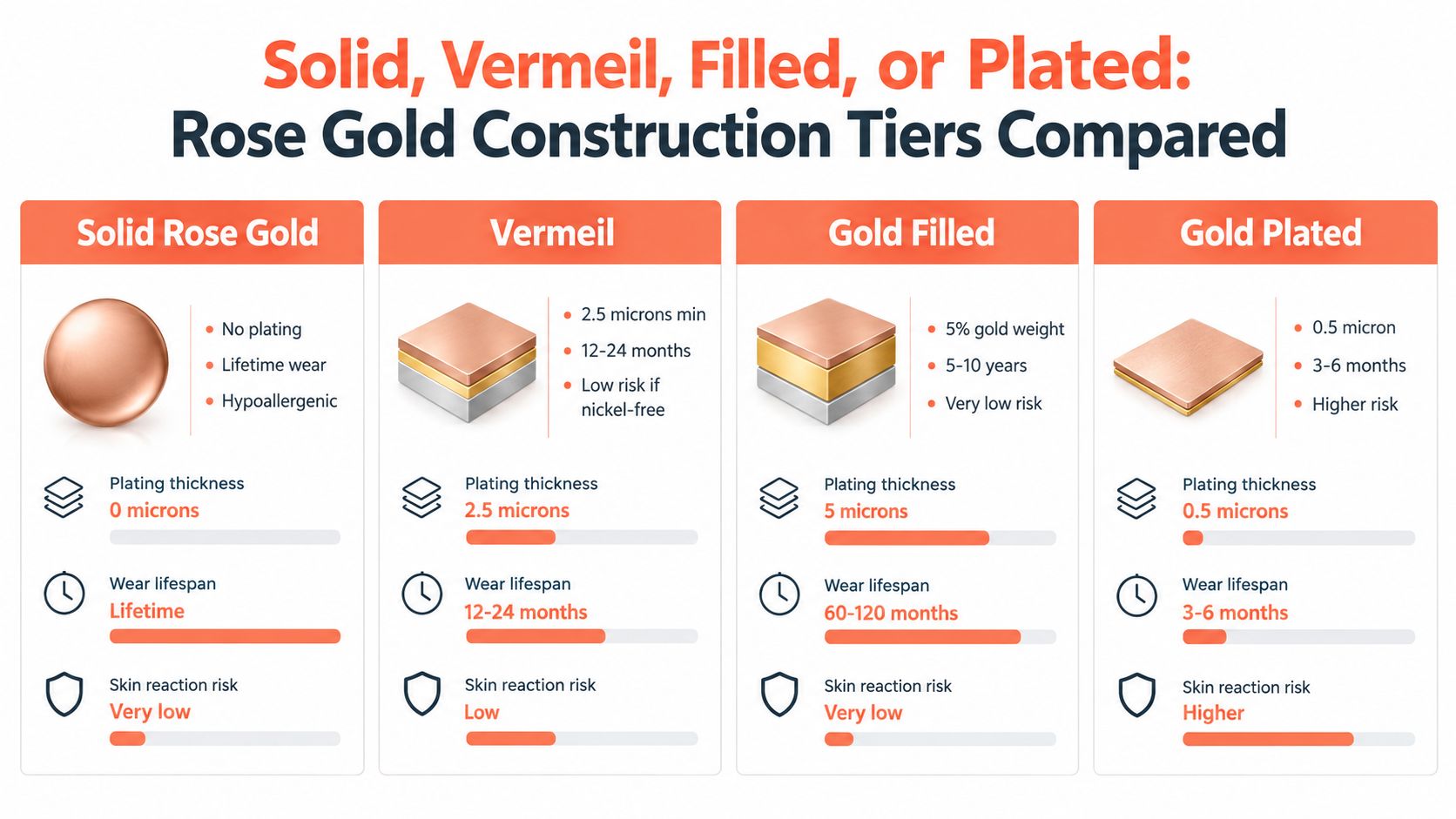
Solid rose gold has no plating layer to wear through. It carries the highest material cost, but it also supports the strongest long-term product story and is the appropriate foundation for fine jewelry and bridal positioning.
Vermeil uses a sterling silver core with a gold layer. Industry definitions commonly require a minimum 2.5-micron gold layer for gold vermeil, and the vermeil jewelry guide explains why the silver core and plating depth should appear clearly in your product specifications. Vermeil can justify a meaningful retail markup when the finish is even and the care instructions are visible.
Gold-filled construction mechanically bonds a gold layer to a base metal, commonly brass. The gold must represent 5% of the total weight under the definition used in the supplied product guidance. It offers a more substantial surface than standard plating and fits customers who want a durable look without paying for a solid-gold piece.
Standard plated jewelry places a thin gold coating over a base metal. Its quality range is wide, from 0.03 to 1 micron, so “gold plated” alone tells you very little. For business buying, a plating thickness of about 0.5 to 1.0 micron or more is cited as a meaningful threshold in this wholesale jewelry quality guide. Ask for the actual thickness, base metal, and testing method.
| Construction | Core and surface | Wear position | Retail role |
|---|---|---|---|
| Solid rose gold | Gold alloy throughout | Long-term wear | Fine jewelry and bridal |
| Vermeil | Sterling silver with at least 2.5 microns | Stronger plated tier | Giftable and elevated fashion |
| Gold-filled | Mechanically bonded layer, 5% gold by weight | Durable fashion tier | Everyday premium |
| Plated | Thin coating over base metal | Shorter-wear fashion tier | Accessible trend and impulse price |
The right tier depends on the promise attached to the ticket. A lower-priced fast-fashion piece can work when the listing says exactly what it is. A higher retail price needs construction details, consistent color, and customer care support. Plated SKUs become margin liabilities when the supplier won't document thickness and the return policy leaves you absorbing finish complaints.
Skin sensitivity also deserves plain language. Rose gold is usually copper-based and often contains little or no nickel, but copper can cause irritation or green discoloration for some wearers. Plated pieces carry an additional risk because the customer may contact the base metal after the coating wears. Base-metal disclosure matters more than the color name.
Where Rose Gold Sits in the 2026 Market
Rose gold isn't dead, and it isn't the default finish it once was. The useful retail position is narrower and more productive: it works as a complementary metal in mixed-metal styling, personalized designs, and bridal collections, while yellow gold and white metals continue to claim attention in broader assortments.
The global rose gold jewelry market was estimated at $25.4 billion in 2025 and is projected to reach $42.8 billion by 2034, implying a 6.2% compound annual growth rate, according to the rose gold jewelry market outlook. That figure describes the wider category, not the sales forecast for your individual necklace. It does, however, confirm that rose gold remains a recurring commercial category rather than a discontinued fashion experiment.
Broader colored-gold sales data gives buyers a more useful signal. Rose gold held 28% of colored gold sales in Q1 2025, compared with 36% in 2020 and 26% in 2023, based on the 2025 rose gold style analysis. The story is moderation. Rose gold has softened from dominant status, but it remains stable enough to earn shelf space when the design and price are right.
| Year | Yellow Gold % | White Gold % | Rose Gold % |
|---|---|---|---|
| 2020 | Not provided | Not provided | 36% |
| 2023 | Not provided | Not provided | 26% |
| Q1 2025 | Not provided | Not provided | 28% |
Buy for velocity, not enthusiasm
I'd use a 90-day review cycle for everyday chains, but I wouldn't present that as a market statistic. It's a practical inventory discipline. If a style moves steadily through that window, reorder with confidence. If it attracts clicks but sits in the case, reduce depth before the next buying cycle.
Bridal and gifting can support deeper rose-gold selection because customers often shop with a specific emotional or personal brief. Everyday chains need tighter testing. Start with multiple silhouettes, observe which lengths and link profiles earn sales, then reorder the winners instead of filling a wall with nearly identical pink chains.
Q4 and Valentine's buying may create seasonal opportunities, but seasonality doesn't rescue a weak finish. The safest 2026 position is a controlled rose assortment supported by mixed-metal styling, not a wholesale commitment to one metal family.
Sourcing Rose Gold Necklaces Wholesale
A supplier quote is only the beginning. Before you wire money, turn the product description into a specification sheet that someone at the factory can't interpret loosely.
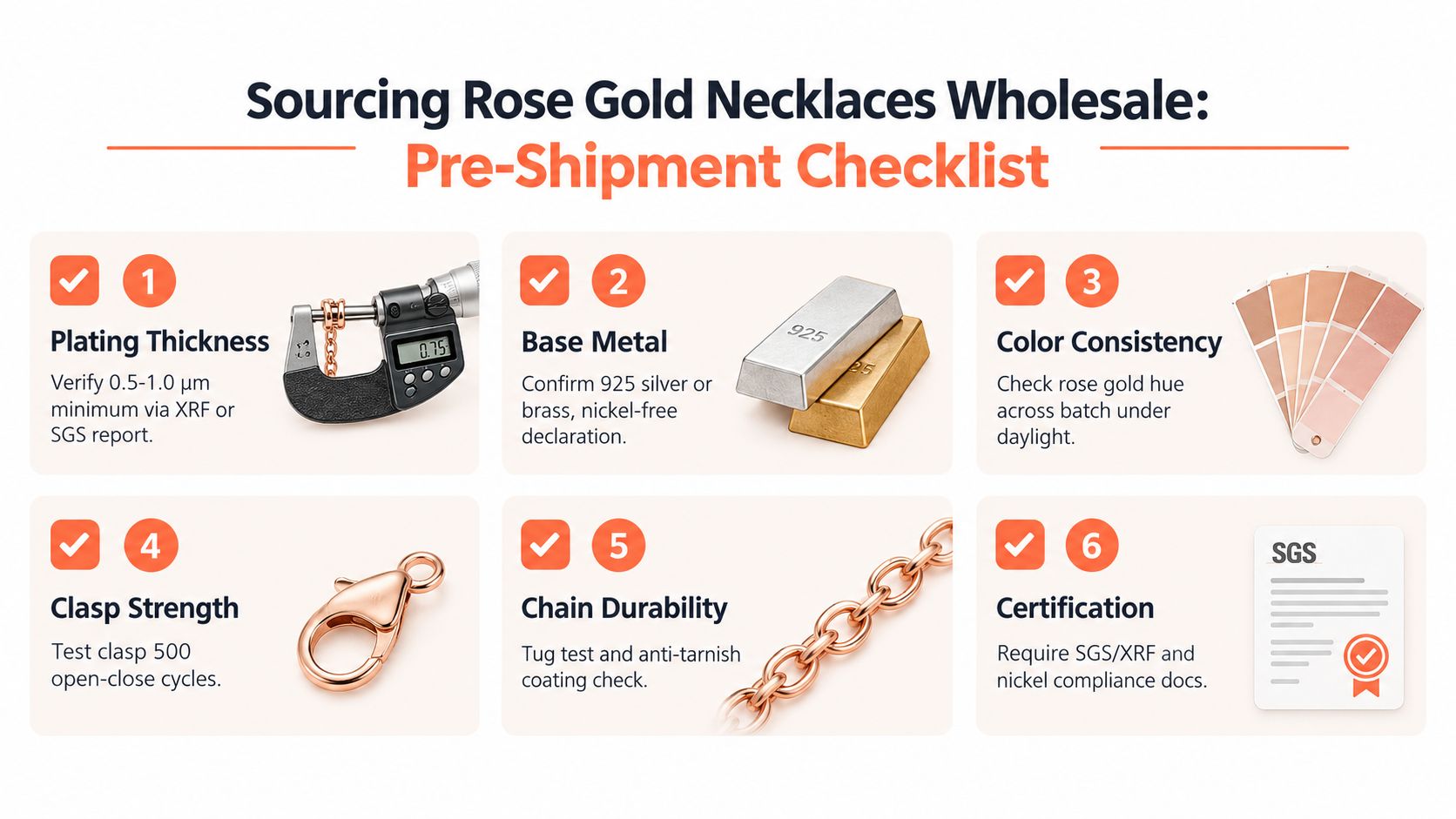
The pre-shipment checklist
- Verify plating thickness. Set 0.5 to 1.0 μm minimum as your business threshold for plated products, and request XRF readings or an SGS report. A supplier who offers only a color description hasn't given you enough information.
- Confirm the base metal. Specify sterling silver, stainless steel, brass, gold-filled, or vermeil. If the piece is sterling silver, look for an S925 specification and verify that the stamp appears on the clasp or relevant metal component, not only on a removable tag.
- Check color consistency. Compare samples from different production runs under daylight and your store lighting. Ask whether the rose tone comes from the alloy itself or from post-production plating.
- Test the clasp and chain. Open and close the mechanism, inspect solder joints, and perform a controlled tug test. The supplied checklist also calls for testing the clasp through 500 open-close cycles, so include that requirement when your quality agreement supports it.
- Document finish protection. Ask whether an anti-tarnish coating is used, how it is applied, and what care limits the factory communicates for the finished necklace.
- Require certification documents. Ask for SGS or XRF verification, nickel compliance documentation where relevant, and any available mill certificate or material declaration.
MOQ deserves a commercial answer, not a reflexive one. A factory holding a 100-piece minimum may suit a small test order or a retailer sampling several designs. A 500-piece MOQ can make sense only when the supplier demonstrates stable color, documented plating, and a proven repeat-order process. Low MOQ doesn't compensate for inconsistent production.
Supplier question: “What happens if the rose tone, plating measurement, or clasp specification fails inspection?” If the answer isn't written into the return or defect agreement, assume you'll carry the risk.
Ask about lead time, plating-line origin, inspection timing, defect-window length, replacement terms, and sample-swatches. Red flags include no mill certificate, no plating-thickness documentation, and refusal to provide sample swatches. Those omissions make it impossible to price the product fairly or explain it accurately to customers.
Building a Rose Gold Assortment That Sells
Don't build the entire chain wall in rose gold. The strongest assortment uses rose as one layer in a broader metal story, allowing customers to combine it with yellow gold and silver instead of forcing a single-color purchase.
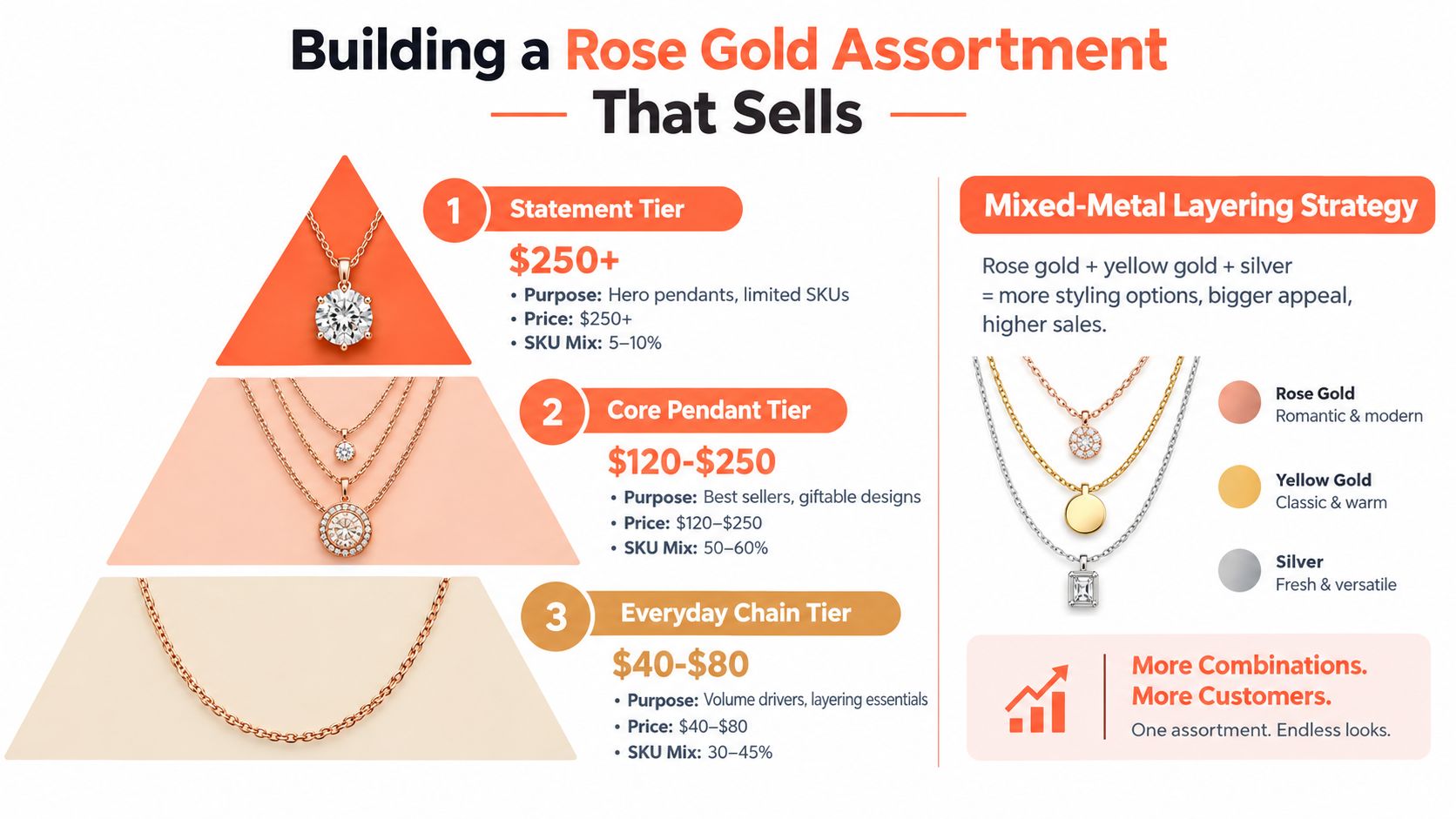
I like a three-tier structure:
- Everyday chain tier, $40 to $80: Use accessible, durable construction for layering essentials. Paperclip, satellite, and clean cable profiles belong here.
- Core pendant tier, $120 to $250: Put the strongest giftable designs here, including engraved bars and meaningful symbols. Vermeil, filled, and carefully specified plated options can serve different price points.
- Statement and bridal tier, $400 and above: Keep the range edited. Hero pendants, solid rose gold, and polished bridal pieces need stronger documentation and presentation.
The exact price architecture is a merchandising framework, not a universal rule. Your customer base, rent, channel fees, and return policy still determine the final ticket. The point is to give each construction tier a job.
Use design families, not duplicate stock
Rose gold tends to carry well in Cuban link, paperclip, satellite chain, and engraved bar pendant designs because those silhouettes support layering and personalization. Sculptural links, mixed-metal details, and meaningful engraving can keep the metal from feeling like a dated color choice. Designs that rely only on the rose hue, with no distinct shape or story, are more exposed when the trend cools.
I recommend a 60/30/10 split between rose, yellow, and white across the chain wall only as a starting assortment rule, and that specific split comes from the supplied merchandising direction rather than a reported market statistic. Adjust it using your own sell-through. If yellow gold accelerates in your store, move open-to-buy toward yellow rather than defending a planned ratio.
For social commerce, demonstrate layering and clasp action instead of showing static close-ups. Retailers creating short-form content can use Viral.new's jewelry video ideas to develop product demonstrations around texture, styling, and personalization.
Shallow breadth across tiers beats deep stock in one rose gold SKU. Give customers several ways to enter the category, then let sales data determine which chain, pendant, and bridal designs deserve a reorder.
Care, Patina, and Customer Questions
A care card protects the sale after the sale. Print instructions that match the actual construction, and train staff to explain that rose gold's copper content can react differently from one wearer to another.
Customers may notice subtle darkening or green discoloration on the skin. Copper can react with individual body chemistry, sweat pH, lotions, and moisture. That reaction is generally harmless, but irritation is a different issue, especially when a plated surface has worn and exposed the base metal.
The care card I'd include
- Clean gently: Use pH-neutral soap, lukewarm water, and a soft microfiber cloth.
- Store separately: Place each necklace in an individual anti-tarnish pouch to reduce friction and contact with moisture.
- Remove before exposure: Keep the piece away from chlorine pools, heavy lotions, and direct contact with household chemicals.
- Protect delicate finishes: Don't use ultrasonic cleaners on vermeil or plated chains.
- Avoid abrasives: Skip abrasive polishing compounds, which can remove surface finish and change the appearance.
A customer who understands expected patina is less likely to interpret every color change as a manufacturing defect. A customer who reports itching, persistent redness, or a finish that flakes in normal use deserves a proper inspection and a clear return decision.
Questions your staff should answer
Why does the skin look green? Copper in the alloy or exposed base metal can react with sweat and lotions. Explain the chemistry calmly, and don't dismiss irritation.
Can the necklace be resized? A jeweler may adjust some chain lengths or replace components, but soldered designs, plated surfaces, and delicate pendants limit what can be done safely. Confirm the construction before promising an alteration.
How should I explain vermeil wear? Tell customers that vermeil has a sterling silver core and a gold surface layer. Friction, cosmetics, and moisture can gradually affect that layer, so care and honest expectations matter.
When is a return warranted? Unexpected peeling, uneven plating from delivery, broken clasps, or a material specification that doesn't match the listing justify investigation. Mild, gradual patina that matches the disclosed alloy and care guidance isn't automatically a defect.
A printed care card adds more perceived value than elaborate packaging when it prevents confusion. It also gives your staff a consistent answer instead of leaving every return decision to guesswork.
JewelryBuyDirect offers wholesale rose gold necklace options across plated titanium steel, pendant, sterling silver, and other material categories, with no minimum order quantity and supplier documentation to review before scaling an assortment. Visit JewelryBuyDirect to compare construction tiers, test a focused selection, and build a rose gold buying plan around verified specifications rather than polished photos.