
Stainless Steel Chain for Jewellery Making: A Buyer's Guide
316L stainless steel is the most reliable grade for daily-wear jewellery chains because its low carbon content and added molybdenum improve weld integrity and resistance to sweat and salt, while 304 is better suited only for dry, low-friction fashion pieces where cost matters more than long-term wear performance. For most stainless steel chain for jewellery making, that grade decision is the starting point, not a finishing detail.
A familiar sourcing problem follows. A maker chooses an inexpensive chain that looks excellent on arrival, builds it into bracelets and necklaces, then sees dulling, stretched links, or customer complaints after regular wear. The chain wasn't necessarily badly designed. It was often the wrong alloy, gauge, finish, or construction for the product.
Why Stainless Steel Chain Changed How Jewellery Makers Source
A small jewellery brand usually balances three pressures at once: the finish must look consistent, the component must survive ordinary wear, and the landed cost must leave room for margin. Precious metals can deliver a premium feel but raise material costs. Plated base metals can create attractive colours, yet their surface treatment may wear through at contact points. Stainless steel occupies a practical middle ground, especially for brands selling everyday fashion accessories.
Its value comes from more than appearance. Stainless steel resists corrosion because it contains at least 10.5% chromium, which forms a thin passive oxide film over the surface. That film protects the metal and can self-heal when scratched, helping chains retain a polished appearance with less tarnishing than many ordinary base metals, as explained by Eurofer's stainless and specialty steel reference.
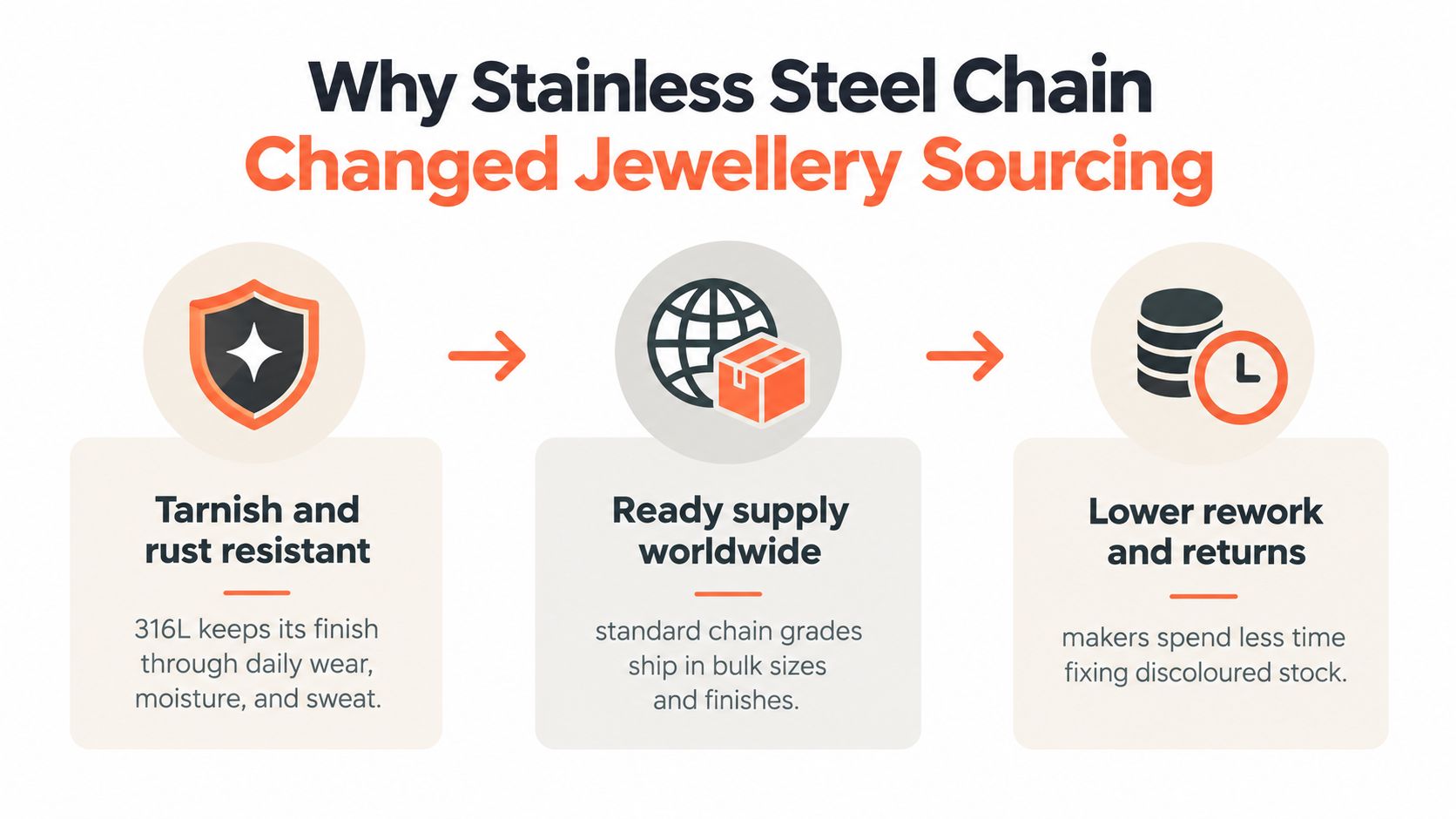
The category has also become commercially substantial. One market estimate valued the global stainless steel jewelry market at USD 2.603 billion in 2025, with a projection of USD 3.75 billion by 2034 at a 4.1% CAGR. A separate 2026 report projected growth from USD 7.08 billion in 2025 to USD 10.8 billion by 2035 at a 4.3% CAGR, according to Business Research Insights' market report. The different estimates use different market definitions, but both point to sustained demand rather than a short-lived craft trend.
Buyer's perspective: Treat stainless steel as a repeatable wholesale category. Compare grade, construction, finish, and supplier controls before comparing unit price.
This guide's practical question is simple: does the chain fit the customer's wear conditions and your margin target? A professional buyer doesn't accept “stainless steel” as enough information.
Understanding Stainless Steel Grades for Jewellery Chains
The word stainless describes a family of alloys, not one universal material. Chromium creates the protective surface film, but the rest of the composition influences how a chain behaves during fabrication and wear.
Chromium protects the surface
The passive oxide layer is thin, invisible, and continually reforms in normal conditions. That chemistry is why an unplated stainless chain can remain visually stable through ordinary handling better than many low-cost base-metal alternatives. It also explains why a scratch doesn't automatically expose the chain to immediate, widespread corrosion.
The protection has limits. Chlorides, acidic residues, friction, contamination, and poor finishing can compromise surface performance. A chain exposed to sweat, salt air, or repeated rubbing needs a more suitable grade and a well-prepared surface, not just a stainless label.
Why 316L earns the premium
316L is especially relevant to jewellery fabrication. Its typical composition is 16–18% chromium, 10–14% nickel, 2–3% molybdenum, and carbon below 0.03%, according to JewelTrendPro's explanation of 316L stainless steel jewellery.
The low-carbon designation helps reduce carbide precipitation during welding and fabrication. In practical terms, joined areas are less likely to lose the corrosion resistance that makes stainless steel attractive in the first place. Molybdenum improves resistance to pitting caused by chlorides, which matters for sweat, humid cities, coastal air, and products worn frequently.
A usable grade decision
Choose 316L when the chain will touch skin continuously, sit inside a bracelet or anklet exposed to moisture, or form part of a product where returns would be costly. Choose 304 when the item is a dry, occasional-wear fashion piece and the lower material cost supports the intended retail price.
Neither grade should be marketed as universally hypoallergenic. Alloy composition, surface condition, wear environment, and individual sensitivity all matter. Buyers with significant nickel sensitivity may need a different material, such as implant-grade titanium, rather than relying on a broad “hypoallergenic” label.
Comparing 316L with 304 in Real Jewellery Use
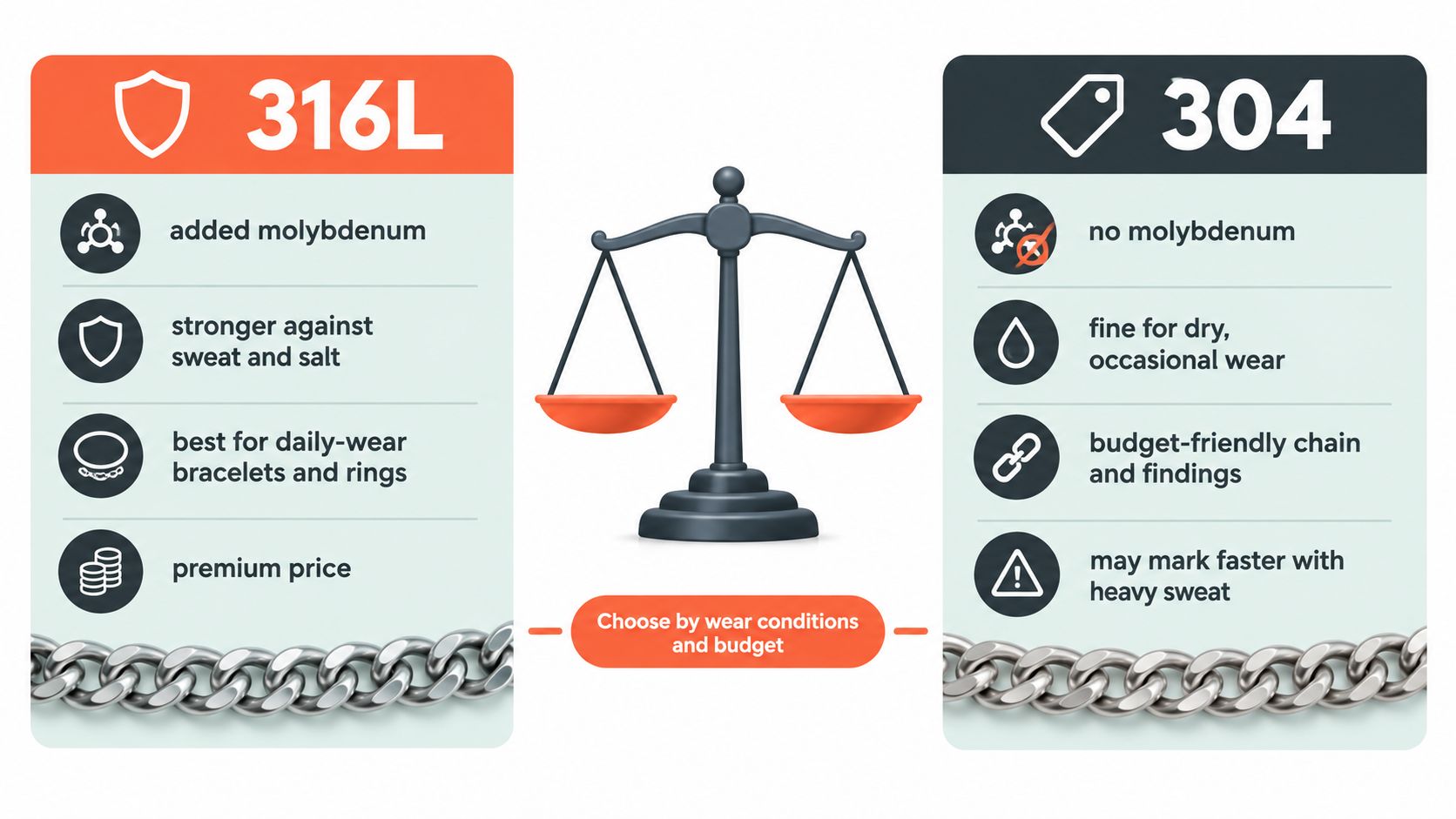
A chain worn against sweaty skin every day faces a different material test from a necklace used occasionally in a dry setting. 316L contains molybdenum, while 304 does not. That element improves resistance to pitting, so the higher grade can justify its cost when durability, customer satisfaction, and fewer returns matter.
Compare composition with the wearing environment
A technical findings guide places 304 at roughly 18–20% chromium and 8–10.5% nickel, with no molybdenum. It places 316 at roughly 16–18% chromium, 10–13% nickel, and 2–3% molybdenum. This difference in chemistry explains why 316 performs better around saltwater, sweat, and acidic conditions, as described in this stainless-steel findings guide.
Comparative testing shows the practical gap. In continuous saltwater immersion, 304 begins degrading after 72 hours, while 316 withstands more than 1,000 hours under the same laboratory conditions, according to JewelTrendPro's 304 versus 316 comparison.
304 remains a sensible choice for dry necklaces, occasional accessories, decorative components, and price-led designs. The saving is useful when the expected wear environment does not demand the additional pitting resistance.
Check skin-contact claims carefully
Both grades can contain nickel. Many wearers tolerate stainless steel, but sweat, acids, friction, and prolonged contact can increase the chance of a reaction. Grade alone does not support a universal “hypoallergenic” claim. Customers with severe nickel allergy may need titanium instead.
For a clearer explanation of the designation, see this guide to what 316L means on jewellery. Ask suppliers to identify the grade rather than listing only “stainless steel,” and request material documentation for body jewellery or products designed for continuous skin contact.
Practical rule: Pay for 316L where moisture exposure and after-sale risk justify it. Use 304 selectively when the product's wear conditions and margin support the lower-cost grade.
Evaluating Chain Strength, Gauge, and Mechanical Limits
Corrosion resistance won't stop a chain from stretching. A link can remain bright while deforming at a contact point, opening at a join, or wearing thin where adjacent links rub together. Mechanical specifications therefore belong beside alloy information on a buyer's checklist.
Typical stainless-steel jewellery chain sits in the 215–290 MPa yield-strength range, with hardness around 150–190 HV on the Vickers scale. Practical wire gauges for chain construction are often about 1.2 mm to 2.5 mm, roughly 16ga to 10ga, according to this loop-chain engineering guide.
Read the numbers in context
Yield strength indicates how much stress the material can take before permanent deformation begins. Hardness helps explain resistance to abrasion and link marking. A chain with greater hardness may hold its profile better at high-contact points, but a heavier gauge isn't automatically better if the link geometry is poorly closed or the finish creates sharp edges.
A delicate layered necklace needs drape and comfort. A pendant chain needs enough section strength to support the pendant and enough closure security to prevent accidental opening. A bracelet generally experiences more repeated bending and surface contact, so link construction and clasp quality can matter as much as the wire size.
Inspect construction, not just specification sheets
Ask suppliers for close-up photographs or samples showing:
- Link closure: Are rings fully closed, evenly formed, and free from visible gaps?
- Join quality: Do welded or fabricated areas look smooth rather than bulky or cracked?
- Surface contact: Are neighbouring links rubbing against sharp burrs or rough edges?
- Clasp interface: Does the clasp eye match the chain's scale and resist twisting?
- Stretch behaviour: Does a sample elongate noticeably after repeated handling?
The main failure modes are local. A corrosion-resistant alloy can still fail through thin wire, weak joins, poorly formed loops, or a clasp that transfers too much force to one small section. Match gauge and construction to the pendant weight, movement, and customer wear pattern rather than selecting the thickest option available.
Choosing Link Styles, Finishes, and Sizing for Different Jewellery Types
A chain's visual character comes from its geometry as much as its metal. A snake chain gives a smooth, continuous surface and a refined drape, while an open-link chain creates more texture and may accept charms or pendants more easily. Box, curb, cable, and rolo constructions each distribute movement and friction differently.
Match geometry to the product brief
For a minimalist pendant, a smooth polished chain can keep attention on the focal piece. For a charm bracelet, open links make attachment and repositioning simpler. For anklets, a compact link profile can reduce snagging, but the finish still needs to tolerate moisture and contact with footwear.
Brushed finishes hide light handling marks better than mirror polish, while polished surfaces create stronger shine but reveal scratches and residue sooner. PVD colour finishes can support gold-tone or black collections, yet the coating becomes the wear layer at high-friction zones. Clasps, jump rings, and extender chains deserve the same finish review as the main length.
Sizing needs precision. Record total length, link dimensions, wire or strip thickness, clasp type, and extender arrangement. A supplier's stated length may not communicate the same thing as the usable length after clasp assembly, so sample the complete component rather than ordering by a product title alone.
A salt-spray benchmark can help separate marketing language from documented performance. One sourcing guide reports visible corrosion on 304 after 200–300 hours, while quality 316L jewellery withstands 500+ hours without visible corrosion in accelerated testing, as described by this 304 versus 316L sourcing guide.
This video offers a useful visual reference for chain handling and jewellery construction:
Matching Chain Choices to Necklaces, Bracelets, and Anklets
The same chain can perform well in one product and disappoint in another. A necklace usually needs controlled drape and secure pendant support. A bracelet faces constant bending, desk contact, and clasp loading. An anklet combines movement with moisture and friction from socks, shoes, and skin.
| Jewellery Type | Primary Focus | Common Stress Pattern | Typical Failure Risk |
|---|---|---|---|
| Necklace | Drape and pendant security | Pulling from the pendant and clasp | Link opening, kinking, or clasp failure |
| Bracelet | Abrasion resistance and clasp performance | Repeated bending and surface contact | Stretch, local wear, or clasp damage |
| Anklet | Moisture tolerance and flexible comfort | Sweat, water, footwear friction | Finish wear, corrosion at joins, or breakage |
For necklaces, start with the pendant rather than the chain's appearance. A large or irregular pendant can twist a fine chain and concentrate load at the bail. A smooth snake chain may look elegant, but it needs compatible end fittings and careful handling because its construction isn't interchangeable with an open-link chain.
Bracelets deserve conservative sourcing. Choose a construction that tolerates repeated movement, inspect the clasp eye, and avoid assuming that a bright surface indicates strength. A 316L option usually makes more sense for daily-wear bracelets, especially when the brand promises low-maintenance use in active routines.
Anklets are the harshest of the three categories. Moisture and chlorides are common, and friction is continuous. Use a corrosion-resistant grade, rounded surfaces, secure closures, and enough flexibility for walking. A low-cost 304 chain may work for an occasional fashion anklet, but it creates more exposure risk when sold as an everyday accessory.
For wholesale planning, build separate specifications for each category. That approach prevents a visually consistent collection from hiding inconsistent performance and helps retailers explain why two chains with similar styling have different prices.
Sourcing Stainless Steel Chain as a Jewellery Retailer
Reliable wholesale sourcing starts with documentation and samples, not a catalogue photograph. Ask the supplier to identify the alloy grade, explain whether colour comes from plating or PVD, and provide finish and construction information. Check that samples match the production goods in link size, clasp design, colour, polish, and packaging.
Use a repeatable supplier screen
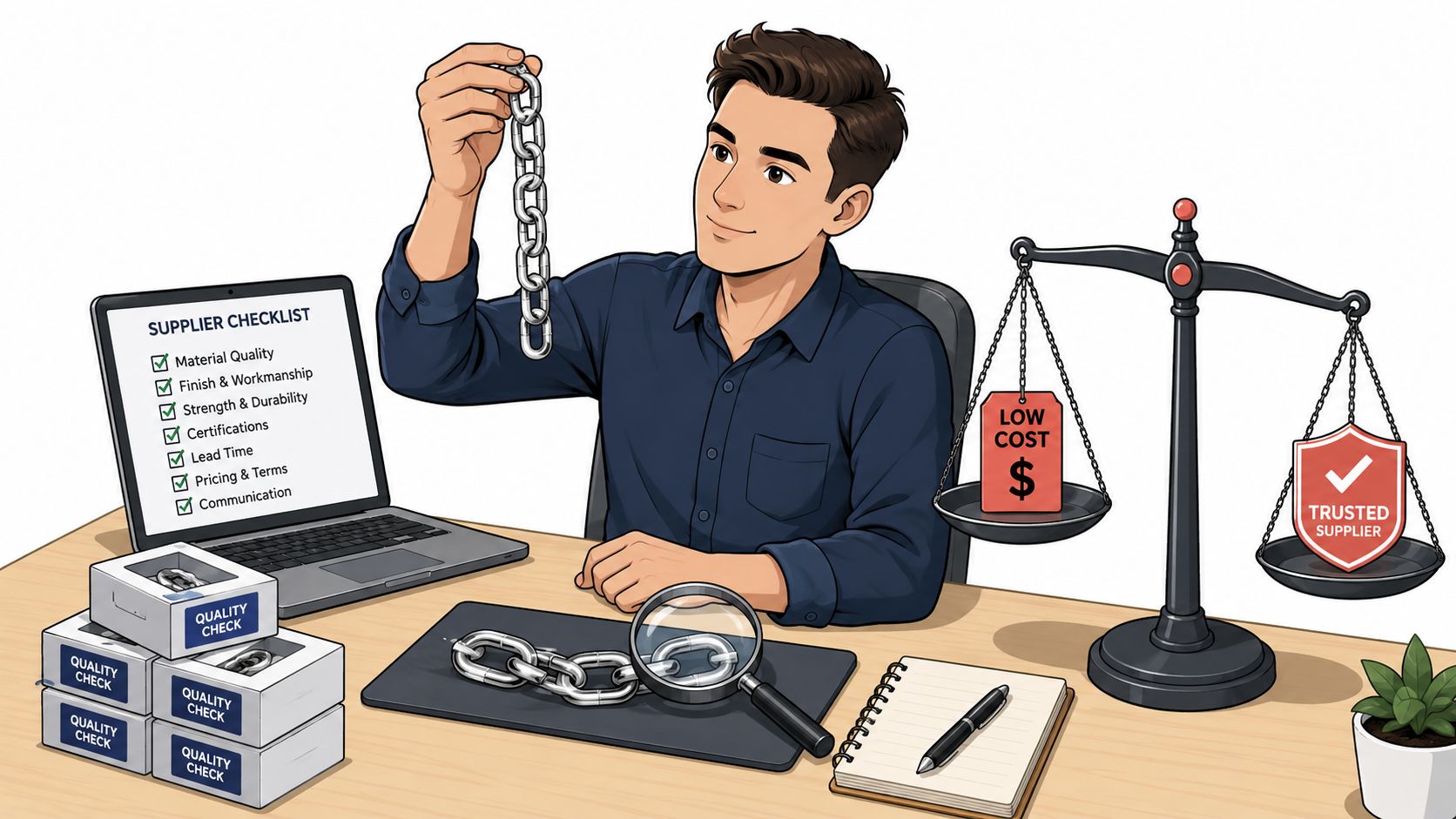
A practical evaluation includes:
- Material traceability: Confirm whether the supplier can identify 304, 316, or 316L rather than using stainless steel as a catch-all.
- Manufacturing controls: Look for quality documentation and consistent inspection of joins, clasps, and surface finish.
- Sample testing: Handle the actual chain, measure usable length, flex it repeatedly, and inspect it under magnification.
- Commercial protection: Review return, damage, shipping, and replacement terms before placing a larger order.
- Inventory flexibility: No-MOQ purchasing can help a small brand test multiple styles without tying up cash in unproven stock.
JewelryBuyDirect illustrates this type of B2B model with a catalog of 120,000+ SKUs across necklaces, bracelets, rings, earrings, body jewellery, and jewellery-making components. Its stated offer includes factory-direct pricing, no minimum order quantity, free worldwide shipping on qualifying orders, fast trackable logistics, 7-day returns, and damage protection. The platform also reports an 85% repeat customer rate across 46 countries, details that can matter when a retailer needs to test a chain range before committing to deeper inventory. For a broader look at wholesale component selection, see this wholesale jewellery chain guide.
Don't let a low unit price hide operational costs. Inconsistent colour, missing clasps, scratched surfaces, and poor packaging create rework before the product ever reaches a customer. A slightly higher purchase price can be more economical when it reduces sorting, relisting, repair, and returns.
Care, Finishing, and Long-Term Performance Tips
Stainless steel needs little maintenance, but finished chains still fail when storage and handling are careless. Keep stock dry and separated, protect polished surfaces from abrasive contact, and avoid packing finished pieces against rough components. Before assembly, inspect each cut end, jump ring, and clasp. A sharp edge can catch adjacent links or irritate the wearer's skin.
For routine cleaning, use mild soap, lukewarm water, and a soft cloth. Dry the chain completely, including around clasps and tightly joined links. Avoid abrasive powders, aggressive polishing compounds, and harsh chemicals, which can mark the surface or alter a colour finish. Give customers clear care instructions at purchase, particularly for bracelets and anklets exposed to sweat.
Wet-wear pieces need a practical inspection routine. Dry them after sweat or water exposure, then check PVD-coated edges, clasps, and high-friction areas for chips or exposed base metal. Chloride pitting often begins at surface defects, so early inspection can identify a finishing problem before it spreads.
A dull patch is not automatically tarnish. Stainless steel may show residue, surface contamination, or tea staining, while chlorides, sweat, and friction can compromise passivation. Clean the piece first, inspect it under good light, and only then decide whether the issue reflects a defective finish or an unsuitable grade. The stainless steel jewellery care guide provides further maintenance guidance.
Before ordering, confirm the grade, gauge, link geometry, finish process, supplier inspection method, and customer care instructions. Ask whether colour-coated chains have consistent coverage at bends and cut ends, because those areas receive the most wear. Prepare product imagery to the required cover ratio of 383:204, or about 1.88:1, so important content and text are not cropped online.
If you source stainless steel chain for jewellery making, JewelryBuyDirect offers wholesale chains and related components with no minimum order quantity, trackable logistics, and coverage across core jewellery categories. Compare grades, test new designs, and assess long-term wear before committing to a larger assortment.