
Wholesale Body Jewelry No Minimum: A Sourcing Guide
You've found a supplier that promises wholesale body jewelry with no minimum order, and the catalog looks exactly right. The prices are low, the photos are polished, and you can supposedly order one piece at a time. But before you add new nose rings, barbells, body chains, or fashion accessories to your store, you need to answer a harder question: Can this supplier deliver safe, consistent products at a landed cost that still works for your business?
No-MOQ sourcing can reduce dead stock and make trend testing far easier. It can also create hidden exposure if the supplier treats “no minimum” as a substitute for material documentation, quality control, or dependable fulfillment. The practical playbook is simple: use flexible ordering to test demand, but vet every supplier as if you were building a long-term inventory relationship.
The Strategic Advantage of No Minimums
A boutique owner spots strong online interest in a new piercing style and places an order. The supplier requires a large quantity per design, so she chooses one color and commits much of her buying budget to it. Weeks later, shoppers ask for different finishes and sizes, while the original style remains in storage. The demand signal was useful. The purchasing decision was too rigid.
Traditional wholesale programs often impose meaningful minimum order quantities. Industry guidance describes 50 to 200 pieces per style for China manufacturers, 6 to 24 pieces per style or $100 to $300 per order for U.S. wholesalers, and 100 to 300 pieces per design for private-label or custom programs. A wholesale jewelry MOQ overview explains why no-minimum purchasing removes a major constraint for smaller retailers.

“No minimum” changes the buying sequence. You can start with a focused assortment, observe sell-through, and reorder styles that earn their shelf space. That flexibility suits independent boutiques, online stores, pop-up vendors, social sellers, and resellers with limited storage or uneven demand.
Turn flexibility into a testing system
A no-MOQ relationship should support controlled testing, not random buying. Use small orders to answer specific commercial questions:
- Style demand: Compare minimalist pieces with colorful, decorative, or symbolic designs.
- Material positioning: Separate fashion-oriented stainless steel and alloy products from higher-spec titanium or implant-grade selections.
- Customer fit: Track which products appeal to everyday shoppers, piercing clients, gift buyers, or trend-led customers.
- Reorder potential: Favor suppliers that reproduce successful SKUs consistently, rather than suppliers that only offer a wide catalog.
Material safety belongs in the test plan. Low-volume ordering reduces inventory exposure, but it does not make inconsistent plating, unclear alloy composition, rough finishing, or unreliable sizing acceptable. Request material details and inspect samples before expanding an item across colors or sizes.
Operational reliability matters just as much. A supplier may accept one-piece orders yet perform poorly on replenishment, packing accuracy, lead times, or batch consistency. Record how each test order arrives, then use that evidence when deciding which supplier deserves repeat business.
The global category is substantial, and flexible purchasing fits retailers that need to test niches without tying up cash in unproven designs. The opportunity is a disciplined assortment process: order narrowly, verify quality, measure demand, and expand only the SKUs that perform.
Where to Find Reliable No-MOQ Suppliers
Start with several sourcing channels, but judge each one by the quality of evidence it gives you. A polished social profile can help you discover products, yet it rarely proves material grade, batch consistency, return handling, or export reliability.
Build a multi-channel shortlist
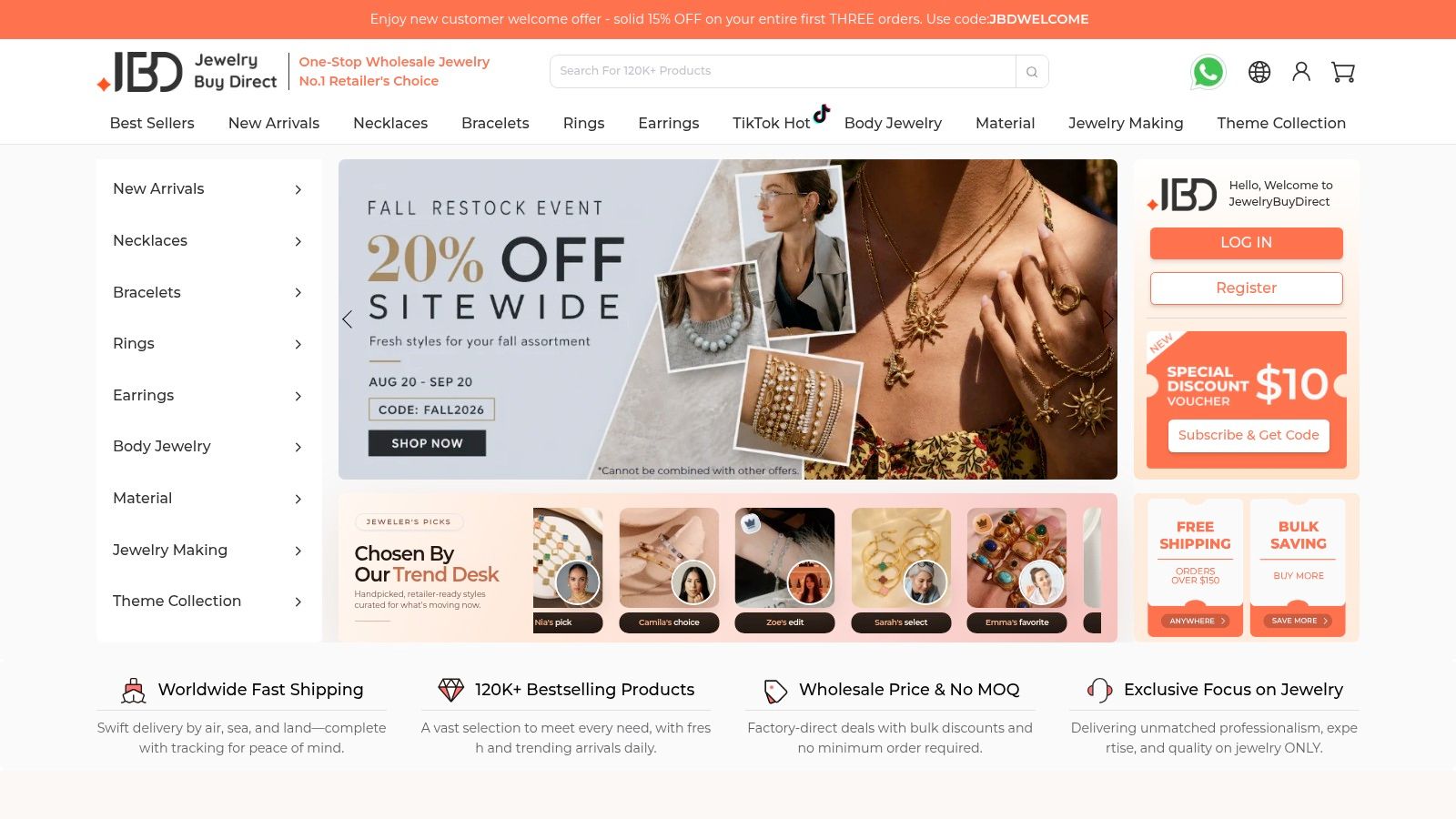
Dedicated B2B marketplaces are useful when you want searchable catalogs, wholesale terms, product categories, and ordering systems in one place. JewelryBuyDirect is one example of a platform offering no-MOQ wholesale purchasing across body jewelry and broader fashion-accessory categories. Use a marketplace as a screening tool, not as proof that every listed product is appropriate for a fresh piercing.
General wholesale directories can surface factories, importers, and distributors that don't rank prominently in ordinary retail searches. Ask whether the business owns production, represents multiple factories, or resells catalog images. That distinction affects pricing, customization, replenishment, and accountability when a shipment arrives with inconsistent finishes.
Instagram and other social channels are useful for finding emerging designs and seeing how a supplier presents products in real-world settings. They're weak as a standalone verification method. Request a formal catalog, material declarations, test reports, sample-order terms, and a written returns process before you treat a social account as a serious vendor.
Virtual trade shows and industry communities can reveal suppliers with specialist knowledge, especially for piercing components and higher-spec materials. Pay attention to whether representatives answer technical questions directly. A supplier that can explain the finished product, not just the base alloy, is easier to evaluate.
For a practical comparison of supplier models, review this guide to finding jewelry dropshippers and wholesale partners. Keep at least a few candidates active until samples, documentation, and fulfillment performance narrow the field.
Ask every shortlisted supplier the same questions. Can you mix SKUs in one order? Is there a per-style minimum despite the advertised no-MOQ policy? Are samples drawn from normal inventory? Can the supplier provide item-level documentation? How are damaged, incorrect, or substituted products handled?
A useful supplier discovery call should produce documents and clear next steps, not just enthusiastic answers.
Vetting Beyond the Product Photo
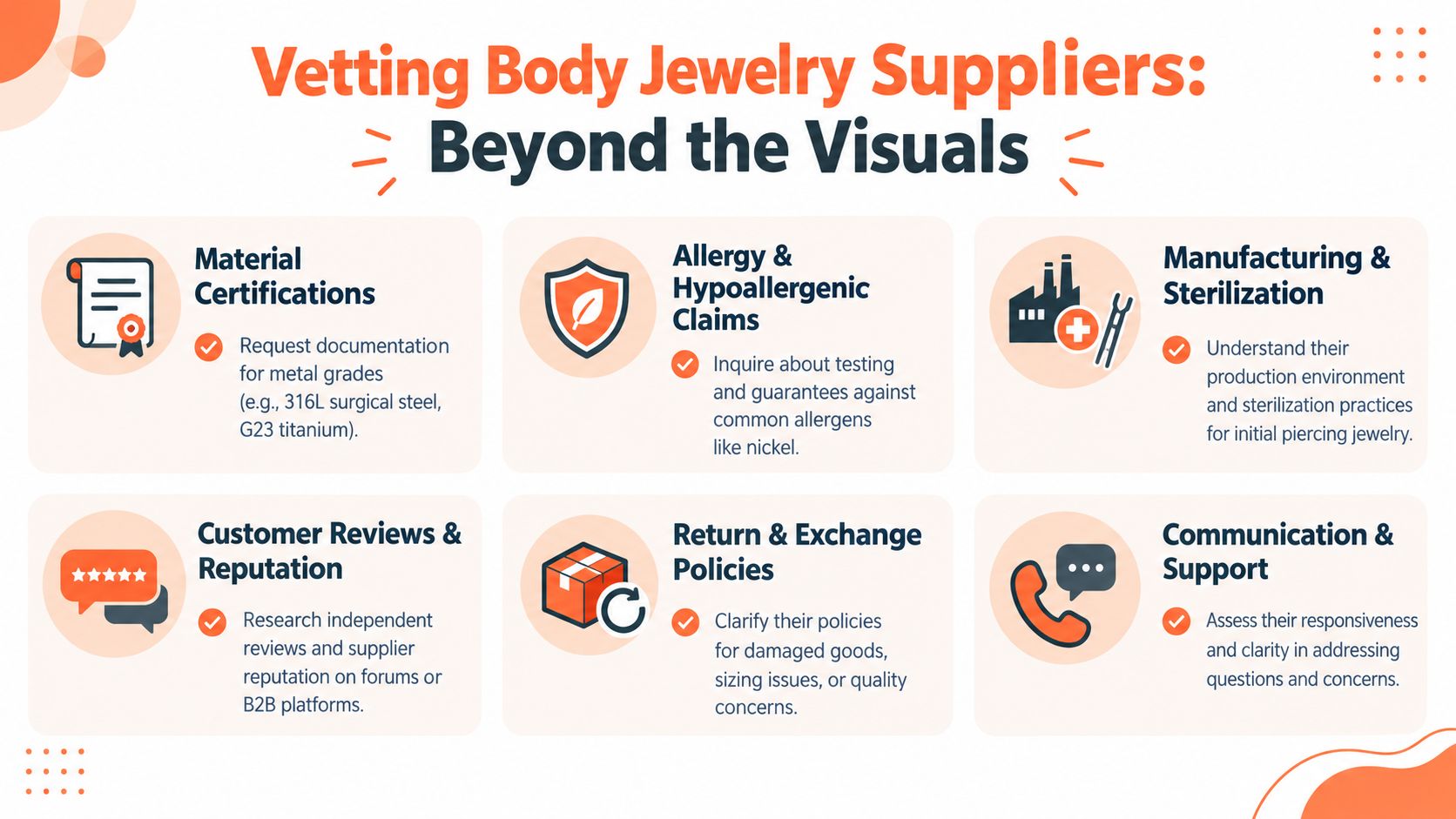
A product photo can tell you whether a design suits your assortment. It can't tell you whether the post releases too much nickel, whether a coating will wear through in a body-contact zone, or whether the certificate belongs to the exact SKU you're buying. Material safety must outrank unit price, especially when you sell products intended for pierced skin.
For higher-spec body jewelry, ask about ASTM F136 titanium, ASTM F138 stainless steel, or materials supported by relevant ISO 10993 biocompatibility testing. These references are more useful than vague labels such as “surgical steel,” “hypoallergenic,” or “premium metal.” Request a material certificate and check that it describes the finished product, not only a raw-metal source.
Separate fashion stock from piercing stock
A retailer can carry both fashion body jewelry and products intended for professional piercing, but the inventory must be separated by use case. Fresh piercings demand the strictest material, finish, and documentation standards. Jewelry for healed piercings may offer more design flexibility, but it still needs to meet applicable nickel-release and product-safety requirements.
For EU and UK sales, the technical issue is nickel release, not merely whether a supplier calls a product nickel-free. Jewelry inserted into pierced body parts must release no more than 0.2 µg/cm²/week, while other items in prolonged skin contact must stay at or below 0.5 µg/cm²/week. Buyers should request EN 1811 nickel-release testing guidance for the exact SKU and confirm that coatings remain compliant for at least two years of normal use.
That distinction matters because an alloy can contain nickel while its surface treatment keeps release below the legal threshold. Conversely, a product described as nickel-free can still be unsuitable if the documentation is incomplete or the finished coating fails testing.
Buyer rule: Never approve a mixed-lot substitution for a tested SKU unless the replacement has matching documentation.
California adds another important filter. Body-piercing jewelry sold for new piercings must be made entirely from specified materials, including implant-grade stainless steel or titanium, niobium, solid 14-karat-or-higher nickel-free gold, platinum, or certain low-porosity plastics. The California body-piercing jewelry requirements also illustrate the larger point: “no MOQ” can increase risk when suppliers combine fashion products and piercing-grade products without clear material controls. SGS has also reported that ASTM International reapproved an adult-jewelry standard in 2026, reinforcing the importance of current material expectations.
Use a written inspection checklist
Before listing a product, inspect the threading, polish, closures, stone settings, plating, dimensions, and contact surfaces. Rough edges and poorly finished threads can create customer complaints and make a product unsuitable for its intended use. Decorative adhesives and unstable finishes deserve extra scrutiny around fresh piercings.
Check the supplier's answers against the physical sample. Then document the approved SKU, material, finish, size, test report, packaging, and acceptable tolerance. This guide to finding a jewelry manufacturer can help you evaluate production partners beyond catalog presentation.
Decoding Pricing and Shipping Economics
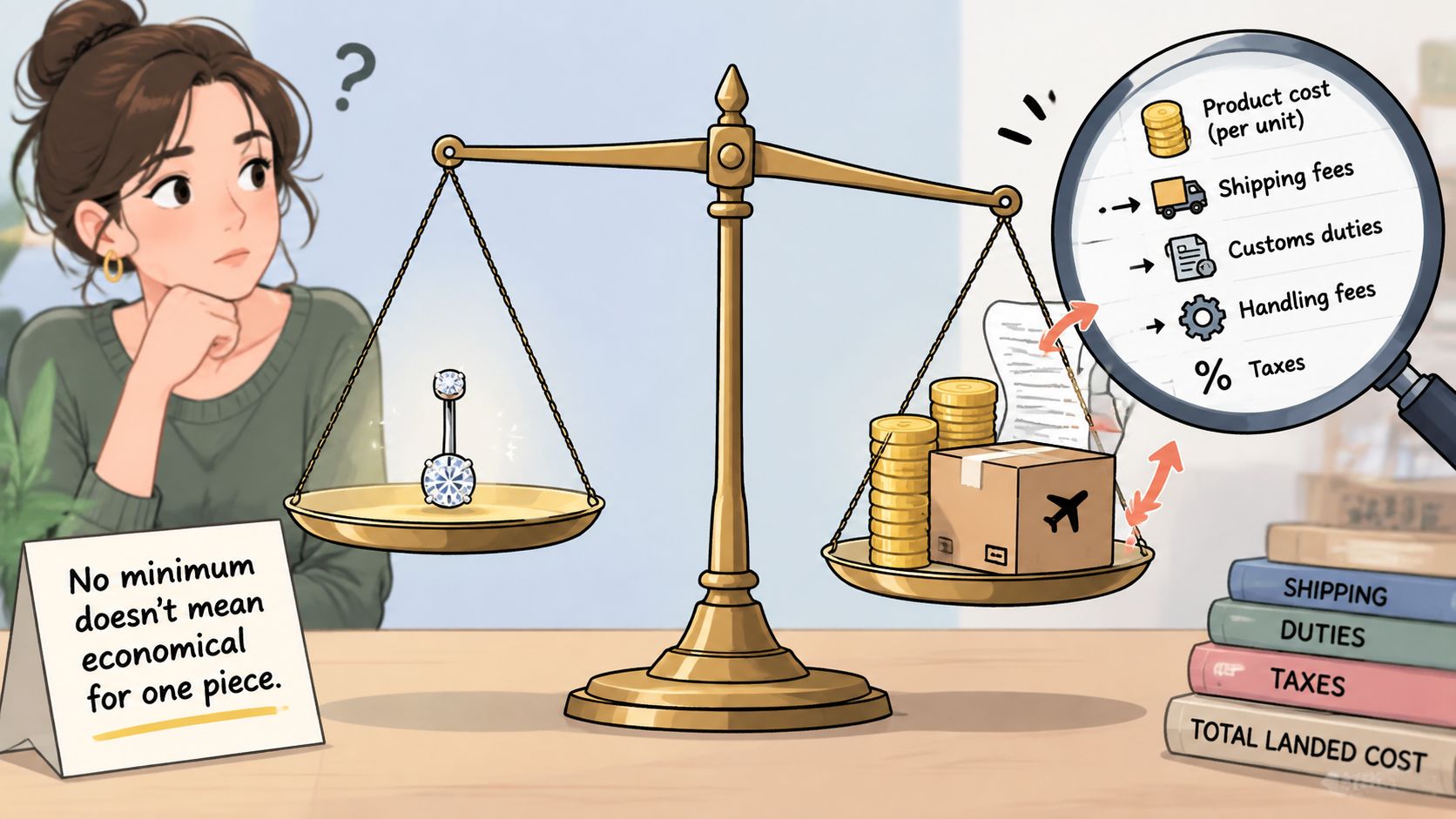
A no-minimum policy removes an order barrier, but it doesn't make every one-piece purchase economical. The relevant figure is landed cost, which includes the item price, freight, packaging, handling, customs or duties where applicable, inspection, and the internal cost of receiving and preparing inventory.
Consider a small trial order. The product may have an attractive wholesale price, but shipping can represent a disproportionate share of the transaction when the parcel contains only one or a few pieces. Compliance review can add cost too, particularly when you need to inspect samples, request reports, or test a product before putting it into a piercing-oriented assortment.
Calculate the whole order, not the unit price
Use a simple buying worksheet with these fields:
| Cost area | What to record |
|---|---|
| Product | Unit cost, quantity, finish, and approved material |
| Freight | Shipping method, handling fee, and tracking |
| Border costs | Customs, duties, taxes, or brokerage where applicable |
| Quality control | Sample inspection, testing, and receiving time |
| Selling costs | Packaging, marketplace fees, returns, and replacements |
| Replenishment | Lead time and the cost of repeating the order |
Market guidance notes that body jewelry MOQs can start at 1 unit, while many brands still use first-order thresholds of $100 to $150. That's why jewelry safety and metal-content guidance is useful alongside a pricing review. The key question isn't whether you can buy one piece. It's whether that piece remains competitive after freight, packaging, inspection, and selling costs.
Use order value strategically
Bundling samples can improve economics without forcing you to overbuy one style. Group products by a clear test theme, such as minimalist studs, titanium basics, colorful fashion pieces, or seasonal body chains. You'll collect more useful merchandising information while spreading fixed shipping costs across the order.
Wholesale suppliers may also use value thresholds to reduce shipping expense. One fashion-accessory supplier, for example, describes discounts rising from 10% on £150 orders to 30% on £2,000 orders, illustrating how order value can affect unit economics. Review the wholesale accessory discount structure before assuming the smallest possible order is the cheapest path.
A supplier's free-shipping threshold can change the calculation as well. If a vendor offers free worldwide shipping on $150 or more, compare a consolidated test order against several isolated purchases. Use the wholesale profit margin calculator to model retail price, landed cost, returns, and the margin you need before reordering.
Finalizing Your Sourcing Partnership
A supplier passes the product test only after it passes the relationship test. Before paying, ask for written terms covering payment, order confirmation, substitutions, damage claims, returns, exchanges, and support availability.
Confirm the commercial terms
Check whether the supplier accepts cards, bank payments, or buy-now-pay-later options. Payment flexibility can help a small retailer protect cash flow, but it shouldn't distract from the total amount owed or the timing of repayment. Confirm whether taxes, duties, shipping, and handling appear before checkout or arrive later.
Read the return policy line by line. You need a defined process for damaged items, incorrect quantities, wrong sizes, and products that differ from the approved sample. Clarify the reporting window, required photographs, return-shipping responsibility, and whether the supplier issues refunds, replacements, or credit.
Test support before you scale
Send technical questions before placing a larger order. Ask about material certificates, nickel-release testing, coating durability, and batch substitutions. A reliable support team should answer clearly, preserve the product distinction between fashion and piercing use, and provide documents rather than redirecting you to generic listings.
Evaluate operational signals during the sample order:
- Response quality: Do answers address the actual question?
- Order accuracy: Does the shipment match the invoice and approved samples?
- Packaging: Do pieces arrive protected, labeled, and easy to inspect?
- Resolution speed: Does the supplier take responsibility when something is wrong?
- Reorder clarity: Can you identify the same SKU and specifications again?
The right partner reduces friction after the sale, not just during the first conversation.
Scaling Your Assortment with Confidence
No-MOQ sourcing works best when every order answers a specific business question. Assign each SKU a role before buying. Core pieces should serve steady everyday demand, trend styles should refresh the display, and premium-look designs should add visual and price variety. Keep piercing-grade products documented separately from fashion items, especially when material safety and intended use differ.
The body jewelry market is broad, giving retailers room to serve different styles and use cases. That range also increases the cost of careless selection. Low-volume orders let you test more designs, but they do not remove the need to verify materials, finishes, sizing, and supplier consistency.
Let sales decide what scales
Track product views, add-to-cart activity, conversion, sell-through, customer questions, returns, and repeat orders for every test order. Compare products within the same merchandising theme, rather than judging each SKU in isolation. A slower style may still attract a valuable customer segment, while a fast seller with quality complaints should not become a core reorder.
Reorder only when the product passes three checks:
- Demand: Customers choose it without excessive discounting.
- Quality: Samples and repeat shipments match the approved specification.
- Economics: Landed cost and selling expenses leave a workable margin.
Increase depth selectively after those checks. Keep testing new designs around the proven core instead of replacing the assortment whenever a trend appears. No-minimum purchasing becomes a repeatable operating cycle, test, measure, reorder, and scale, when supplier records and cost data stay accurate.
JewelryBuyDirect offers no-MOQ wholesale sourcing across body jewelry and fashion accessories, with a catalog suited to testing small assortments before expanding proven styles. Visit JewelryBuyDirect to review products, compare landed-cost options, and document decisions around the items customers buy.