
Wholesale Necklace Chains That Actually Sell
You've just reconciled three months of necklace sales, and the numbers don't make sense. The chains sold, but replacements, restocking costs, plating complaints, and a handful of skin-reaction returns consumed the margin. Your supplier's low unit price looked attractive until the product reached your display case.
That problem usually starts before production. Buyers approve a style without defining the wire diameter, link dimensions, clasp strength, finish, documentation, and reorder tolerances. This guide gives you the spec-first buying process I use for wholesale necklace chains, so a cheaper quote doesn't become an expensive return wave. For broader guidance on building profitable boutique accounts, Gainsty's tips for boutique accounts are also useful, especially when you're deciding which products deserve repeat promotion.
Why Most Boutique Chain Orders Lose Margin
A chain order loses money in three places: the product fails, the supplier changes the specification, or the buyer never calculated the landed cost. I've seen all three happen in the same reorder. The original sample looks acceptable, the bulk shipment arrives with a different color or weaker clasp, and the boutique discovers the problem only after customers wear the chains.
The first leak is finish performance. A gold-colored chain can look excellent in a sample and still lose color quickly if the coating is too thin or poorly bonded. Treat any plating claim above 0.03 micron as something to verify, not something to accept verbally. Ask for the plating method, measured thickness, base metal, and a test report tied to the exact product family.
The second leak is the clasp. A supplier may describe a lobster clasp as “strong” without giving a pull-force rating. That isn't enough. A clasp that opens under less than 8N of pull force creates returns that customers describe as “the necklace broke,” even when the chain links are intact.
The third leak is dimensional inconsistency. Link length, width, wire diameter, and finish can drift between production lots. A small difference may not be obvious on one piece, but it changes drape, pendant balance, and the way layered necklaces sit together.
Practical rule: Never approve a chain from a photograph and a unit price alone. Approve a written specification that the factory must repeat on every reorder.
The margin leaks buyers miss
- Unverified plating: Require a measured report, not a supplier adjective such as “long-lasting.”
- Unrated clasps: Request pull-strength data and test the clasp repeatedly on samples.
- Uncontrolled dimensions: Put wire diameter, inner link dimensions, finished length, and acceptable tolerance on the purchase order.
- Unclear compliance: Ask for certificates tied to the exact model, with an issuing body, certificate number, validity dates, and applicable test method.
Wholesale necklace chains sit inside a large jewelry category. The jewelry market was valued at USD 366.79 billion in 2024 and is projected to reach USD 578.45 billion by 2033, while necklaces and pendants represented 21.13% of the jewelry market in 2025 in one industry forecast, according to JewelryBuyDirect's chain market overview. That demand creates opportunity, but it also makes chain quality a serious operating issue. High-volume products expose every defect repeatedly.
The answer is a spec-first buying routine. Define the product, test the sample, verify the supplier, calculate landed cost, and preserve the exact approved specification for the reorder. Price still matters, but it comes after fit, durability, compliance, and consistency.
The Six Chain Constructions That Drive Reorders
Customers reorder familiar constructions because each one solves a different styling problem. Your assortment should therefore cover distinct link geometries rather than six visually similar chains in different colors.
Cable and box chains
A cable chain uses round links connected in a straightforward sequence. It's the dependable base for charms, small pendants, and unpaired showpieces. At 16 inches, it sits close to the collarbone. At 18 inches, it becomes the most versatile everyday length. At 20 inches, it creates a relaxed drop that works well with a visible pendant.
A box chain uses squared links that give a sleek, structured appearance. The geometry makes the chain look visually substantial without requiring a bulky silhouette. It pairs well with a clean pendant and works especially well at 18 or 20 inches, where the straight drape keeps the pendant centered.
Curb and Figaro chains
A curb chain has flattened, interlocking links that naturally turn toward the wearer. It suits men's everyday jewelry, unisex layering, and bold basics. A 16-inch curb wears close and assertive, an 18-inch version works for everyday unisex merchandising, and a 20-inch version gives a lower, more relaxed line.
A Figaro chain alternates a longer link with shorter links. That rhythm makes it easy to merchandise for gifting because it feels more distinctive than a plain cable while remaining familiar. Use 18 inches for an accessible core option and 20 inches when the customer wants more visual drop. A 2.8 mm Figaro in an 18-inch gold finish makes a credible core bestseller candidate, but approve the exact dimensions and finish before assigning it that role.
Rope and snake chains
A rope chain twists multiple strands into a textured, light-catching surface. It earns its place as a statement style, especially in thicker gauges. For example, a 1.5 mm rope chain supporting a 6 g pendant on a 24-inch drop should be sample-tested for kinking, clasp behavior, and pendant movement before you list it as a finished combination. The long drop increases tension on the chain.
A snake chain uses tightly connected links that create an almost smooth, fluid surface. It lays flat and works for collars, minimal pendants, and polished evening displays. Because the links have less visible separation, kinks can be difficult to correct. Store and ship snake chains carefully, and don't attach a heavy pendant until the supplier confirms the intended load.
Gauge and architecture matter more than style names. Reported break ranges place 1.0 to 1.5 mm cable or box chains at roughly 15 to 25 lb, 2.0 to 3.0 mm curb or Figaro chains at about 45 to 70 lb, and 4.0 to 6.0 mm rope or heavy curb chains at 90 to 150+ lb, according to chain link mechanics guidance. These are chain-level figures, not permission to attach any pendant without testing the clasp, jump ring, and finished assembly.
| Chain Type | Link Geometry | Best Length | Pendant Load Limit | Reorder Signal |
|---|---|---|---|---|
| Cable | Round, individually linked rings | 16 to 20 in | Match to diameter and clasp, sample-test the finished set | Reorder when it becomes the default charm base |
| Box | Squared links with a clean profile | 18 to 20 in | Suitable for sleek pendants when link and clasp are approved | Reorder when pendant pairings sell consistently |
| Curb | Flattened interlocking links | 16 to 20 in | Higher capacity in thicker gauges, verify assembly strength | Reorder when unisex layering demand repeats |
| Figaro | Alternating long and short links | 18 to 20 in | Match pendant size to width and clasp | Reorder when gifting and gold-tone demand return |
| Rope | Twisted, textured strands | 20 to 24 in | Use thicker gauges for statement pendants | Reorder when statement displays produce repeat sales |
| Snake | Tight, nearly smooth linked surface | 16 to 20 in | Keep pendant weight conservative until tested | Reorder when collar and minimalist looks recur |
Laser welding deserves its own sample test. Cable, curb, and some Figaro constructions can tolerate a custom logo jump ring when the wire and weld area are compatible. Snake chains and delicate, tightly articulated designs can distort from heat or lose their smooth lay. Ask for a weld-test sample before approving a branded connector.
Choosing the Right Metal for Your Price Point
A boutique order can look profitable on the quote sheet and still produce returns if the metal, finish, and compliance file do not match the retail promise. Set that promise first. For a durable everyday chain, specify a documented base metal and finish. For a short trend drop, control landed cost and avoid paying for construction your selling window cannot support.
316L stainless steel is the practical workhorse for everyday, unisex, and water-resistant positioning. Reported ultimate tensile strength for 316L stainless steel sits around 520 to 620 MPa, while titanium Grade 5 is reported around 895 to 930 MPa, according to comparative chain material guidance. Titanium is stronger, but it is harder to weld and repair. Use it for specialized, sensitive-skin, or bridal applications rather than treating it as the default for every assortment.
925 sterling silver supports a premium presentation when shoppers expect a hallmark, recognizable material, and an heirloom-oriented feel. Add care instructions because tarnish affects the post-purchase experience. Brass suits high-volume fashion when the finish specification is written into the purchase order. Plated alloy fits fast trend drops where visual impact and turnover matter more than extended wear.
| Metal | Tensile Strength | Plating Standard | Skin Reaction Risk | Retail Price Band |
|---|---|---|---|---|
| 925 sterling silver | Verify alloy-specific test data | Request measured finish and tarnish testing | Confirm nickel content and release results | Premium fashion and fine-accessory positioning |
| 316L stainless steel | About 520 to 620 MPa, see citation above | Request PVD or electroplating details and measured thickness | Lower-risk positioning still requires nickel-release testing | Accessible everyday and waterproof-style positioning |
| Titanium Grade 5 | About 895 to 930 MPa, see citation above | Confirm coating compatibility with the base metal | Often selected for sensitive-skin and bridal uses, verify documentation | Specialized premium positioning |
| Brass | Depends on alloy and construction | Specify a thick, tested finish and protective topcoat | Require nickel, lead, and cadmium disclosure | High-volume fashion |
| Plated alloy | Varies widely by base alloy | Demand thickness, adhesion, and wear testing | Treat risk as unknown until the alloy and release data are supplied | Trend-led, lower-price drops |
Your supplier packet should include the alloy declaration, plating method, measured coating thickness, adhesion or wear results, and nickel, lead, and cadmium disclosures. Request relevant release or migration testing before production, not after customer complaints begin. “Hypoallergenic” alone is not documentation.
Use PVD when the gold color must withstand demanding wear, and require the measured coating thickness in writing. Use e-coating when tarnish resistance forms part of the product promise. Ask for a production-representative sample, since a sample made with a different base metal or finish proves little.
For a focused comparison of everyday stainless construction, review this wholesale stainless steel chain guide. Choose the metal that supports the price your customer expects to pay, then make the supplier prove the specification and compliance documents before you approve the order.
Gauge, Length, and Clasp Specs That Prevent Returns
A chain specification must answer three questions before it reaches production. How thick is the wire? How wide are the links? How long is the finished piece, including the clasp and extension? If the supplier can't answer those questions in writing, you don't have a reorderable SKU.
Start with the wire diameter in millimeters. Then record the inner link width, link count per inch where relevant, overall width, finished length, chain weight, clasp type, extension chain, surface finish, color, and packaging. A 2 mm curb chain can support a substantially heavier pendant than a 1.2 mm cable chain because its architecture and cross-section distribute force differently. Never turn a general style comparison into a blanket load guarantee.
The purchase order should state the intended pendant load and the test method. Reported mechanics guidance places smaller chain failures around link deformation or jump-ring failure, while thicker chains more often fail at the clasp or through solder fatigue. That distinction tells you where to inspect the finished sample.
The length ladder
The standard retail ladder is 16, 18, 20, and 22 inches. Keep the length inclusive of the clasp, end rings, and extension unless your factory uses a different documented convention. A 16-inch cable or snake chain generally serves close-to-neck styling. An 18-inch cable, curb, box, or Figaro chain is the broadest everyday option. At 20 inches, pendants have more room to move, while 22 inches suits longer drops and statement merchandising.
For a practical explanation of how lengths sit on the body, use this necklace chain length guide. Clasp selection should follow the product role:
- Lobster clasp: A secure default for everyday chains, provided the supplier supplies a pull test.
- Spring ring: Suitable for lighter, delicate styles, but less convenient for customers with limited dexterity.
- Toggle: Strong visual appeal for fashion pieces, but the bar must pass cleanly through the ring and remain secure during movement.
- Box clasp: Useful for heavier statement constructions when the mechanism and solder points are tested together.
Don't publish a “maximum pendant weight” from style alone. Put the approved weight on the exact SKU specification, then test the pendant, bail, jump ring, chain, and clasp as one assembly.
| Chain Style | Wire Gauge (mm) | Standard Lengths (in) | Recommended Clasp | Max Pendant Weight (g) |
|---|---|---|---|---|
| Cable | Record exact factory value | 16, 18, 20, 22 | Lobster or spring ring | Set by approved sample test |
| Box | Record exact factory value | 18, 20 | Lobster or box clasp | Set by approved sample test |
| Curb | Record exact factory value | 16, 18, 20, 22 | Lobster or toggle | Set by approved sample test |
| Figaro | Record exact factory value | 18, 20 | Lobster or box clasp | Set by approved sample test |
| Rope | Record exact factory value | 20, 22 | Lobster or box clasp | Set by approved sample test |
| Snake | Record exact factory value | 16, 18, 20 | Lobster or box clasp | Set by approved sample test |
Your reorder email should read like this: “18-inch 316L Figaro, 2.8 mm external width, wire diameter as approved sample, lobster clasp, gold-tone PVD finish, extension length specified, target chain weight specified, pendant load approved at sample stage, packaging unchanged, and replacement production held to the same dimensions.” That format gives a factory something measurable to reproduce.
Pricing, Landed Cost, and Supplier Verification
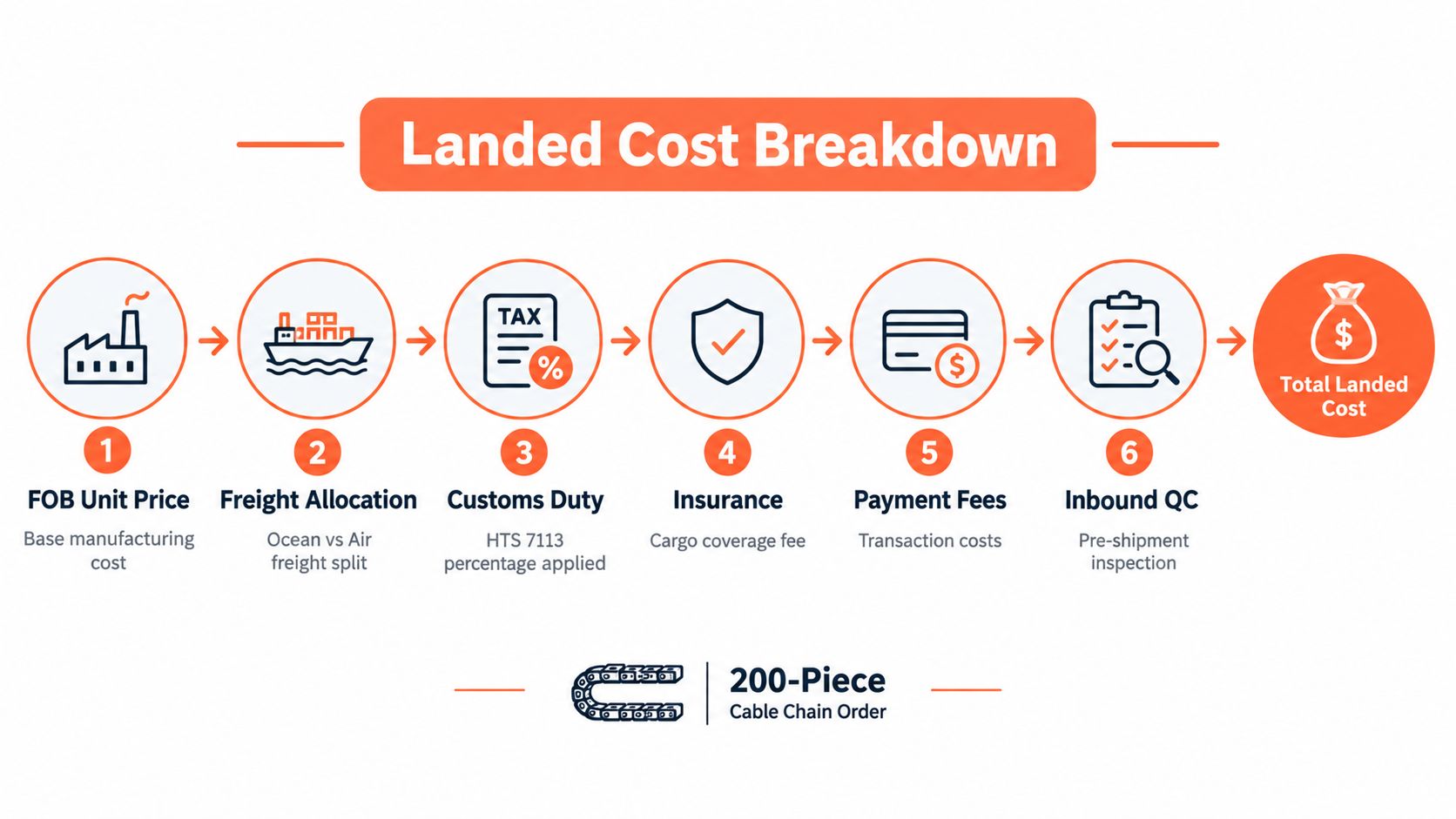
A supplier's FOB price is only the first line of the purchase decision. Your real cost includes freight allocation, customs duty, insurance, payment fees, and inbound quality control. A cable chain quoted at $2.10 FOB can become materially more expensive after those charges. It can't become $90 per piece unless the calculation contains an extraordinary error or unrelated costs, so reject that example as presented and build the landed-cost sheet from verified invoices.
For a 200-piece order, divide each shared expense by the actual sellable quantity, not merely the ordered quantity. Include freight by transport mode, duty under the classification your customs broker confirms, cargo insurance, payment processing, inspection, damaged units, and domestic inbound handling. The supplier's low unit price is useful only after every cost has a line.
Documents that protect the reorder
Ask for documents before paying the production balance:
- Business identity: Obtain the business license and export record, then confirm the legal entity on the invoice matches the entity issuing the documents.
- Material proof: Request mill certificates for stainless 304 or 316L, and authenticity evidence for 925 silver.
- Chemical compliance: Request REACH and RoHS documentation where applicable, plus nickel-release testing under EN 1811 when the product enters markets that require it.
- Finish verification: Require a plating-thickness report measured in microns, with the tested model identified.
- Independent testing: Ask for a third-party laboratory report dated within the applicable validity period and tied to the exact product family.
The two documents boutique owners skip most often are the independent plating-thickness report and the clasp pull-strength rating. Those omissions surface only after customers report fading, broken clasps, or lost pendants. A certificate is meaningful only when it includes a named issuing body, certificate number, validity dates, applicable standard or test method, and a clear connection to the product model, as explained in wholesale supplier verification guidance.
Supplier test: If a vendor sends a generic certificate but won't identify the tested model, treat the document as marketing material, not product verification.
The same discipline applies to pricing. Request 2 to 3 sample pieces, compare 3 to 5 suppliers, and negotiate from the complete landed-cost sheet rather than the FOB line. Wholesale buying guidance recommends comparing samples, supplier terms, shipping, duties, taxes, and warranty or return policies. For a broader operating view of wholesale commerce, the agentcentral wholesale business guide can help you think beyond sourcing and into channel economics.
Merchandising Chains for Higher Basket Value
Layering isn't just a styling trend. It's an assortment architecture that lets one customer buy a coordinated set instead of a single chain. Build the ladder first, then add the statement piece. If the base layer is missing, the bold chain has nothing to complement.
A practical display can use a 1.1 mm cable as the everyday foundation at a $24 retail position, a 2 mm snake chain as the second layer at $38, and a 3 mm curb or Figaro as the statement at $54. These are merchandising examples, not universal pricing rules. Your final price must reflect metal, finish, landed cost, packaging, channel fees, and the customer's expectations.
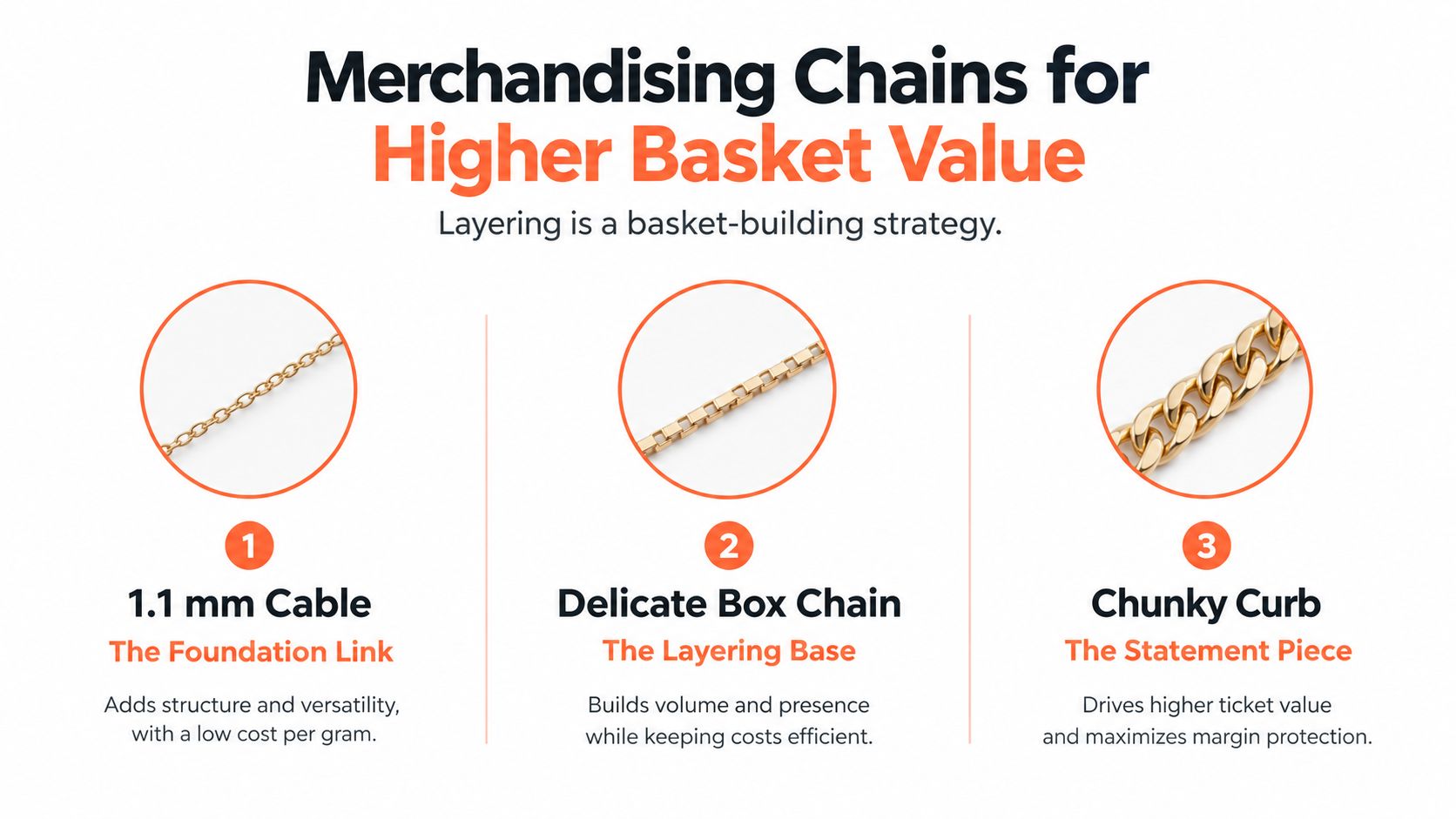
Assign every construction a selling job
- Cable foundation: Use it for daily wear, initial pendants, charm drops, and the first layer in a display.
- Snake second layer: Use its fluid surface to create contrast against a textured cable or curb chain.
- Curb or Figaro statement: Use thickness and geometry to make the final layer visible from across the shop.
- Rope texture: Position it for evening looks, bold gifting, and customers who want surface movement.
- Box pendant pairing: Display it with a clean, centered pendant where structure matters.
- Figaro gifting: Use the alternating links for Valentine's Day, bridesmaid gifting, and men's gift edits.
Extender chains, charm drops, and compatible pendant bails increase attachment opportunities without forcing you to create an entirely new necklace design. Place them beside the core chain, not in a separate fixture. Train staff to ask whether the customer wants a second layer or a pendant before the transaction is complete.
Photograph the layers in-house so the customer sees your exact proportions, finishes, and lengths. Build the everyday ladder before adding a trend-led drop, and keep the base constructions available for reorders. The strongest assortment is not the one with the most styles. It's the one where each style has a clear role and a natural next purchase.
Your Wholesale Chain Buying Checklist
Save this checklist before the next RFQ. A supplier should be able to answer every line without guessing.
Pre-order specifications
- Chain construction: State cable, curb, box, rope, snake, or Figaro.
- Wire and link size: Record wire diameter, external width, inner link dimensions, and link count where applicable.
- Finished length: Specify 16, 18, 20, or 22 inches, including clasp, end rings, and extension.
- Assembly: Name clasp type, jump-ring size, pendant load, and any logo connector or welding requirement.
- Finish: State base metal, color, plating method, measured thickness, protective coating, and packaging.
Sample protocol
- Sample quantity: Request at least three units per style.
- Bend test: Check whether links deform, kink, or fail to return to shape.
- Plating rub test: Test high-contact areas and compare the result with the approved sample.
- Clasp cycle test: Open and close every clasp repeatedly, then test the complete assembly under controlled pull.
- Wear patch: Conduct a 48-hour wear patch with appropriate internal procedures before making sensitive-skin claims.
Supplier verification
- Material certificate: Request the mill certificate or 925 authenticity evidence.
- Nickel release: Require EN 1811 results where applicable.
- Chemical compliance: Request lead and cadmium documentation, including CA Prop 65 evidence when relevant.
- Independent finish report: Make the plating-thickness report essential.
- Clasp rating: Require a documented pull-strength rating.
- Production control: Record MOQ, reorder lead time, defect allowance, inspection method, and batch traceability.
Quality systems can also matter at factory level. ISO 9001 addresses quality management, RJC certification covers areas including human rights, labor practices, environmental impact, and supply-chain due diligence for gold, silver, and diamonds, and ISO 14001 addresses environmental management, as summarized in jewelry factory certification guidance. For product selection and bulk chain options, compare the documented specifications in JewelryBuyDirect's bulk necklace chains collection.
If a supplier refuses a line, walk away. The cost of boutique margin erosion always exceeds the apparent savings of a cheaper quote.
JewelryBuyDirect offers wholesale necklace styles, chains, pendants, layering sets, and jewelry-making components, with materials including 925 sterling silver, stainless steel, titanium, copper, alloy, gold-plated, gemstone, and pearl options. Review the documented specifications and available assortment at JewelryBuyDirect, then request samples before committing to your next reorder.